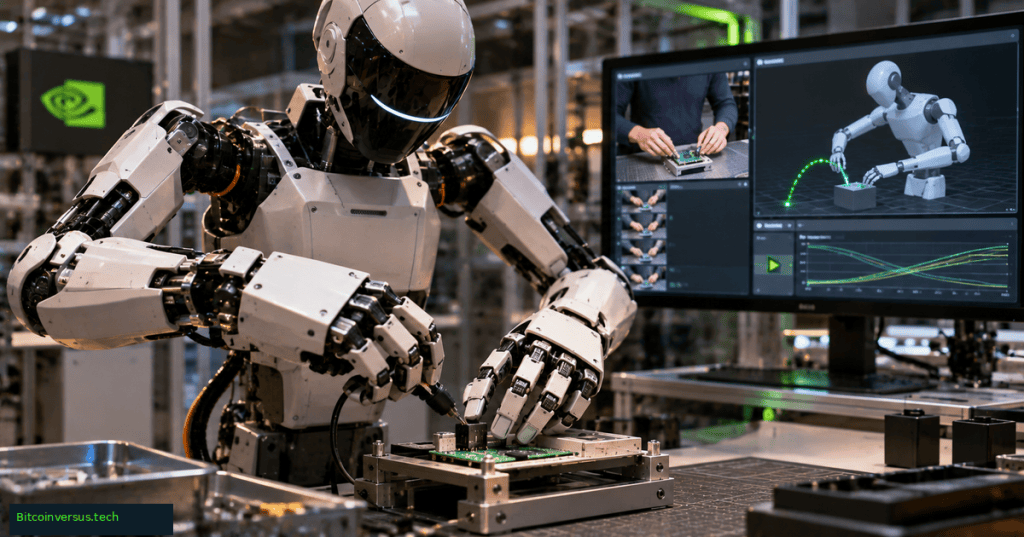
Robots can imitate a recorded movement yet fail when an object shifts or a connector resists insertion. At the Conference on Robot Learning in Austin on November 9, 2026, NVIDIA introduced GR00T 2, a world-action model designed to predict future visual scenes alongside robotic actions. NVIDIA reports 95% average task success after five demonstrations in a selected 50-task test. The figure is a laboratory benchmark, not a claim that industrial robots now operate with 95% reliability.
NVIDIA, “Accelerating Humanoid Robot Development With NVIDIA Isaac GR00T,” June 1, 2026. Official platform overview, published before the GR00T 2 announcement and included for technical context.
From Human Footage to Robot Actions
GR00T 2 jointly learns what a camera should see next and how the robot should move. A diffusion transformer processes visual history, instructions and robot state; smaller robot-specific heads produce commands for differing arms, hands and humanoids. NVIDIA reports pretraining on 402,730 hours of human first-person video, 10,184 hours of handheld-gripper demonstrations and 23,500 hours of robot teleoperation. A 100,000-hour subset of the human footage is available publicly, whereas GR00T 2 model code is scheduled for December, rather than already released in full.
The approach differs from programming every grasp with fixed coordinates. It aims to adapt learned physical behavior when object locations, tools or robot bodies change. Earlier BitcoinVersus.Tech coverage of NVIDIA’s Isaac robotics platform and AWS’s physical-AI toolchain explains the supporting software infrastructure.
The 40%, 71% and 95% Results
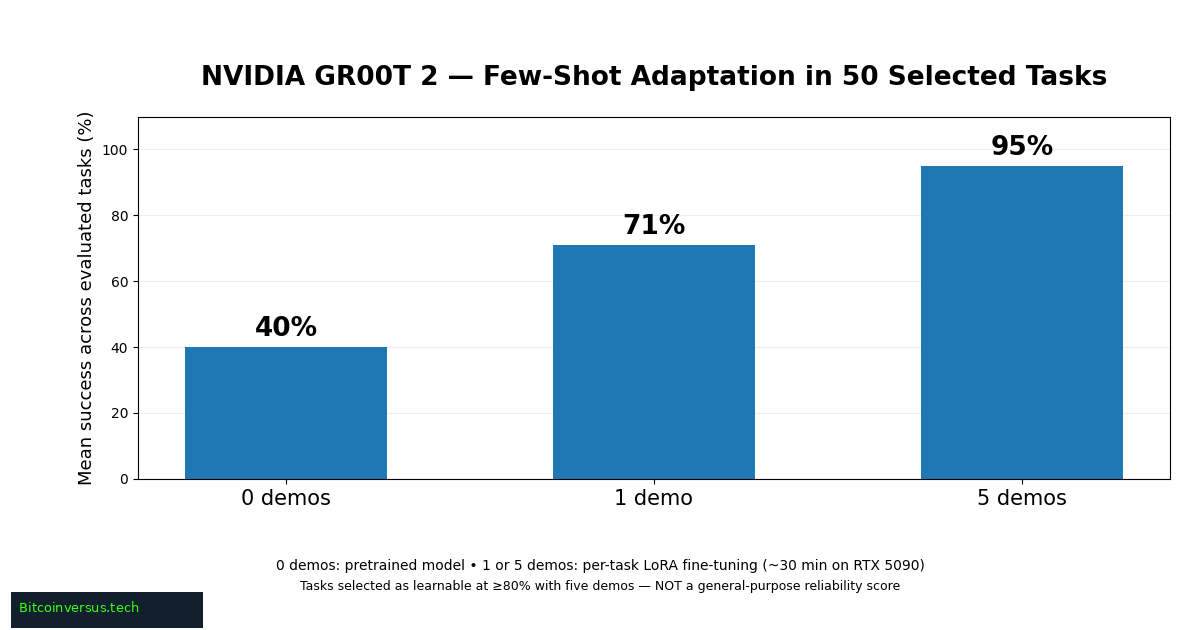
In NVIDIA’s 50-task adaptation study, the pretrained model averaged 40% success without target-robot demonstrations. It completed at least one attempt on 40 of the 50 tasks, a different statistic that should not be reported as an 80% overall success rate. A single demonstration per task raised average success to 71%; five demonstrations raised it to 95%. Each few-shot condition used task-specific fine-tuning, approximately 30 minutes on an RTX 5090.
The accompanying technical report says researchers selected tasks the model could learn to at least 80% success with five episodes. The resulting 95% score therefore should not be generalized to arbitrary factory operations, particularly unseen hazardous work or long sequences requiring near-perfect execution.
Factories, Fine Motor Control and Limits
NVIDIA reports a robotic system fitted with dexterous hands achieved 85% success seating GB300 memory modules in its test, while a separate toy-truck assembly task reached 65%. The smaller GR00T 2 Turbo variant produces predictions in approximately 124 milliseconds on a Unitree G1’s onboard Jetson Thor. That is a model-prediction latency measurement, not an entire physical-task completion time.
Foxconn is applying the technology to server-manufacturing automation; Siemens is evaluating industrial applications, and Nexuni is testing laundry handling, according to NVIDIA. Public production-line yields, workforce impacts and sustained safety performance were not established by the announcement. Related research includes Panasonic’s tactile-control system and Apple’s HALO simulation-trained humanoid; their reported percentages use different tasks and are not directly comparable.
GR00T 2’s wider significance may lie in reducing robot-specific demonstration collection. Translating laboratory dexterity into useful field work still requires rigorous evaluation, failure recovery, safety engineering and deployment economics. Kajima’s autonomous inspection rollout illustrates a narrower operational application, while NVIDIA’s VFlash research focuses on another component of robot performance.
Primary sources: NVIDIA’s CoRL announcement, November 9, 2026; GR00T 2 research results and demonstrations; GR00T 2 technical whitepaper. The benchmarks and deployment descriptions remain researcher- or company-reported.
BitcoinVersus.Tech Editor’s Note
Published November 10, 2026. GR00T 2 task-success figures are attributed to NVIDIA’s evaluation, including the selection criteria for the 50-task adaptation benchmark. The zero-shot 40% average and 40-of-50 task-coverage count are different measurements. The featured cover is an original conceptual illustration, not NVIDIA test footage. An official June platform video provides background, while the in-story GR00T 2 demonstration is hosted by NVIDIA. Commercial deployment and safety results have not been independently established.
We volunteer daily to ensure the information on this platform is Verifiably True. If you would like to support the research, please scan QR code.

Support independent research with an optional donation of 5,000 satoshis. Scan the original QR on another screen with a Bitcoin wallet, or use a compatible saved-image scanner on mobile. Verify destination 3C9o19EH5HSiwEPyCTmEKzxhNCbo2X6TTb and amount before payment.
BitcoinVersus.Tech is not a financial advisor. Financial coverage is provided purely for informational purposes.


Leave a Reply