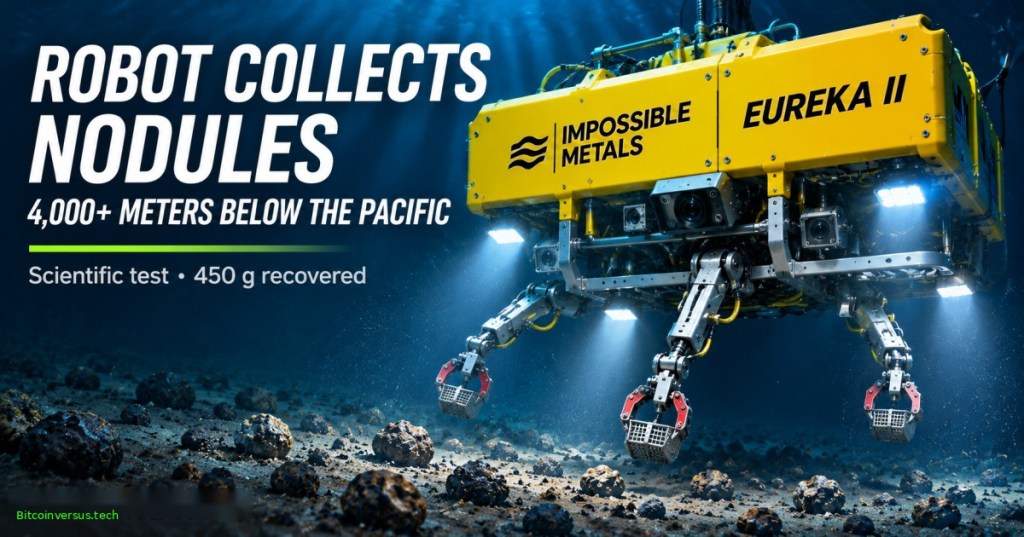
Impossible Metals says its autonomous Eureka Collection System retrieved about 450 grams of mineral-bearing nodules from more than 4,000 meters beneath the Pacific Ocean during a September 2026 scientific expedition. Announced November 9, the test took place in the Clarion-Clipperton Zone, between Hawaii and Mexico. The recovered material is for research, not commercial mineral sales. Reuters separately reported the company’s account but did not establish an independently measured production rate.
Impossible Metals’ official August 24, 2026 footage of Eureka II’s autonomous recovery during an offshore Halifax test. An earlier demonstration of the recovery subsystem, not footage of the September Pacific nodule collection. Credit: Impossible Metals/YouTube.
How a hovering robot selects its targets
Polymetallic nodules contain metals including nickel, cobalt, copper and manganese. Conventional proposed extraction systems often use seabed collectors and riser pipes. Eureka instead combines cameras, machine perception and articulated grippers to identify individual rocks. The company says its software excludes nodules occupied by visible marine life, while the vehicle hovers above the bottom rather than driving over it.
After collecting a payload, Eureka changes its buoyancy to rise toward the surface without pumping the nodules through a long riser. The approach addresses sediment disturbance and recovery-system complexity, but the existence of a selective mechanism does not establish negligible ecological effects. Related subsea sonar and battery engineering illustrates the broader dependence of underwater autonomy on sensors, energy storage and reliable retrieval.
At 4,000 meters, pressure is an engineering constraint
A simplified hydrostatic calculation using seawater density of 1,025 kilograms per cubic meter gives pressure from the water column of approximately 40 megapascals at 4,000 meters: density multiplied by gravitational acceleration and depth. That is roughly 400 times atmospheric pressure, before including surface air pressure. It is an engineering estimate, not a measured pressure rating for Eureka. Electronics enclosures, seals, connectors and mechanical grippers must tolerate sustained loads and repeated descent cycles.
Impossible Metals’ official July 18, 2025 Eureka II walkthrough with its technical leadership, showing collection hardware and onboard subsystems. Historical equipment demonstration; not the September 2026 scientific dive. Credit: Impossible Metals/YouTube.
A 450-gram sample is not commercial throughput
The sample weighed 0.45 kilogram, or 0.00045 metric ton. Neither the November announcement nor the accompanying reporting supplies a sustained collection rate, fleet availability, energy consumption per ton or repeated-mission reliability at the announced depth. A single successful scientific retrieval cannot establish commercial economics. The company plans larger Eureka III trials in 2027 aboard Germany’s RV SONNE under an environmental study initiated by the Federal Institute for Geosciences and Natural Resources.
Viridian Biometals will study bacteria associated with the recovered nodules as part of research into biological metal processing. Claims of lower water or energy use remain proposed process benefits until suitable comparative results are published. Elsewhere, Kajima’s autonomous construction-robot deployments show why laboratory capability and field productivity require separate measurements.
Environmental tests and permits remain essential
Nodules also function as habitat. Avoiding visible organisms cannot detect every smaller or hidden species, and extraction may still change local sediment, sound, light or ecological relationships. Impossible Metals says it works with independent scientific advisers, but independent publication of long-term impact results will be crucial. The International Seabed Authority says it has issued exploration contracts, not commercial exploitation approvals, for seabed areas beyond national jurisdiction.
Official Impossible Metals comparison video explaining its proposed selective robotic approach versus dredging. Company-produced advocacy and engineering illustration, not independent evidence of lower environmental impact. Credit: Impossible Metals/YouTube.
The distinction also matters for adjacent maritime industries. BitcoinVersus.Tech has covered ocean-powered computing infrastructure and ocean-energy engineering, both subject to site-specific operational and environmental constraints. Broader robot-learning advances likewise cannot be assessed solely from selected demonstrations.
The September result supports a narrow finding: a company-operated autonomous system recovered a small scientific sample at extreme depth. Next-generation field data must establish repeatability, ecological disturbance, tonnage per vessel-day, permitting and total operating cost before broader mining claims can be evaluated.
Primary sources: Impossible Metals’ November 9 release; Eureka engineering description; International Seabed Authority guidance. Independent reporting: Reuters, November 9, 2026. Numerical pressure analysis is an estimate from seawater density, gravity and reported depth.
Editor’s Note: The 450-gram sample, depth and autonomy description are company-reported results, independently corroborated as an announcement by Reuters rather than reproduced in an independently monitored field test. The 2027 evaluation is planned. Environmental benefits, production rates and economics remain unproven at commercial scale. The featured image is original conceptual artwork based on visible Eureka II equipment, not a photograph of the dive. All three company videos are archival and predate the September mission. No independent video playback, mobile-device compatibility or long-term environmental outcomes are asserted.

Support volunteer reporting with an optional 5,000-satoshi Bitcoin contribution. Scan the original QR from a second screen using a compatible wallet, or use a mobile wallet that supports scanning a saved image. Confirm the recipient address 3C9o19EH5HSiwEPyCTmEKzxhNCbo2X6TTb and amount before sending. Bitcoin transfers are generally irreversible.
We volunteer daily to ensure the information on the BitcoinVersus.Tech platform is Verifiably True. BitcoinVersus.Tech publishes independent educational technology journalism and is not a financial adviser.


Leave a Reply