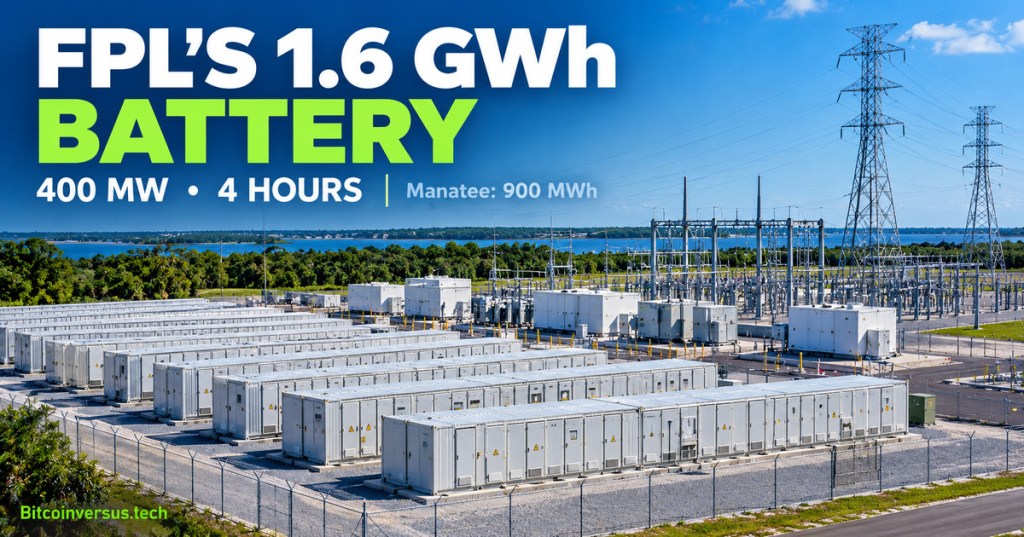
Florida Power & Light (FPL) announced November 9, 2026, that its Lansing Smith Battery Energy Storage System in Bay County, Florida, has been commissioned. The utility rates the standalone lithium-ion project at 400 megawatts (MW) of electrical power and 1,600 megawatt-hours (MWh) of stored energy. At full rated output, that equates to four hours of discharge. A local news report says the site began operating October 31, before the formal announcement.
More energy, despite slightly less power
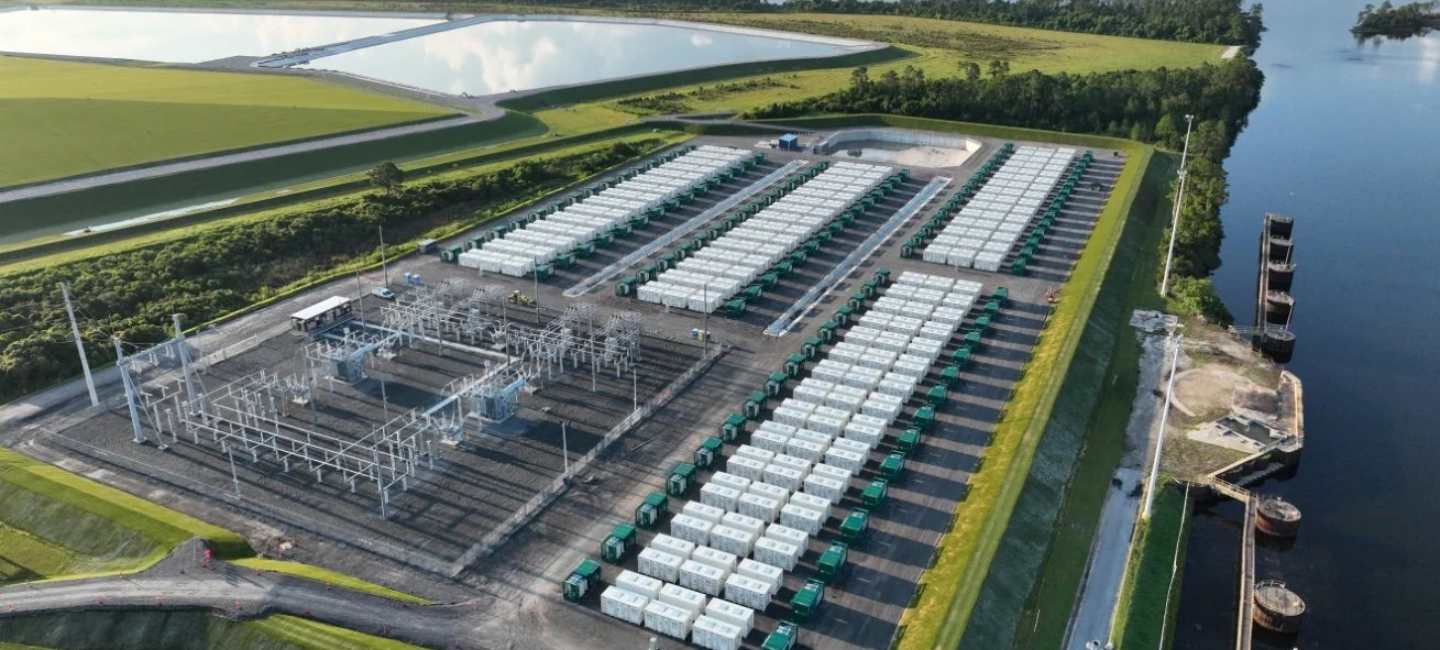
Lansing Smith becomes FPL’s largest battery by stored-energy capacity, not by instantaneous output. FPL’s older Manatee Energy Storage Center in Parrish is rated at 409 MW and 900 MWh. Subtracting gives a 700-MWh advantage for Lansing Smith; dividing by Manatee’s 900 MWh yields 77.8% more energy. Lansing Smith’s 400-MW power rating, however, is about 2.2% below Manatee’s 409 MW.
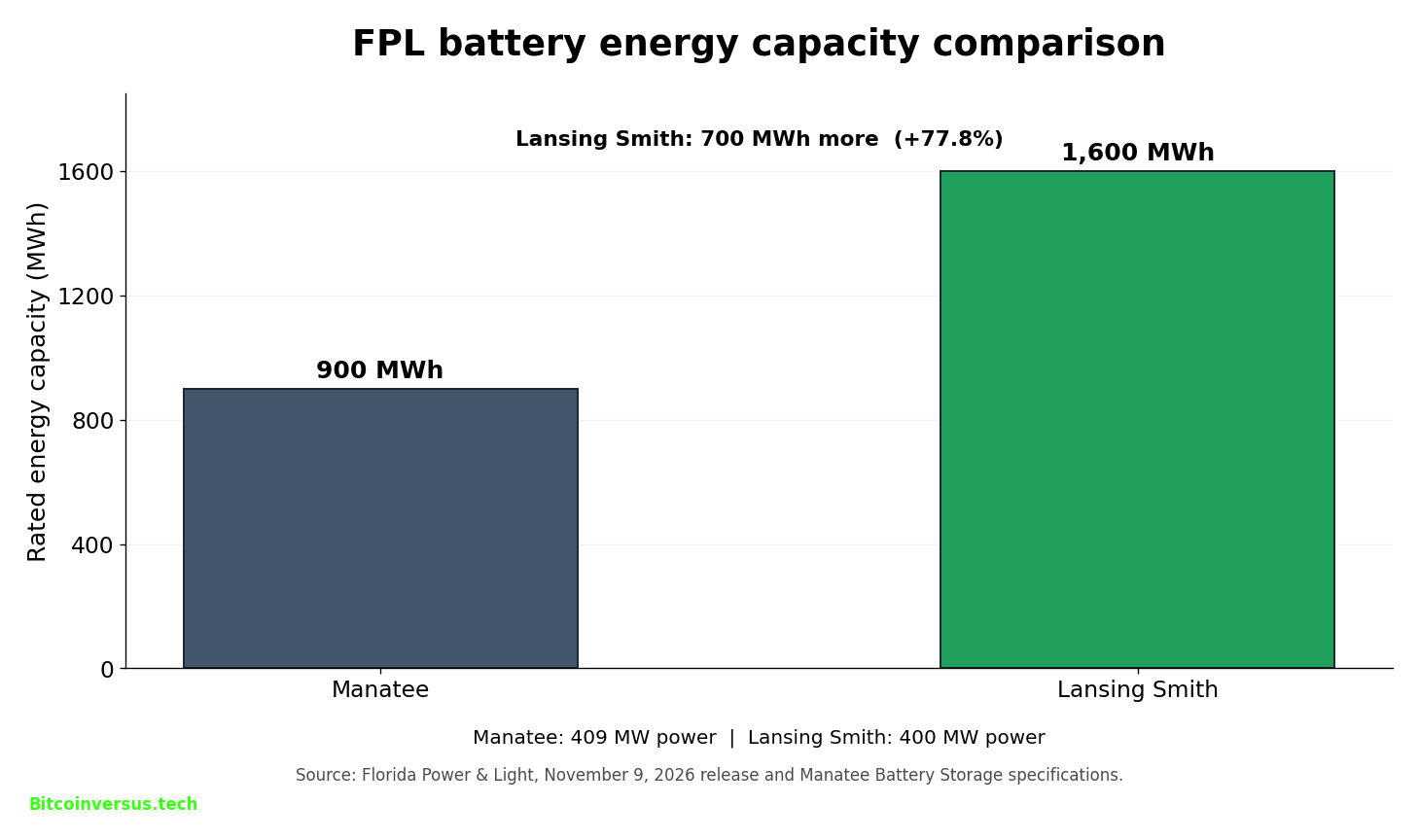
Power and energy measure different engineering properties. MW indicates the rate of electricity delivery, whereas MWh measures the quantity delivered over time. Manatee’s nominal energy-to-power ratio is approximately 2.20 hours; Lansing Smith’s is four hours. Battery degradation, operating reserve, temperature and dispatch settings can reduce actual usable energy or discharge duration. Neither project’s rating guarantees the stated output throughout every operating condition.
What 300,000 homes really means
FPL says Lansing Smith could provide energy equivalent to supplying about 300,000 homes for four hours. Dividing 1,600,000 kilowatt-hours by 300,000 homes and four hours gives an implied average load of 1.33 kilowatts per household. The figure is a comparison based on assumed demand, not 300,000 dedicated home connections or a promise of uninterrupted power during a regional blackout. A grid-connected battery needs appropriate protection and islanding infrastructure for independent backup operation.
Local Panama City News Herald reporting from an onsite tour attributed 358 Samsung battery containers and 120 GE inverter-transformer units to FPL’s development team. Inverters convert battery direct current into grid-synchronized alternating current; transformers then raise voltage for transmission. FPL’s April 2026 planning document describes a planned 230/34.5-kV Parakeet substation, two 225-MVA step-up transformers and a connection of approximately 0.26 mile to the Lansing Smith switchyard. Filing specifications are not independent as-built inspection records.
A former coal yard becomes a grid asset
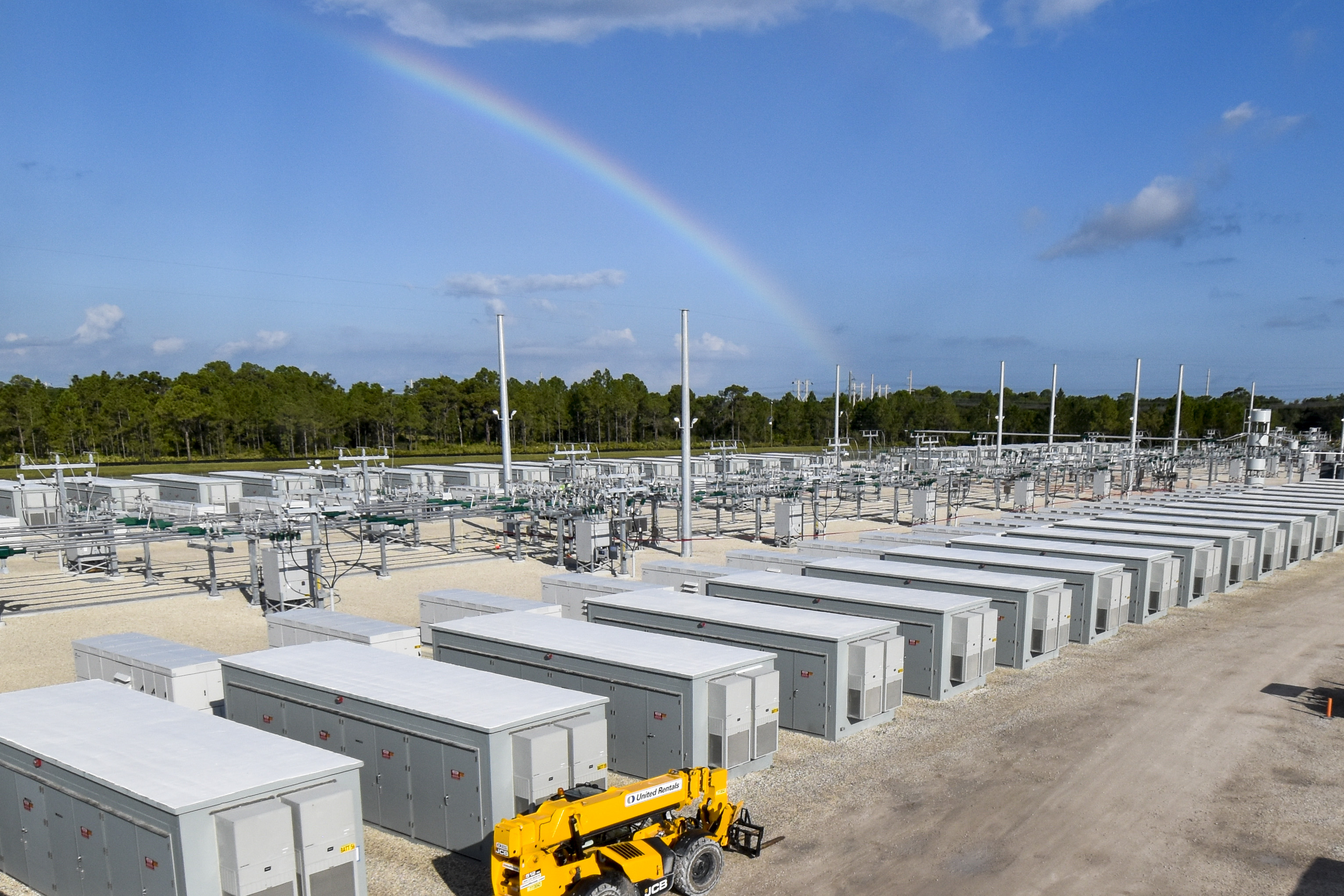
The battery was built on a former coal-storage area. Rather than producing electricity, the system shifts existing generation to periods when demand is higher. FPL expects the flexibility to complement solar, nuclear and natural-gas assets, although the utility has not published site-specific audited savings or independently observed round-trip efficiency since commissioning. Its 2026 plan projected 88% first-year round-trip efficiency; a projection should not be presented as a measured result.
The broader market includes different storage technologies and project stages. BitcoinVersus.Tech previously covered a 600-MWh liquid-air storage facility in China and India’s 92-GWh storage financing program; funded capacity and operating capacity must not be conflated. A separate 1.5-GWh battery-supply proposal likewise describes prospective supply, not commissioned electricity storage.
Lansing Smith also changes the snapshot used in BitcoinVersus.Tech’s October 31 battery-storage ranking, which predates FPL’s November announcement. The commissioning deserves examination on its own terms rather than retroactive claims about previously published rankings.
The engineering tests ahead
Large storage installations still depend on thermal management, fire protection, battery-management software, transformer protection and reliable grid dispatch. Related grid fault ride-through engineering shows how voltage events can challenge inverter-connected equipment. For Lansing Smith, independently disclosed charge-discharge efficiency, sustained four-hour performance, operational availability, safety events and measured customer savings will determine how fully its rated benefits are delivered.
The documented milestone is a commissioned 400-MW/1,600-MWh grid battery, not proof of zero-cost electricity or guaranteed backup for every household. Its distinguishing feature is duration: more rated stored energy than Manatee, despite marginally lower rated output power.
Sources and method: FPL press release, November 9, 2026; FPL Manatee specifications; FPL 2026–2035 Ten-Year Power Plant Site Plan; Panama City News Herald site-tour reporting, November 4. Original calculations: (1,600 − 900)/900 = 77.8%; 1,600 MWh / 400 MW = 4 h; 1,600,000 kWh / (300,000 × 4 h) = 1.33 kW/home.
Editor’s Note: FPL’s 1,600-MWh and 400-MW ratings are company-reported. The 77.8% difference is an independently calculated comparison of published rated energy capacities, not observed delivered energy. The 300,000-home equivalent and anticipated financial benefits are not independently verified operating measurements. The 88% efficiency and substation configuration appeared in planning documents, not in independent as-built test reports. The featured illustration is conceptual and does not depict the actual Lansing Smith site. The in-story project photograph is sourced from FPL, and the Manatee photograph is archival and clearly identified. No official YouTube video suitable for the new Lansing Smith development was verified; in-story photographs and an original chart were used instead. Real-device layout and media playback testing were not performed.

BitcoinVersus.Tech is volunteer-run and publishes independent educational technology reporting. An optional 5,000-satoshi donation can support continued research. Scan the original QR from a second screen using a compatible Bitcoin wallet, or on mobile use a wallet supporting image-based QR scanning. Independently verify recipient address 3C9o19EH5HSiwEPyCTmEKzxhNCbo2X6TTb and the amount before sending; Bitcoin transactions are generally irreversible.
We volunteer daily to ensure information on the BitcoinVersus.Tech platform is Verifiably True. Coverage is for educational and informational purposes and does not constitute financial or investment advice.


Leave a Reply