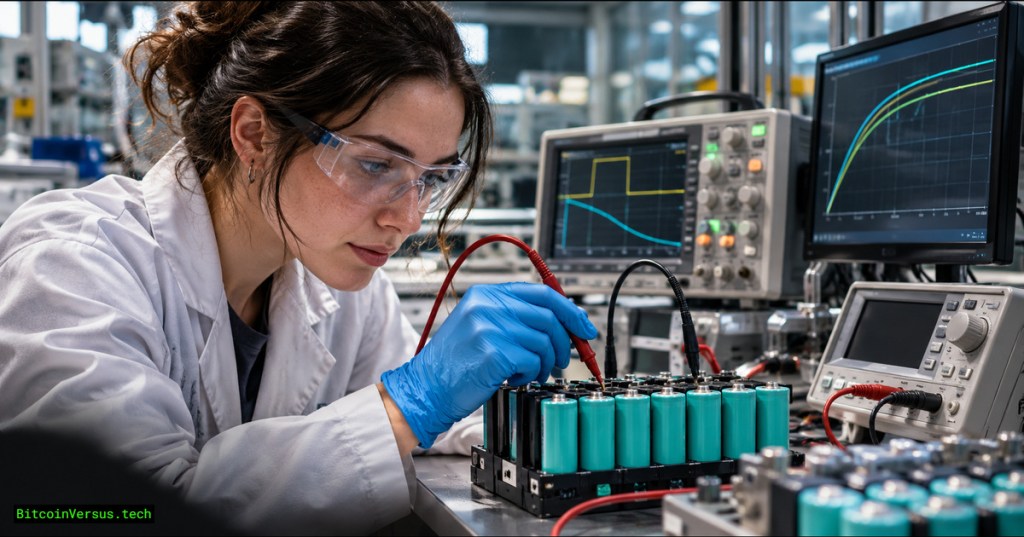
University of New South Wales researchers have built a prototype that estimates the condition of a used lithium-ion battery cell in under three minutes, compared with the hours required for conventional full charge-discharge testing. UNSW reported laboratory accuracy above 90% and announced an A$1.3 million industry project on November 10, 2026, to evaluate the technique on more than 500 batteries. Commercial validation remains ahead.

The method sends brief electrical pulses through a cell, records its voltage response and feeds the measurements into statistical models. The goal is to estimate battery state of health—remaining usable capacity and degradation—without repeatedly filling and emptying a potentially worn cell. The research team includes Dr Ziyang Lyu and Associate Professor Huadong Mo.
UNSW Sydney’s official 2017 archival video “Making a city-sized dent in e-waste” documents campus battery collection and recycling. Historical context only; it does not show the 2026 rapid-testing prototype. Credit: UNSW Sydney / YouTube.
What the three-minute result actually measures
A battery can be retired from an electric car while retaining enough performance for less demanding storage duties. Yet a recycler must distinguish reusable units from damaged or degraded ones. The problem expands as automakers build more packs: BMW’s new US battery facility is one example of the growing production ecosystem.
UNSW places a conventional pack-level capacity check at roughly 10 hours and A$120. Its new target is below A$25 per pack, while the reported speed is under three minutes per cell. Those units matter: a fast single-cell measurement does not establish the end-to-end time for disassembling, screening, reconnecting and certifying an entire automotive pack.
The researchers say the approach can address lithium iron phosphate (LFP), nickel cobalt aluminium (NCA) and nickel manganese cobalt (NMC) batteries. A mixed incoming stream is harder to classify than a laboratory batch because chemistry, previous operating temperatures, ageing, charge level and unknown damage can alter pulse signatures.

The 500-battery field trial is still ahead
The partnership with battery recycler DY New Energy would test more than 500 batteries under operational conditions. UNSW is developing the models and an intelligent battery-management-system interface, while the industry partner contributes battery data and workflow access. The proposed reuse-versus-recycle decision engine is a development objective, not an already deployed commercial screening system.
A greater than 90% laboratory accuracy rate needs context before a plant can trust automated decisions. Critical questions include which health thresholds were used, the error rate on dangerous cells, how models behave on unseen manufacturers and whether pack-level connections or thermal faults escape a pulse test. Accurate capacity prediction alone does not replace electrical-safety evaluation.
Battery chemistry researchers face similar translation challenges. QuantumScape’s solid-state cell tests and Talga’s graphite cycling results supply useful lab data, but they do not establish lifetime performance in every vehicle or installation.
Second-life potential and real safety limits
Second-life batteries can serve applications with gentler power demands than EV acceleration. Utilities already need suitable storage for grid balancing: Statkraft’s grid-forming battery project illustrates one possible category of demand, though no connection to UNSW’s trial has been announced. FPL’s large battery installation also shows why lifecycle testing matters at scale.
Faster diagnostics may reduce unnecessary recycling, but a screening tool cannot independently certify fire safety or remaining service life. Battery transport, pack traceability, warranty terms, mechanical damage and local safety standards remain essential before any retired cell is placed into another system. The university says factory-floor performance and real-world data are the next tests.
The measurable advance is a promising rapid assessment process supported by early laboratory results and a funded validation program. The industry milestone will be whether those results survive mixed-condition field samples, allow safe reject decisions and achieve reliable pack-level cost reductions without sacrificing diagnostic accuracy.
Primary sources: UNSW Sydney original announcement, November 10, 2026; pv magazine independent coverage, November 14, 2026; Applied Energy review of second-life battery state-of-health methods, 2024. The three-minute laboratory result is per cell; baseline cost and time refer to pack checks, and planned project outcomes are not presented as completed results.
Editor’s Note: The research team reported laboratory accuracy above 90%, not independent third-party certification. A$1.3 million in project funding and the proposed 500-plus-battery validation represent planned work. The original 1200 × 630 featured cover is photorealistic conceptual artwork portraying a fictional scientist, not an image of the UNSW researchers. Its bottom-left watermark follows the supplied black-background, neon-green pixel-lettering design. Two laboratory photographs are authentic UNSW images; the archived university YouTube video is historical recycling context and not a demonstration of the new technology. WordPress embed generation does not prove playback in every browser.

BitcoinVersus.Tech is volunteer-run and publishes independent technical journalism. An optional 5,000-satoshi donation supports ongoing research. Scan the original QR from a second screen using a compatible Bitcoin wallet; on the same phone, use a wallet that can import a saved QR image when supported. Independently verify recipient 3C9o19EH5HSiwEPyCTmEKzxhNCbo2X6TTb and the 5,000-satoshi amount before sending. Bitcoin transfers are generally irreversible.
We volunteer daily to ensure the information on BitcoinVersus.Tech is Verifiably True. Technical and financial coverage is educational and informational, not personalized engineering, securities, tax or investment advice.


Leave a Reply