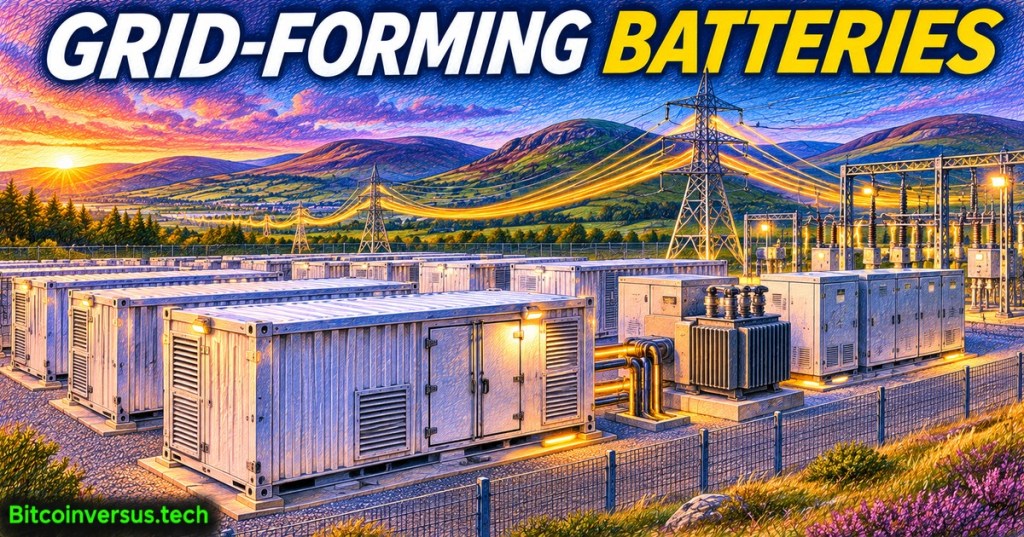
Statkraft has placed a 50-megawatt grid-forming battery system into commercial operation at Neilston Greener Grid Park near Paisley, Scotland. The company announced completion of the first phase on November 12, 2026, with an international announcement following November 13. The project uses battery power electronics to help stabilize voltage and frequency as more wind and solar electricity enters Great Britain’s grid. A separate development consent permits expansion up to 750 MW, but only the initial 50 MW phase is operating.
Statkraft’s official March 2023 explainer, “Why do we need Greener Grid Parks?” It describes the company’s grid-stability approach but predates the Neilston commissioning and is not footage of the November 2026 opening. Credit: Statkraft / YouTube.
A battery that helps establish a grid reference
Conventional grid-following inverters synchronize their output to voltage and frequency already established by the electrical network. Grid-forming converters actively regulate electrical behavior to support a stable reference during disturbances. They can provide fast frequency response, voltage support and system-strength services, reducing some dependence on running large synchronous generators solely for stability.
Traditional generators store kinetic energy in rotating turbines. A grid-forming battery uses electronic controls and stored electrical energy to provide a rapid response that can resemble selected stabilizing effects of inertia; it does not contain the same physical rotating mass. Fault-current capability, available energy and response behavior depend on inverter and system design.
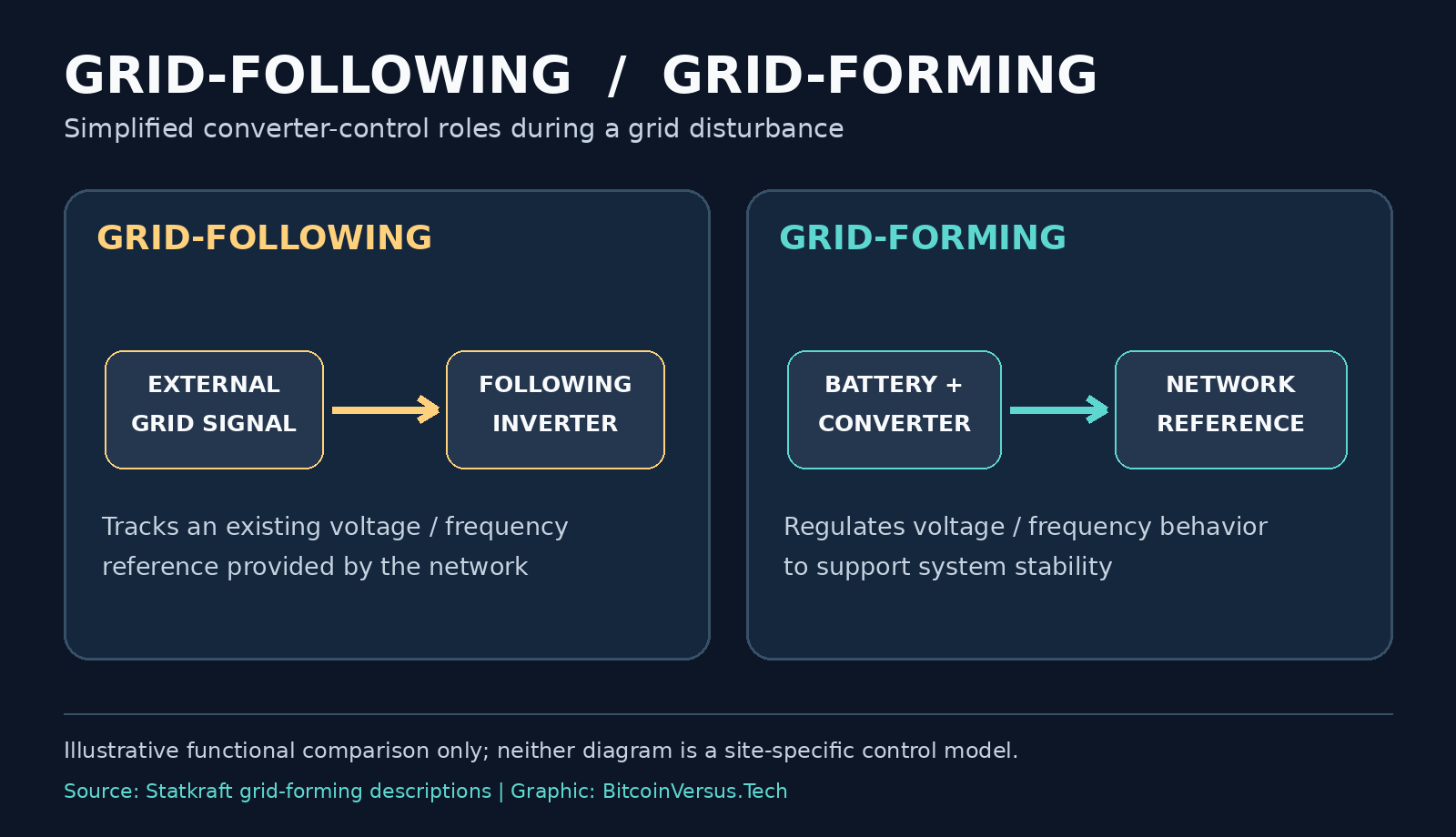
The contrast matters beyond the UK. BitcoinVersus.Tech previously examined Australia’s new electrical requirements for large inverter-based loads and data-center fault ride-through. Grid-forming storage addresses the supply-side stability challenge, while large facilities must still control how they behave when the network is disturbed.
50 MW is operating; 750 MW remains an approved ceiling
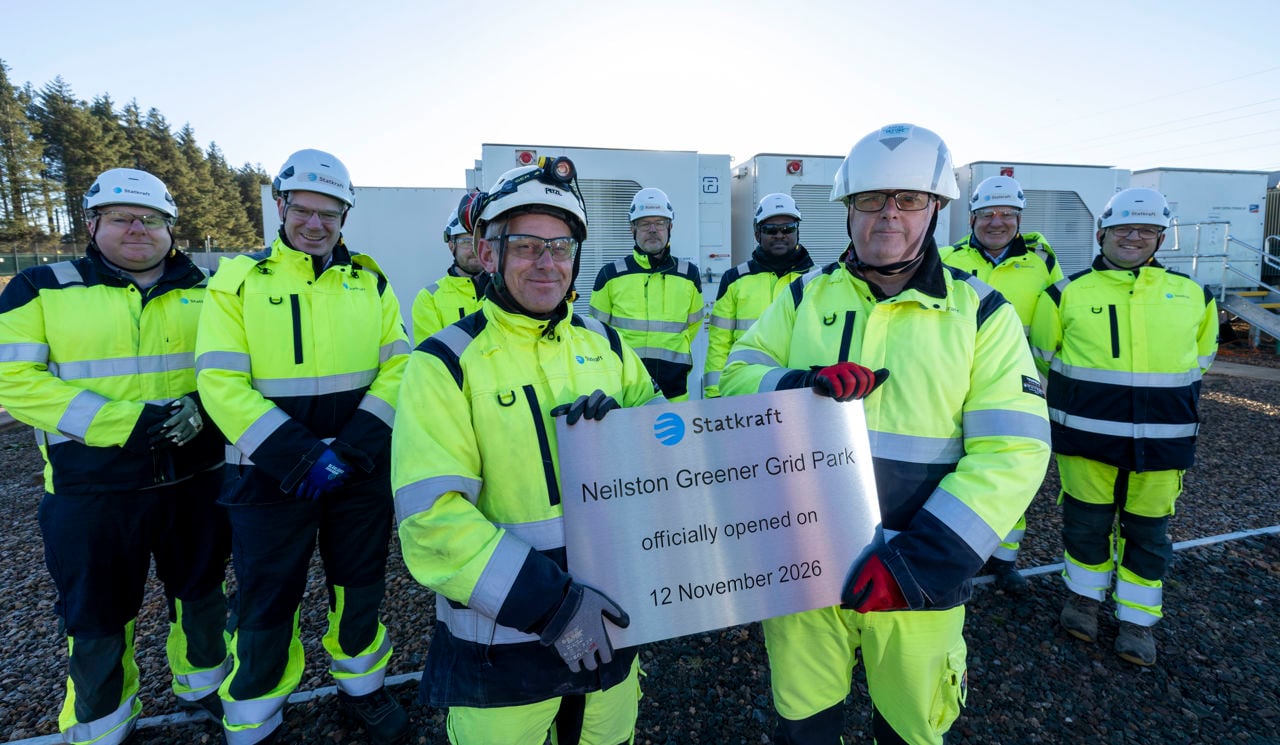
Statkraft’s project page identifies 50 MW as operational and 750 MW as approved capacity. Scottish government records confirm the later approval for an expanded battery facility, but the developer has not published a construction timetable for the entire enlargement. A consented upper limit must not be counted as energized electrical capacity.
The company’s commissioning announcement does not establish a confirmed energy capacity in megawatt-hours. MW measures power; MWh measures stored energy. Without a verified MWh figure, a two-hour or four-hour operating duration cannot be calculated from 50 MW alone. For comparison, BitcoinVersus.Tech’s report on Florida Power & Light’s 400 MW/1,600 MWh battery includes both ratings because that utility disclosed them.
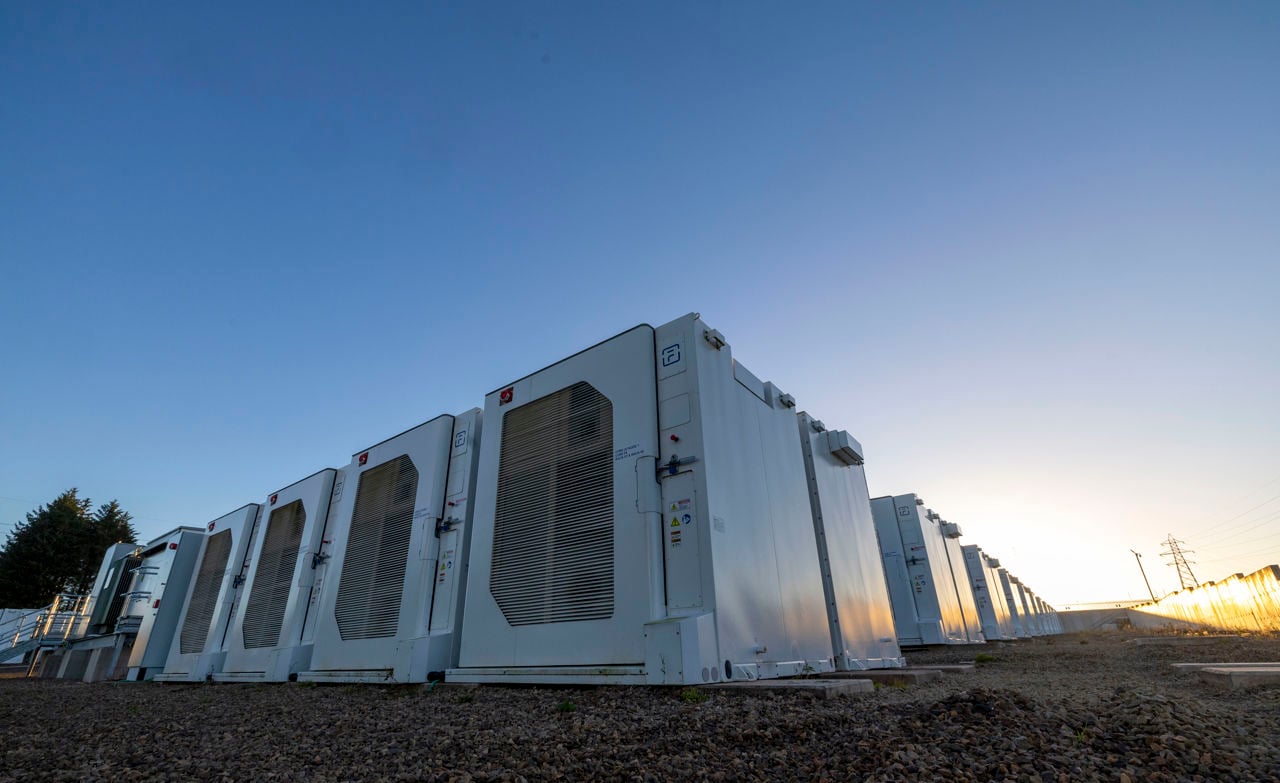
The wider engineering and economic case
Britain’s National Energy System Operator says grid-forming stability support is delivered continuously while qualifying equipment is connected, rather than requiring routine control-room dispatch for each stability event. That operating model differs from using a battery solely to move electricity from low-price to high-price hours. A project can provide both kinds of services, subject to contracts and engineering limits.
Statkraft also lists a second grid-forming battery scheme at Coylton under construction and synchronous-compensator projects at other UK locations. Those developments reflect the broader need for power-system strength as the generation mix changes. BitcoinVersus.Tech’s renewable-capacity outlook and UK transmission infrastructure coverage explain the parallel investment pressures.
Grid-forming batteries can reduce reliance on fossil-fuel generators for certain stability services, but they cannot independently solve all transmission congestion, resource-adequacy or long-duration energy shortages. Published statements provide no independently audited performance trace for Neilston’s disturbance response or consumer-bill savings.
Bottom line: Neilston’s 50 MW grid-forming battery is operating now, adding a real stability asset to Scotland’s electricity system. The 750 MW approval establishes a potential future scale—not installed capacity or a forecast of when expansion will arrive.
Primary sources: Statkraft UK opening announcement, November 12, 2026; Statkraft international announcement, November 13; Neilston project status and 50 MW / 750 MW distinction; Scottish government development consent record; NESO stability services documentation; Statkraft’s official background video; Solar Power Portal independent reporting, November 13. Capacity and service claims are attributed to the project developer and grid operator.
Editor’s Note: Statkraft commissioned phase one at Neilston, rated 50 MW; its separate consent for a facility up to 750 MW does not mean all 750 MW is online. Neither the November announcements nor the cited project page give a verified operating MWh capacity or discharge duration; no duration is inferred. Grid-forming support is described as an electronic control service, not identical to the kinetic inertia of a rotating generator. The original 1200 × 630 colored-pencil featured cover contains one editorial title and the neon-green publication watermark and is conceptual, not a Neilston photograph. Both in-story site photographs are authentic images supplied by Statkraft for its November 12 announcement. The original technical diagram is illustrative. The official Statkraft YouTube video dates from March 2023; saved iframe rendering and actual playback are separately audited. No unverified video or social post is presented as live footage of commissioning.

BitcoinVersus.Tech is volunteer-run and publishes independent educational technology reporting. An optional 5,000-satoshi donation supports ongoing research. Scan the original QR from a second screen with a compatible Bitcoin wallet; on mobile, use a wallet that supports scanning a saved image. Independently verify the recipient address 3C9o19EH5HSiwEPyCTmEKzxhNCbo2X6TTb and the payment amount before sending. Bitcoin transfers are generally irreversible.
We volunteer daily to ensure information on the BitcoinVersus.Tech platform is Verifiably True. Coverage is educational and informational and does not constitute financial or investment advice.


Leave a Reply