
Large artificial-intelligence data centers need to withstand brief power-grid disturbances without abruptly disconnecting hundreds of megawatts of demand. A November 5, 2026, engineering analysis from the Open Compute Project (OCP) highlights an open grid-interface specification developed by Google, Meta, Microsoft and NVIDIA. The standard became effective September 17; OCP’s November article explains its relevance rather than announcing a new legal requirement.
The technical problem is voltage ride-through: keeping computing loads connected when a transmission fault temporarily lowers voltage at the utility point of interconnection. Sudden disconnection of a huge electrical load can disturb the balance between supply and demand, pushing system frequency or voltage upward. The 22-page OCP specification references a 1,500-megawatt simultaneous load-loss event in August 2024.
Different voltage dips receive different ride-through requirements
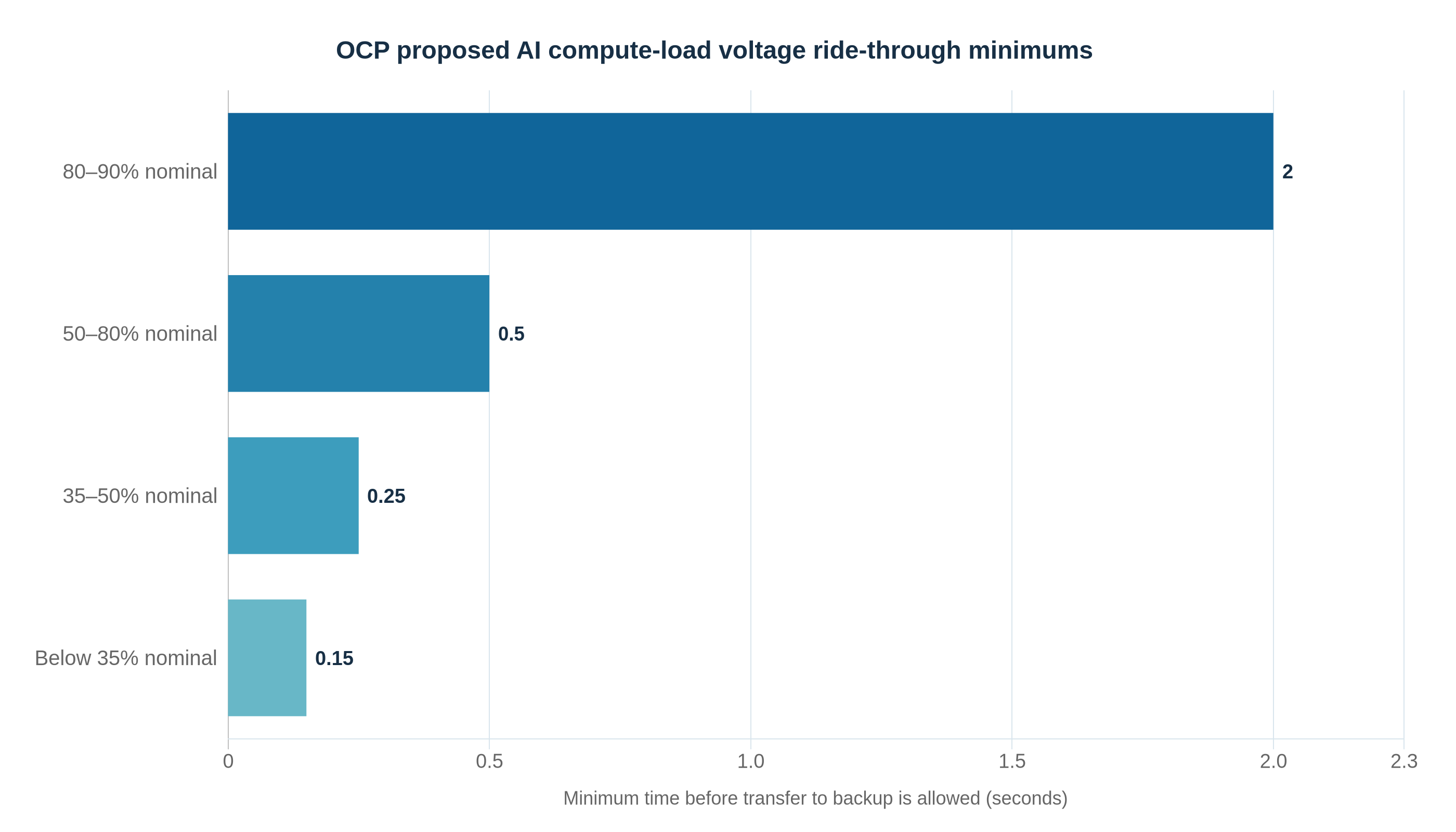
The specification defines several thresholds using per-unit voltage, where 1.0 means nominal voltage. At 80%–90% of normal voltage, computing equipment should remain connected for at least two seconds before a transfer to backup becomes permissible. At 50%–80%, the minimum is 0.5 second; at 35%–50%, 0.25 second; below 35%, 0.15 second.
After voltage recovers to the normal 90%–110% range, the proposed rule requires returning to at least 90% of pre-fault computing power within two seconds for the listed sag events. For an illustrative 100 MW computing load, the recovery threshold is 90 MW. Neither figure describes a named data center; the calculation simply translates the percentage requirement into megawatts.
OCP explicitly applies the proposed commitment to the computational portion, typically 70%–90% of a facility’s total load. Cooling, pumps and other mechanical systems can behave differently during faults. The specification does not guarantee that all systems remain online, and more severe events may permit backup transfer rather than sustained grid consumption.
Why grid behavior matters more than megawatt ratings alone
Previous BitcoinVersus.Tech reporting covered NERC’s proposed grid rules for large computational loads and ERCOT’s demand for hardware-tested load models from Bitcoin miners. The OCP document approaches the problem from the computer-facility side: specifying what equipment should do when the utility voltage changes unexpectedly.
Electrical systems may combine uninterruptible power supplies, power converters, fast controls and battery energy storage to bridge disturbances. Yet battery response speed, inverter current limits, fault protection and post-fault restoration must be tested together. The related BitcoinVersus.Tech lesson on data-center UPS and battery engineering explains why stored energy and discharge power are separate design limits.
An engineering baseline, not automatic certification
Ride-through requirements alone do not solve fast GPU power oscillations or every utility interconnection problem. OCP identifies ramp-rate limits and forced oscillations as possible subjects for later specifications. It also leaves project-specific voltage measurements, protection coordination and grid-reclosing behavior to detailed engineering reviews. BitcoinVersus.Tech previously examined how voltage sags and other power-quality disturbances are measured.
The practical next step is validation: utilities and operators must compare equipment models, simulate credible faults, test UPS and server recovery, and establish acceptable operating limits before energizing large campuses. An open specification offers a common reference, but published requirements cannot establish that any particular AI data center is already compliant.
Primary sources: OCP November 5 technical analysis; OCP Interface Specification Between Hyperscalers and Utility Grid for Disturbance Performance, version 1.0; OCP 2026 Global Summit recorded-session directory.
Editor’s Note: Reporting distinguishes the September 17, 2026, specification from the November 5 OCP technical discussion. Ride-through figures apply to computing loads under defined conditions, not to every data-center subsystem or binding utility regulation. The chart interprets the OCP specification, while the featured image is conceptual editorial artwork rather than a photograph of a facility.
Support BitcoinVersus.Tech
To support the research, scan the approved donation QR below to contribute 5,000 satoshis. On a phone, open the article on another screen and scan its QR using a compatible Bitcoin wallet. Verify the destination and amount in the wallet before sending payment.

We volunteer daily to ensure the information on this platform is Verifiably True. If you would like to support the research, please scan QR code.


Leave a Reply