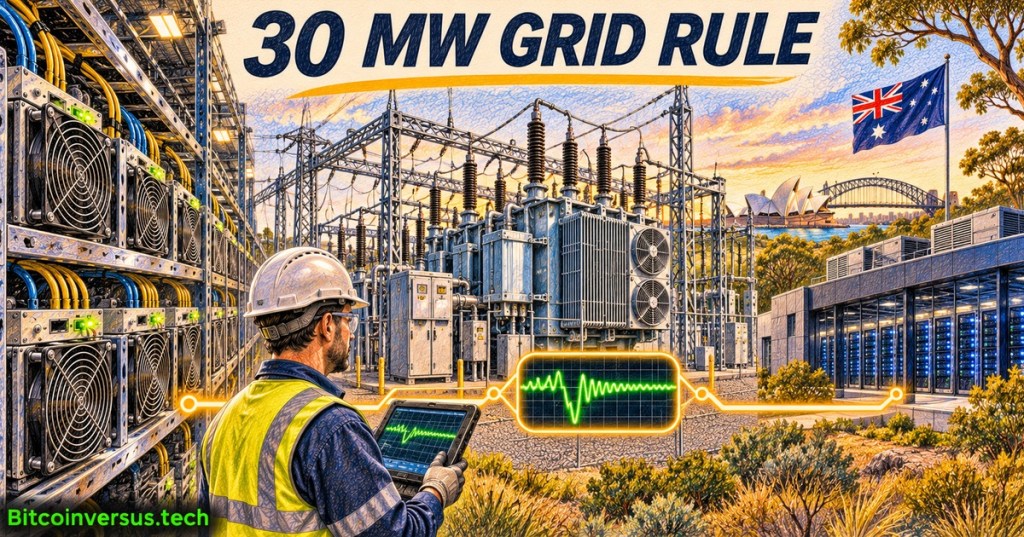
Australia has introduced new grid-connection requirements for large inverter-based electricity loads, including data centers and potentially qualifying Bitcoin mining facilities. The Australian Energy Market Commission (AEMC) finalized its rule on November 12, 2026, setting a 30-megawatt (MW) combined nameplate threshold for automatic application of Schedule 5.3 technical access standards in the National Electricity Market (NEM).
The rule addresses a hardware problem: industrial power electronics can react abruptly to voltage disturbances, risking the simultaneous loss of large loads. AEMC confirmed the decision in its official LinkedIn updates as well as its signed determination. No blanket rule covers every Bitcoin mine; classification depends on electrical design, capacity and the connection arrangement.
What a 30 MW connection must demonstrate
The NEM covers much of eastern and southern Australia, not every electricity grid nationwide. A large inverter-based load (IBL) is equipment supplied through power electronics such as inverters, converters or rectifiers, potentially susceptible to power-electronic control instability. The final rule applies consistently to qualifying transmission- and distribution-connected loads.
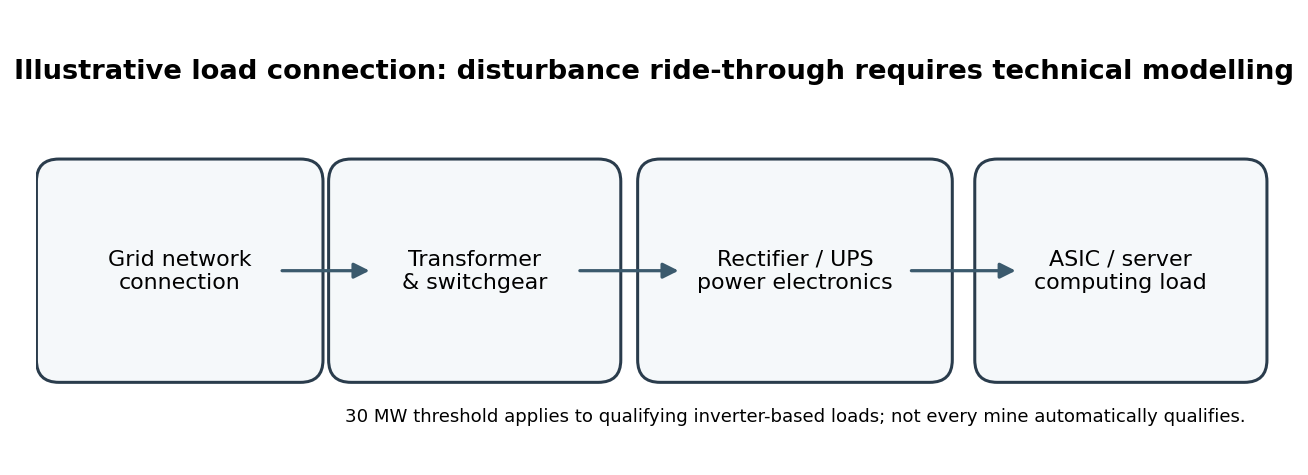
Affected connections must demonstrate specified voltage and frequency disturbance ride-through, meaning appropriate continued operation and recovery through certain defined events rather than unnecessary disconnection. Large IBLs also face instability monitoring provisions. Network service providers must assess multiple nearby loads together where their electrical arrangements and behavior justify considering their combined effects.
The obligations concern behavior at the grid interface, not just nameplate ASIC efficiency or average kilowatt-hour consumption. A miner with many AC-to-DC power supplies may need to examine rectifier controls, protective trips, restart behavior and power-quality modelling with its network provider. Previous BitcoinVersus.Tech coverage of ERCOT’s hardware-tested mining models and data-center fault ride-through explains the engineering parallels.
A threshold designed for a growing connection queue
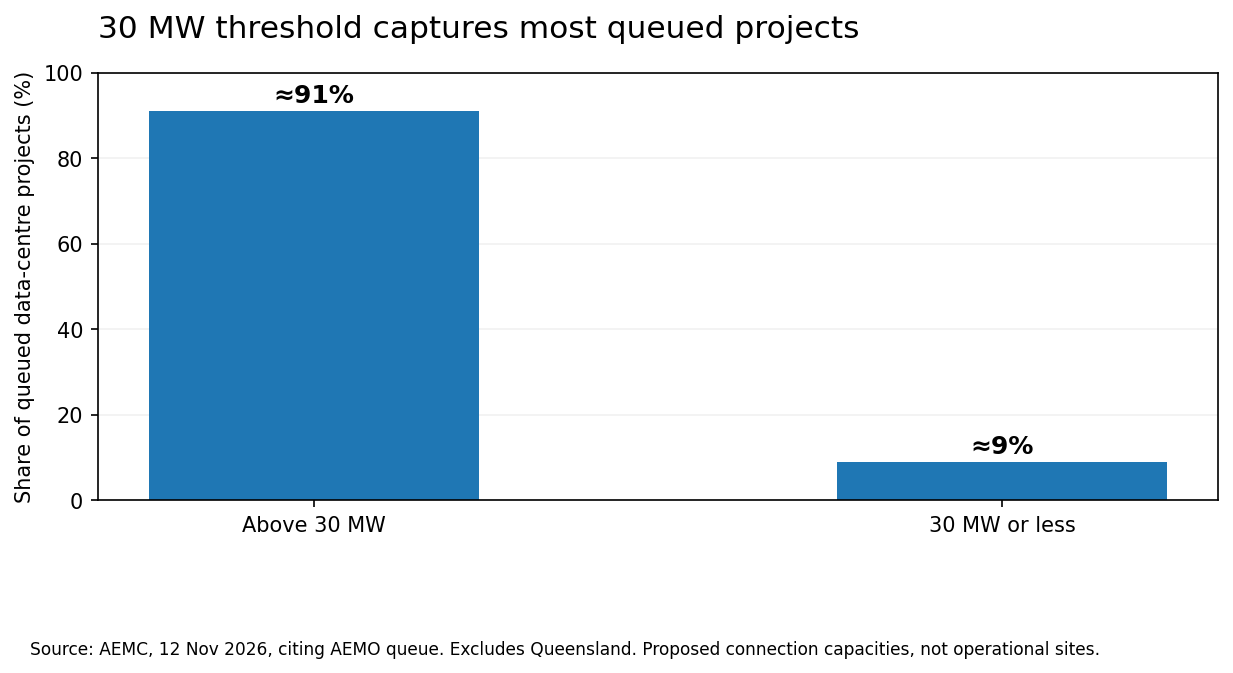
According to AEMO data cited by AEMC, approximately 91% of queued data-center projects above 30 MW in the NEM outside Queensland would meet the size threshold. The percentage describes proposed projects, not all operating data centers or Bitcoin mines. Smaller connections can still face proportionate requirements where local system effects justify them.
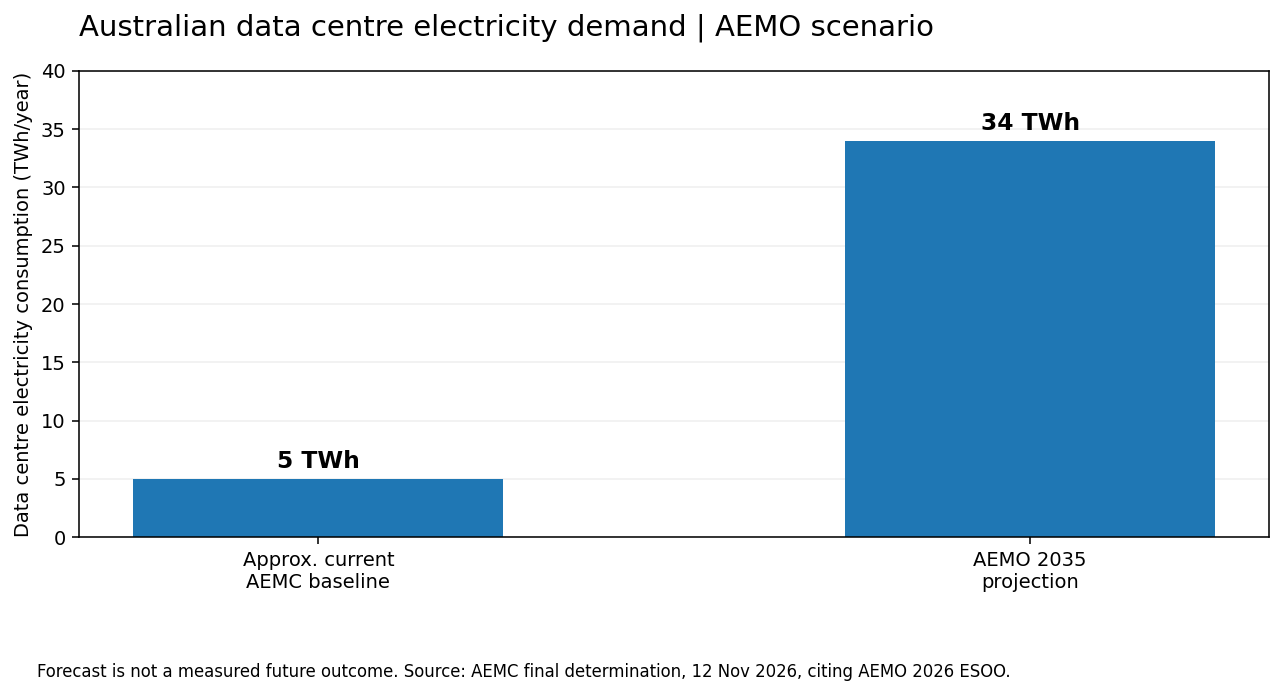
The regulator cited a separate forecast of data-center electricity demand rising from roughly 5 terawatt-hours to 34 TWh by 2035, an increase of about 6.8 times. The forecast describes possible future national data-center demand, not established consumption or mining-specific growth.
Immediate requirements versus proposals still under review
The technical access rule took effect November 12. A targeted six-month transition applies to some advanced applications with previously accepted negotiated standards, with a key deadline of May 12, 2027. The transitional protection is not an automatic exemption for every existing or planned facility.
On the same day, AEMC separately opened consultation on operational visibility and potential registration, communications and load-ramping requirements. Submissions close December 17, 2026. Those additional operating controls are proposals, not enacted obligations. The distinction matters to project budgets and commissioning schedules.
Operators should compare the Australian requirements with U.S. work on large computational-load standards, while using established data-center power-path engineering methods for preliminary planning. An electrical consultant and network provider must determine actual compliance duties.
Better ride-through and clearer technical rules may reduce cascading outages and connection uncertainty. New studies, controls, testing and equipment changes can also increase upfront cost. The immediate finding is a new mandatory connection standard for qualifying loads—not a ban on mining, a universal 30 MW restriction, or proof that every Bitcoin facility requires new hardware.
Primary sources and calculation: AEMC final determination, ERC0394, November 12, 2026; AEMC operational visibility consultation, ERC0455; AEMC November coordination fact sheet; AEMC official announcement republished by pv magazine, November 13; AEMC official LinkedIn updates. Forecast arithmetic: 34 ÷ 5 = 6.8. Approximate percentages and projections follow agency source definitions.
Editor’s Note: The final rule and the pending operational-visibility consultation are separate regulatory actions. The 30 MW trigger applies to qualifying inverter-based loads in the National Electricity Market; it is not a universal minimum size for Bitcoin mines or an Australia-wide prohibition. Queued-project data excludes Queensland. AEMO’s 34 TWh estimate is a forecast rather than measured consumption. The original 1200 × 630 cover is conceptual colored-pencil illustration, not a photograph of an identified Australian mining site. The three in-story diagrams and vertical charts are original, have source-labelled assumptions and are not official AEMC artwork. AEMC’s own LinkedIn statement is linked for context, not displayed as a verified social widget. No relevant official YouTube video with a verified watch identifier was established. Visual mobile layout and actual video playback were not independently tested.

BitcoinVersus.Tech is volunteer-run and publishes independent educational technology reporting. An optional 5,000-satoshi donation supports ongoing research. Scan the original QR from a second screen with a compatible Bitcoin wallet; on mobile, use a wallet that supports scanning a saved image. Independently verify the recipient address 3C9o19EH5HSiwEPyCTmEKzxhNCbo2X6TTb and the payment amount before sending. Bitcoin transfers are generally irreversible.
We volunteer daily to ensure information on the BitcoinVersus.Tech platform is Verifiably True. Coverage is educational and informational and does not constitute financial or investment advice.


Leave a Reply