
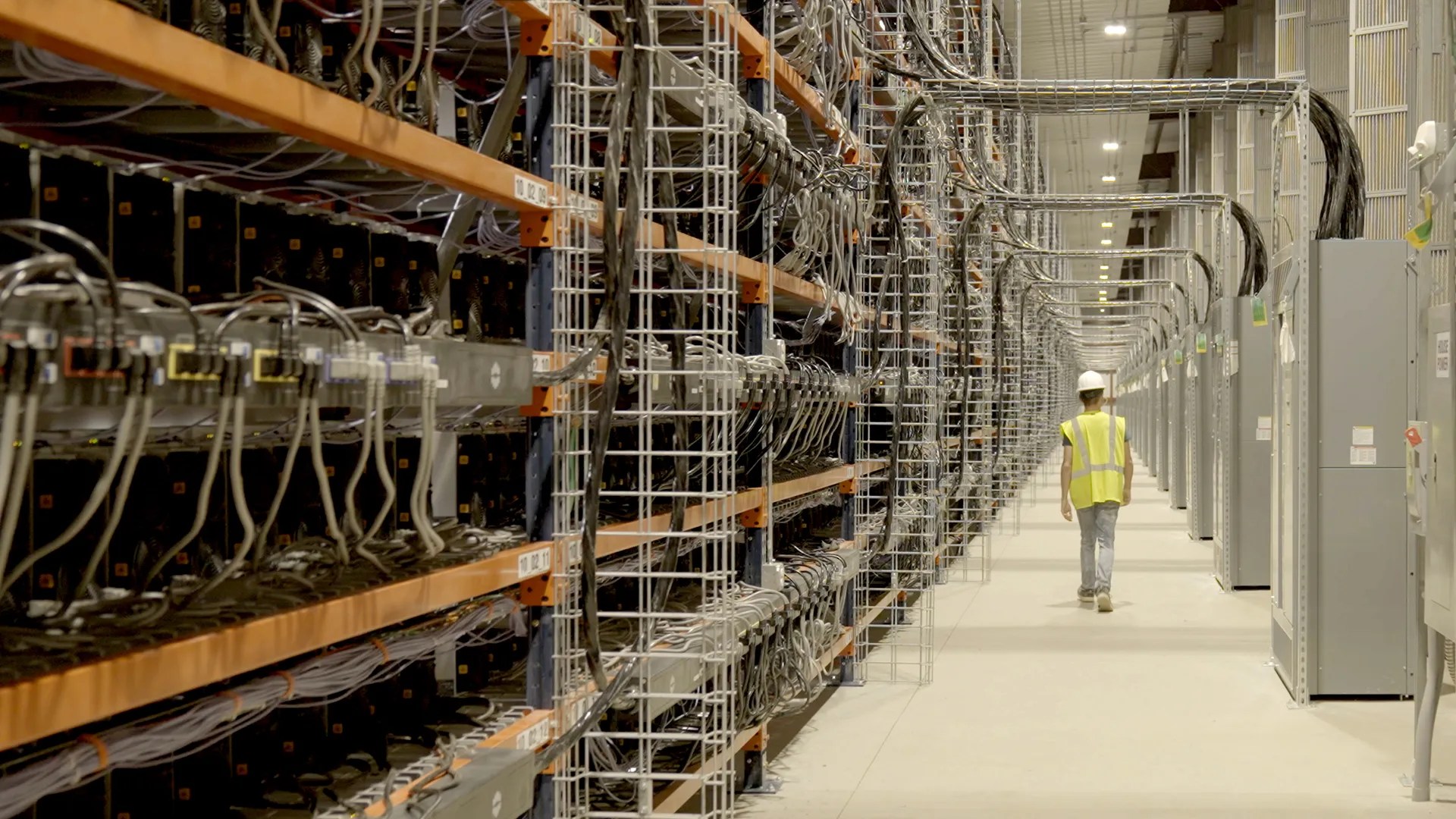
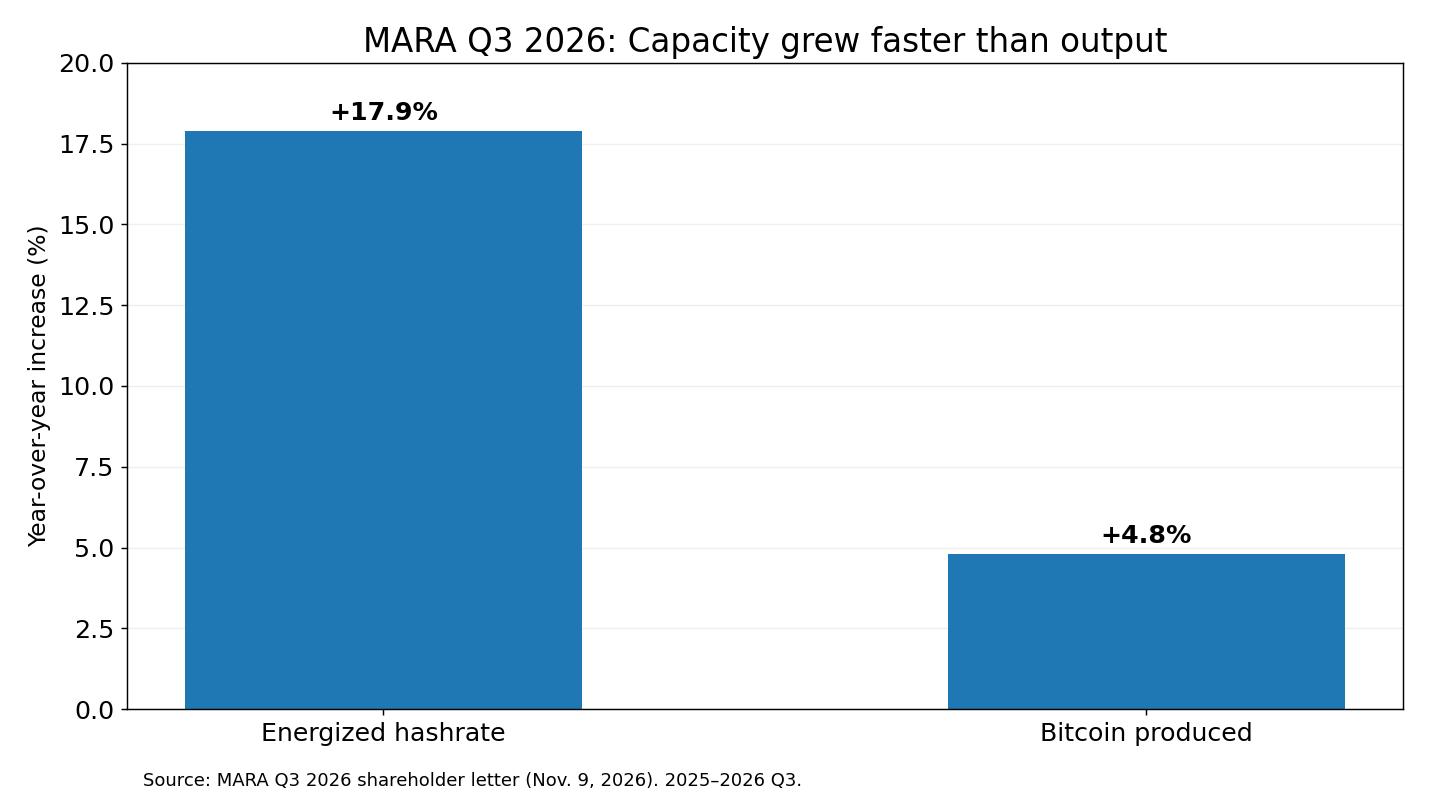
MARA Holdings reported ownership of approximately 435,000 Bitcoin mining rigs worldwide as of September 30, 2026, including its share of equipment held through an equity-method investment. Yet Q3 Bitcoin production increased only 4.8% year over year, despite an 17.9% rise in energized hashrate. The November 9 SEC filing highlights the difference between deploying more computing equipment and earning a proportional share of Bitcoin’s block rewards.
Archival January 2026 CNBC interview with MARA chief executive Fred Thiel on mining infrastructure and AI computing. The source was previously identified in BitcoinVersus.Tech’s MARA coverage; the recording is not the November Q3 results presentation. Credit: CNBC / YouTube.
What 435,000 rigs actually means
The company reported 71.2 exahashes per second (EH/s) in energized capacity, versus 60.4 EH/s at the end of Q3 2025. MARA defines energized hashrate as manufacturer-rated capacity from installed equipment that could run at full output, including machines temporarily offline. Therefore, 71.2 EH/s is not a direct measurement of average live hashing or a guarantee that every reported rig was operating continuously.
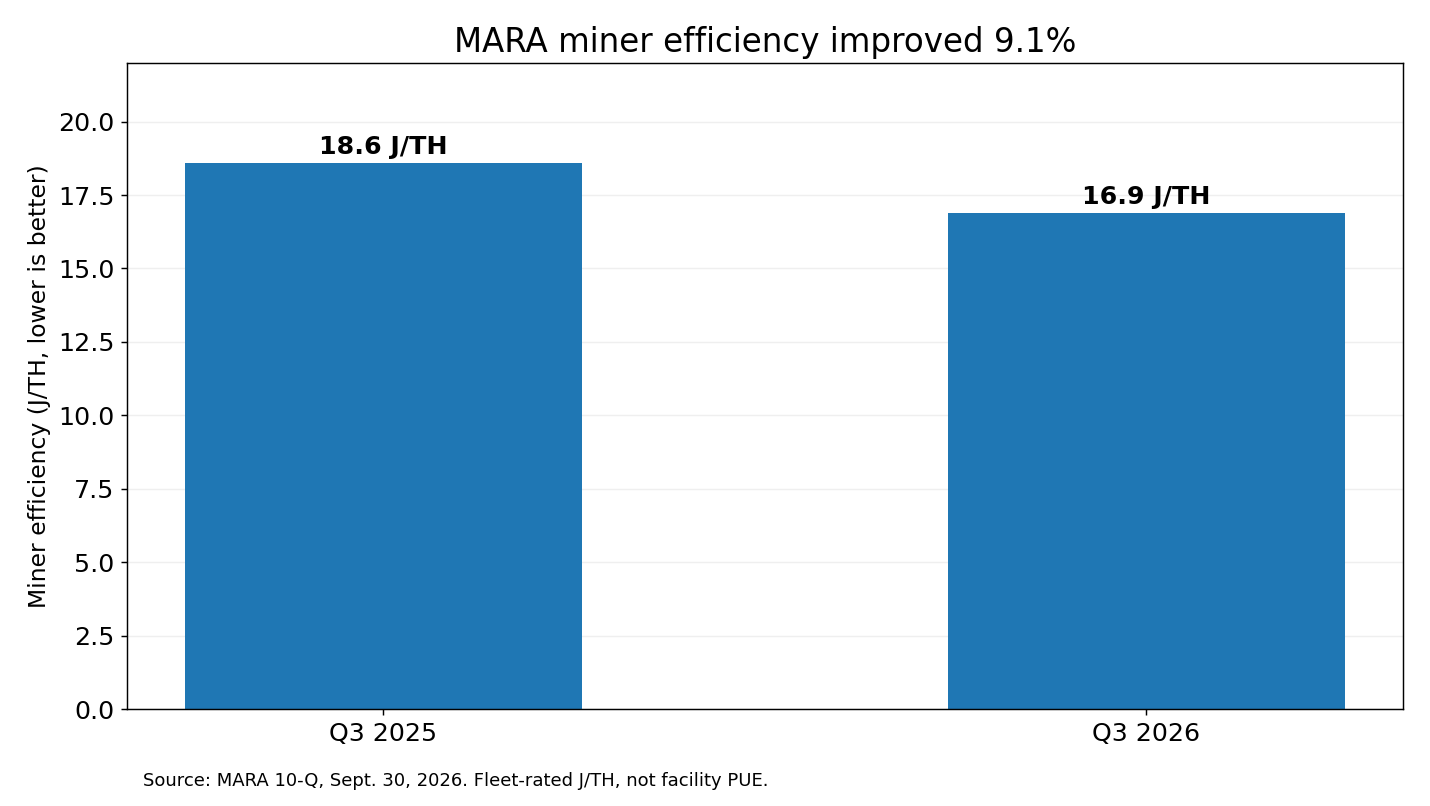
The 10-Q lists average miner efficiency of 16.9 joules per terahash, improved from 18.6 J/TH one year earlier. The 1.7 J/TH reduction equals approximately 9.1% less miner energy per unit of hashing under equivalent operating conditions. It does not establish the same percentage decrease in facility electricity consumption, which also reflects fleet utilization and cooling overhead.
Hashrate grew almost four times faster than Bitcoin production
MARA mined 2,247 BTC in Q3 2026, compared with 2,144 BTC a year earlier. Its mining pool won 644 blocks versus 633. While installed capacity rose sharply, network difficulty, competing hashrate and operational factors limited the production increase. The company also reported a 7% sequential decline from Q2, when it produced 2,422 BTC.
The contrast resembles the challenge examined in BitcoinVersus.Tech’s public-miner production rankings. An operator must earn a growing share of network computation merely to maintain its relative reward share as competitors upgrade. Our ASIC efficiency comparison likewise distinguishes a machine’s rated efficiency from the economics of running an entire fleet.
Power infrastructure and costs remain decisive
MARA reported 1.9 gigawatts of total energy capacity, up from 1.7 GW, while purchased energy cost per Bitcoin at its owned sites rose slightly from $39,235 to $39,674. Its reported $0.04/kWh energy rate does not include all depreciation, overhead or financing costs. Revenue fell 35% to $164.2 million despite higher BTC production; the company reported $632.1 million in GAAP net income, but the income figure should not be interpreted as profit from mining alone.
Expansion gives MARA a stronger base of electrical infrastructure for other compute customers. Its 505 MW Ohio power-plant transaction and earlier Nebraska facility transition illustrate the move toward owning or controlling power assets. The previous MARA Bitcoin sales analysis provides financing context.
A separate Bitdeer fleet-energy analysis underscores an important industry distinction: newer ASICs can increase compute per joule even as the total number of operating units and aggregate electricity use expand.
Bottom line: MARA’s filing verifies a large, improving ASIC fleet and substantial energized capacity. Sustained operating hashrate, mining difficulty, electricity costs and asset utilization—not rig count alone—will determine whether greater scale produces stronger returns.
Primary sources and calculations: MARA Q3 2026 Form 10-Q; November 9 shareholder letter; official Q3 earnings webcast and releases; MARA corporate site and equipment photograph. Calculations: (71.2 − 60.4)/60.4 = 17.88%; (2,247 − 2,144)/2,144 = 4.80%; (18.6 − 16.9)/18.6 = 9.14%. Quarter-end hashrate and quarterly BTC mined represent different measurement windows.
Editor’s Note: MARA’s figures come from its November 9, 2026 quarterly filing and shareholder letter. The 435,000 rigs include MARA’s interest in equipment held through an equity-method investment; the figure does not establish that all miners were active simultaneously. Energized hashrate is manufacturer-rated potential output, not verified sustained throughput. Financial and operational figures may be unaudited. The 1200 × 630 colored-pencil cover is conceptual, not an authentic facility photograph. The official corporate photograph has no independently confirmed capture date. The CNBC video is archival contextual coverage carried in an earlier BitcoinVersus.Tech MARA article and does not depict Q3 results. Independent live playback remains unverified. Both original vertical charts use zero baselines and source-labeled values.

BitcoinVersus.Tech is volunteer-run and publishes independent educational technology reporting. An optional 5,000-satoshi donation supports ongoing research. Scan the original QR from a second screen with a compatible Bitcoin wallet; on mobile, use a wallet that supports scanning a saved image. Independently verify the recipient address 3C9o19EH5HSiwEPyCTmEKzxhNCbo2X6TTb and the payment amount before sending. Bitcoin transfers are generally irreversible.
We volunteer daily to ensure information on the BitcoinVersus.Tech platform is Verifiably True. Coverage is educational and informational and does not constitute financial or investment advice.


Leave a Reply