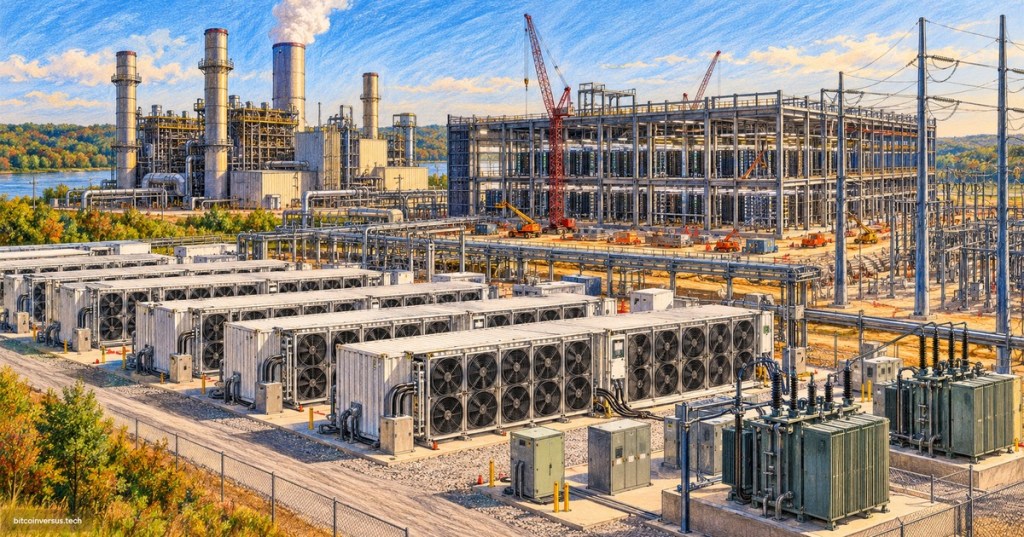
MARA Holdings spent the first half of 2026 proving that a large public Bitcoin miner can treat mined bitcoin as both a reserve asset and a source of industrial capital. Through June 30, the company sold 23,093 BTC for about ₿19,240 ($1.6 billion) in cash proceeds while reducing debt and expanding toward power generation, AI infrastructure and critical IT.
The numbers come directly from MARA’s August 2026 quarterly filing. The company said it sold approximately 23,093 BTC during the first six months of 2026 at an average price of $70,631 per bitcoin, generating about ₿19,240 ($1.6 billion). Dollar-to-bitcoin conversions in this story use a publication-time BTC price of roughly $83,159 and are only a snapshot.
MARA Used Bitcoin as Liquidity, Not Just a Treasury Asset
During the first quarter alone, MARA sold roughly 20,880 BTC for ₿18,038 ($1.5 billion). The company said part of that cash was used to repurchase more than ₿12,025 ($1 billion) of convertible notes and reduce a credit line by ₿2,405 ($200 million). By June 30, total debt had fallen from about ₿43,289 ($3.6 billion) at the end of 2025 to roughly ₿28,860 ($2.4 billion).
That makes the transaction different from a miner simply selling production to pay routine power bills. MARA explicitly described bitcoin as both a long-term store of value and a flexible source of liquidity. In other words, the same BTC produced by its hashrate can remain on the balance sheet during favorable conditions or be monetized when management sees a higher-return use for the capital.
The Higher-Return Bet Is Power Infrastructure
On April 30, MARA announced an agreement to acquire Long Ridge Energy & Power in Ohio for approximately ₿18,038 ($1.5 billion), including assumed debt. The company said the site includes a 485 MW combined-cycle natural-gas power plant expected to reach 505 MW nameplate capacity, more than 1,600 acres of industrial land, water access and fiber infrastructure.
The acquisition is designed to move MARA further upstream in the electricity stack. Instead of only buying power for SHA-256 ASICs, the company would own generation and land that can support both mining and higher-density computing. MARA said the Long Ridge transaction could increase its owned and operated power capacity by about 65%.
Bitcoin Mining Gives MARA A Flexible Load
One reason miners keep appearing in the AI infrastructure story is operational flexibility. A Bitcoin mining fleet can be curtailed quickly when electricity is scarce or expensive, then restarted when power becomes abundant. BitcoinVersus.Tech has previously examined how Bitcoin mining can act as AI’s flexible power backup and how miners are increasingly shifting megawatts from ASICs to AI.
AI clusters are less flexible because customers expect their models, inference services and enterprise workloads to remain online. MARA’s strategy is to combine these two load profiles: steady AI demand can occupy premium infrastructure while interruptible mining can absorb power that would otherwise be stranded or curtailed.
Long Ridge Is More Than a Mining Site
MARA said Long Ridge has a line of sight to as much as 600 gross MW of AI and critical-IT load and more than 1 GW of total potential campus capacity when existing MARA operations are included. The company also highlighted all-in power-plant operating costs below $15/MWh and approximately ₿1,732 ($144 million) of annualized adjusted EBITDA based on the facility’s second-half 2025 performance.
That combination matters because hashprice can change quickly while a power plant, substation, transmission interconnect, land parcel and fiber route remain useful for decades. Owning the physical energy stack gives MARA more ways to earn money from the same site than simply maximizing terahashes every hour.
The Company Still Says Bitcoin Mining Is The Foundation
The AI pivot does not mean MARA has abandoned Bitcoin. Its filings say the company expects its BTC holdings to generally increase over time through mining and selective purchases, even though the balance will fluctuate as it sells coins for capital-allocation needs. At June 30, MARA still reported a bitcoin position worth about ₿25,253 ($2.1 billion).
The company is instead broadening what a miner can own. The traditional model starts with ASICs, containers, transformers and an electricity contract. MARA’s 2026 model increasingly adds generation assets, utility-scale land, fiber, data-center networking and AI-ready buildings on top of the mining operation.
Selling Bitcoin Changed The Balance Sheet
The first-half sales also reduced MARA’s exposure to bitcoin price swings. Its first-quarter shareholder letter said falling BTC prices contributed to a large negative mark-to-market change in digital-asset value. Reducing convertible debt at the same time lowered interest and refinancing pressure and gave management more flexibility to fund infrastructure projects.
CoinDesk reported in May that MARA’s first-quarter revenue fell 18% to $174.6 million while the company posted a large net loss driven mainly by unrealized changes in its bitcoin holdings. The contrast helps explain the strategy: mining remains the operating foundation, but power and data-center infrastructure can create cash flows that are less directly tied to the daily BTC price.
What This Says About The Mining Industry
MARA’s 2026 moves show how the largest miners are evolving after years of chasing lower joules per terahash and larger fleets. ASIC efficiency still matters, but access to cheap power, interconnections, land and financing can matter just as much when mining revenue per PH/s compresses.
The next generation of large miners may therefore look less like single-purpose server operators and more like vertically integrated energy-and-compute companies. MARA selling 23,093 BTC is important not because it means the company stopped believing in Bitcoin, but because it shows how mined bitcoin can be recycled into the physical infrastructure that determines where the next terahash—or the next AI workload—runs.
BitcoinVersus.Tech
Advertisement
BitcoinVersus.Tech covers Bitcoin mining hardware, energy, data centers, semiconductors and the infrastructure behind modern compute.
Editor’s Note
We volunteer daily to help keep the information on this platform verifiably accurate. Support our independent research through the support options available on BitcoinVersus.Tech.
BitcoinVersus.tech is not a financial advisor. Content is provided for informational purposes.


Leave a comment