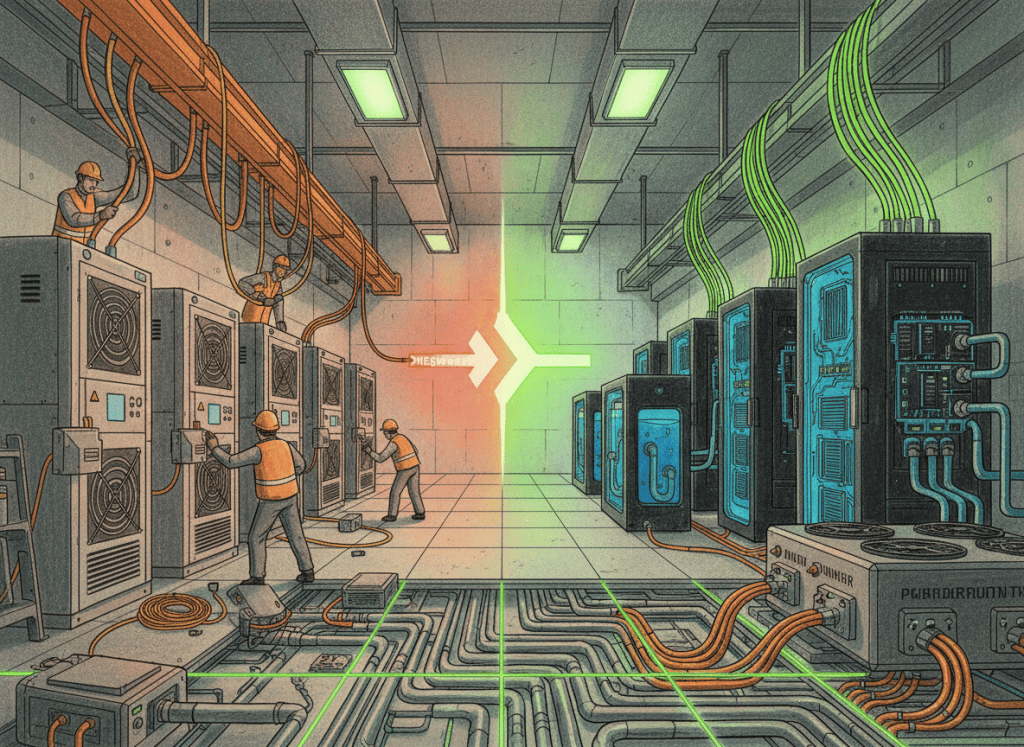
Bitcoin mining and artificial intelligence may not have to compete for every megawatt. New industry discussions tracked by CoinShares point toward a hybrid model in which AI receives priority compute capacity while Bitcoin ASICs act as a fast, flexible buyer for electricity that would otherwise sit unused.
The idea matters because the mining-to-AI transition has usually been framed as a one-way conversion. In the emerging model, both workloads can remain on the same power platform, with ASICs curtailing when higher-value AI demand rises and restarting when spare generation becomes available.
Bitcoin ASICs could become the buyer of last resort for power
Recent industry discussions summarized by CoinShares after the H.C. Wainwright Global Investment Conference describe Bitcoin mining as a potential flexible or load-balancing workload alongside AI infrastructure. ASICs can absorb excess electricity when AI utilization is lower and rapidly curtail when contracted compute requires the capacity.
That behavior is especially relevant behind the meter. A natural-gas turbine or other on-site generator can operate more consistently if mining equipment monetizes power that the AI side of a campus does not need at a particular moment.
AI still has the stronger economics per megawatt
The research firm’s Q2 mining report estimates annualized AI profit around $1.5 million per MW under the conditions it analyzed, versus approximately $500,000 per MW for Bitcoin mining. That roughly three-to-one gap explains why miners continue assigning premium powered capacity to AI and HPC.
BitcoinVersus.tech has already documented miners shifting megawatts from ASICs toward AI, Cango installing GPU compute at a mining site, and Luxor expanding into AI infrastructure. The flexible-load concept adds another architecture: keep mining available instead of removing it completely.
Powered land is becoming the scarce asset
CoinShares says the discussion has expanded beyond hyperscale conversions toward modular data centers, behind-the-meter gas generation and eventually nuclear power. Smaller sub-75 MW Texas sites are also attracting attention for inference and regional cloud workloads.
That reinforces themes in our coverage of Hut 8’s ERCOT power development, Soluna’s Bitcoin-to-AI campus expansion, CleanSpark’s AI-campus financing, and Bitdeer’s AI cloud capacity expansion.
The hybrid model is still an emerging concept
There is an important limitation. CoinShares says it has not yet seen a major commercial contract explicitly built around this shared AI-and-Bitcoin load structure. For now, the model is an emerging industry concept rather than a proven standard contract architecture.
Even so, ASICs have a technical advantage as flexible electrical loads. Mining machines can reduce consumption much faster than many industrial processes, which can make them useful for balancing variable generation and monetizing otherwise stranded capacity. The economics ultimately depend on electricity price, Bitcoin hashprice, AI utilization, contractual uptime and the capital cost of operating both compute stacks.
Bitcoin mining and AI infrastructure
The video above comes from a verified channel with more than 800,000 subscribers and specifically examines the hybrid model of AI in front and Bitcoin mining behind the primary workload.
BitcoinVersus.Tech Editor’s Note: The flexible AI-plus-mining architecture described here is an emerging model. CoinShares says it has not yet observed a major commercial contract explicitly implementing the structure.
Support independent Bitcoin, mining, ASIC and infrastructure reporting: 3C9o19EH5HSiwEPyCTmEKzxhNCbo2X6TTb
BitcoinVersus.tech is not a financial advisor. This media platform reports on financial subjects purely for informational purposes.


Leave a Reply