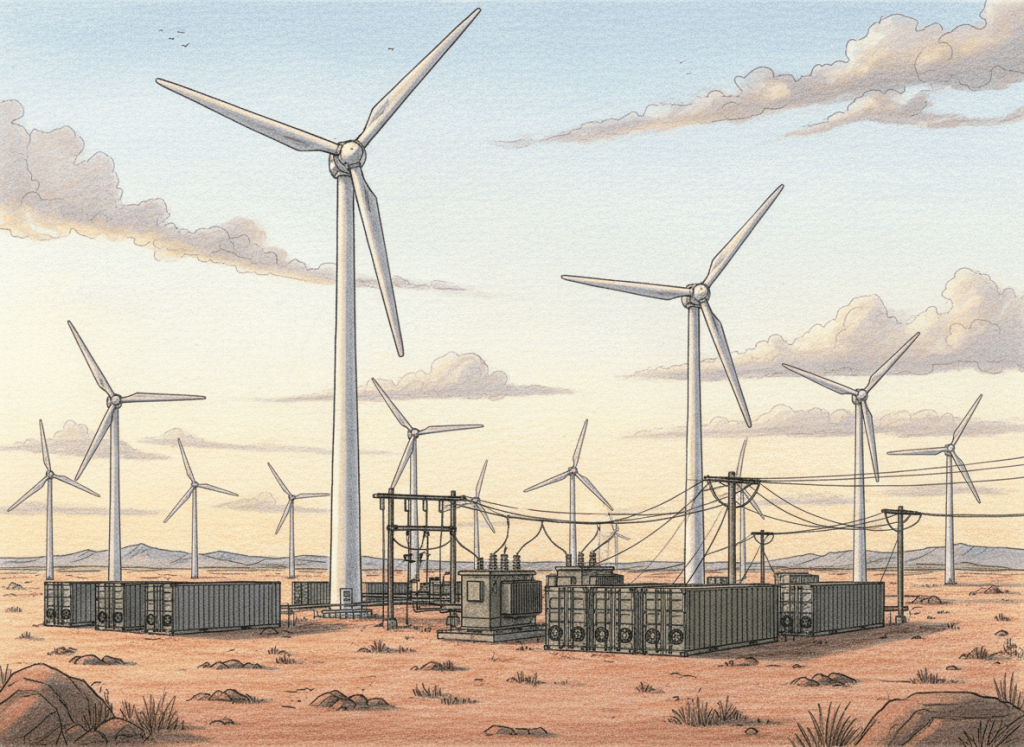
Soluna Holdings’ wind-powered Project Dorothy in Briscoe County, Texas is becoming a useful case study in how Bitcoin mining infrastructure can secure power today while creating a path toward much larger AI data-center development.
Recent industry coverage highlighted ERCOT’s conditional Base Load classification for the 100 MW Dorothy campus. Soluna says Dorothy 1 and Dorothy 2 already account for 98 MW of energized capacity, while an additional 50 MW interconnection request is under study. The company is separately developing Dorothy 3 as a planned 300 MW AI and high-performance computing expansion.
98 MW is already energized for Bitcoin infrastructure
Project Dorothy sits behind the meter at the 150 MW Briscoe Wind Farm, which Soluna acquired in April 2026. Soluna’s current project inventory identifies Dorothy 1 as a 50 MW Bitcoin hosting and mining campus and Dorothy 2 as another 48 MW of Bitcoin hosting and mining capacity.
Soluna’s project page lists more than 15,000 operational miners at Dorothy 1 and more than 13,000 at Dorothy 2 in its latest displayed site statistics. The company uses excess and curtailed wind generation as an input for compute rather than treating the data center as a conventional grid-only load.
Another 50 MW is under study
Soluna says it has submitted a load interconnection request for an additional 50 MW at Dorothy. The local transmission and distribution provider is studying that request directly. The company says the existing 100 MW campus has been conditionally classified as Base Load in ERCOT’s Batch Zero process.
The distinction matters because Texas is dealing with an enormous queue of proposed large electrical loads. Soluna cited more than 438 GW of large-load requests in ERCOT’s queue as of mid-2026, with data centers representing nearly 90% of those requests. Existing generation and behind-the-meter infrastructure can therefore become a significant development advantage.
Bitcoin mining is the bridge to a 300 MW AI campus
Soluna is not describing Dorothy 3 as another Bitcoin mine. The planned next phase is designed for AI and HPC workloads on land adjacent to the existing mining campuses and the company-owned wind farm. That makes the existing Bitcoin operation part of a broader infrastructure strategy: monetize renewable power with ASICs, establish operating data-center infrastructure, then expand the same energy campus into higher-density compute.
Across its portfolio, Soluna says it has approximately 206 MW of operating capacity and a development pipeline of roughly 6.3 GW. Its sites support both Bitcoin mining and AI infrastructure, with Project Kati in Texas providing another example of the company’s mining-to-AI development model.
Why this matters for Bitcoin mining
The important asset is increasingly more than the ASIC fleet. Land, generation, substations, transformers, interconnection rights, cooling and operating experience can determine whether a mining site can expand or support another form of compute. Project Dorothy shows how an operating Bitcoin campus can sit at the center of that transition without making Bitcoin mining itself disappear overnight.
Sources
- Soluna: Project Dorothy ERCOT update
- Soluna data-center project inventory
- Colocation Scout: Soluna’s 266 MW Texas Base Load position
BitcoinVersus.Tech Editor’s Note
BitcoinVersus.Tech reports on Bitcoin, Bitcoin mining hardware, data centers, semiconductors, energy and emerging technology. Support independent reporting with Bitcoin: 3C9o19EH5HSiwEPyCTmEKzxhNCbo2X6TTb.
Financial disclaimer: This article is for informational and educational purposes only and is not financial, investment, legal or tax advice. Bitcoin, cryptocurrency mining and publicly traded securities can be volatile. Readers should conduct their own research before making financial decisions.
Related BitcoinVersus.tech coverage: Cango mining site adds AI GPUs · Luxor mining to AI · Bitdeer Malaysia AI expansion · CleanSpark mining update


Leave a Reply