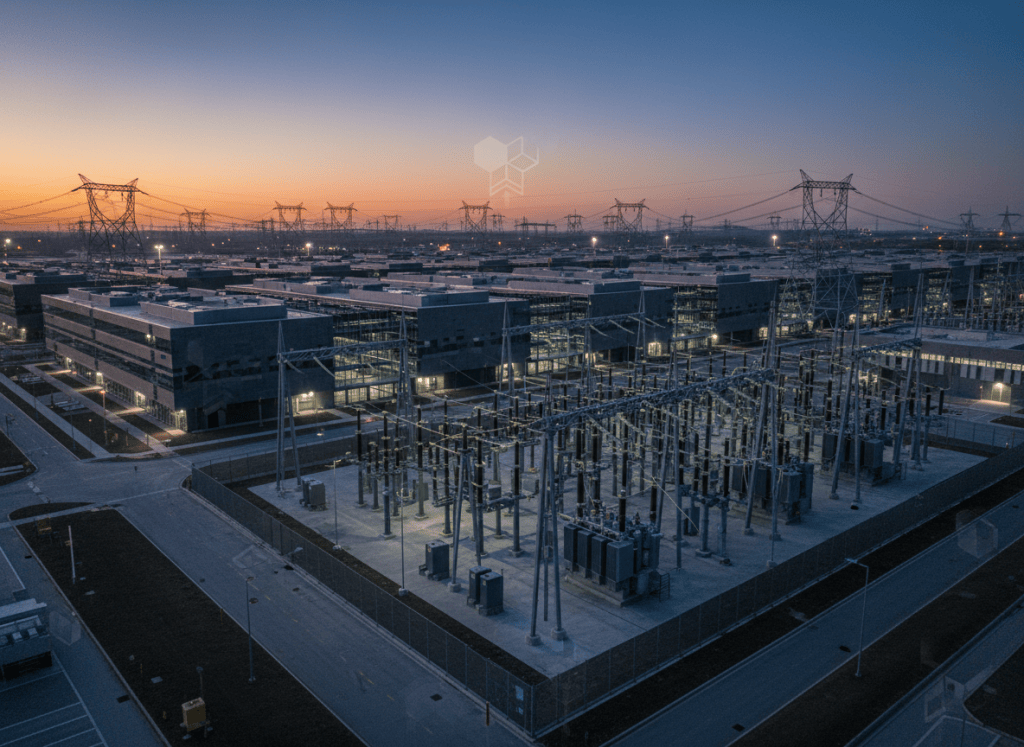
A BlackRock-backed infrastructure group and IFM Investors are reportedly in exclusive talks to acquire STACK Infrastructure’s Asia-Pacific data-center portfolio in a transaction that could value the assets at roughly $20 billion to $25 billion. The important point is not simply the headline number. It is the growing willingness of institutional capital to treat powered land, utility interconnections, cooling capacity and hyperscale data halls as strategic infrastructure rather than a niche real-estate trade.
Reuters reported that the consortium includes the BlackRock-backed Artificial Intelligence Infrastructure Partnership, or AIP, alongside IFM Investors. The details remain preliminary: the buyers are preparing due diligence, talks could still stall or collapse, and other bidders may remain interested.
The signal is infrastructure control, not just another AI valuation
STACK’s Asia-Pacific footprint includes facilities in Tokyo, Osaka, Sydney, Melbourne and Johor Bahru, Malaysia. Those are markets where the scarce inputs behind AI growth are increasingly physical: grid access, substations, fiber routes, cooling systems, construction capacity and sites that can support very high rack densities. BitcoinVersus.tech has previously examined what happens inside an AI data center, and the STACK talks show how valuable the full industrial stack surrounding compute has become.
The possible acquisition also extends a strategy BitcoinVersus.tech has followed since BlackRock and Microsoft formed a $30 billion AI infrastructure fund. AIP has since attracted institutional capital and, according to BlackRock’s own 2025 annual report, had raised more than $12.5 billion from founders and clients. Its first announced major transaction was a roughly $40 billion acquisition of Aligned Data Centers.
Why Asia-Pacific matters
Asia-Pacific is not one data-center market. Tokyo and Osaka are mature hyperscale and enterprise hubs. Sydney and Melbourne face their own power, land and permitting constraints. Johor Bahru has become a strategic extension of Singapore’s digital-infrastructure ecosystem, where developers can pursue larger campuses while remaining close to major network and cloud demand.
That makes a portfolio transaction different from buying a single operating building. The buyer is potentially acquiring a network of operating sites, development pipelines, utility positions and regional customer relationships. The value of those assets depends heavily on how much power can actually be delivered, when it can be delivered, and how quickly facilities can be converted into revenue-producing compute capacity.
This is the same reason BitcoinVersus.tech has been tracking the shift toward 800 VDC power architectures, multi-megawatt cooling systems and high-density liquid cooling. The constraint is no longer merely access to GPUs. The infrastructure around those GPUs is becoming a competitive asset of its own.
$25 billion is a valuation range, not a completed deal
The distinction matters. The reported $20 billion to $25 billion figure is a possible valuation for the portfolio, not money already spent and not a signed acquisition. Blue Owl Capital, STACK’s owner, had reportedly sought more than $30 billion earlier in the sale process. A lower potential range could reflect negotiation, financing conditions, asset mix, required future capital spending or normal price discovery.
That caution is particularly important because AI data-center debt has been getting more expensive. Large projects need not only equity but also enormous amounts of debt, utility spending and follow-on construction capital. A headline enterprise value therefore tells only part of the economic story.
AIP is building a portfolio, not making a one-off bet
BlackRock’s 2025 annual report says AIP had raised more than $12.5 billion from founders and clients. The partnership was created to finance AI infrastructure at a scale that can extend beyond individual buildings into power, campuses and supporting systems. That broader structure helps explain why STACK’s regional footprint could be strategically useful even before considering the reported purchase price.
The earlier BlackRock-backed Aligned transaction provides useful context. The earlier segment below is an English-language Bloomberg video discussing that acquisition and the infrastructure strategy behind it.
Why Bitcoin miners should pay attention
The transaction is not a Bitcoin-mining deal, but it is directly relevant to mining infrastructure. Bitcoin operators spent years learning how to secure large power blocks, build high-density compute sites, manage cooling and operate around grid constraints. Those same physical competencies now sit near the center of the AI infrastructure race. BitcoinVersus.tech has documented that convergence through Luxor’s move into AI infrastructure and Soluna’s mining-to-AI expansion.
The deeper signal is that power-secured digital infrastructure is becoming a financial asset class with transaction values measured in tens of billions of dollars. For miners, data-center developers and utilities, that raises the strategic value of interconnections, substations, fiber access and sites that can host multiple generations of compute hardware.
The market is already watching
A concise market-summary post about the reported talks can be viewed here before the X embed below.
What to watch next
The next material signal is whether due diligence produces a signed agreement and whether the final valuation remains inside the reported range. After that, the important questions will be financing, regulatory approvals, ownership structure, planned capital spending and how aggressively AIP and IFM expand the portfolio’s available power and compute capacity.
Until a definitive agreement is announced, this should be read as an advanced transaction process rather than a completed acquisition. That distinction does not reduce the importance of the story. It clarifies it: some of the world’s largest pools of capital are competing for the physical infrastructure required to run AI at scale.
BitcoinVersus.Tech Editor’s Note:
Support independent Bitcoin, mining, AI hardware and infrastructure reporting: 3C9o19EH5HSiwEPyCTmEKzxhNCbo2X6TTb
BitcoinVersus.tech is not a financial advisor. This media platform reports on financial subjects purely for informational purposes.


Leave a Reply