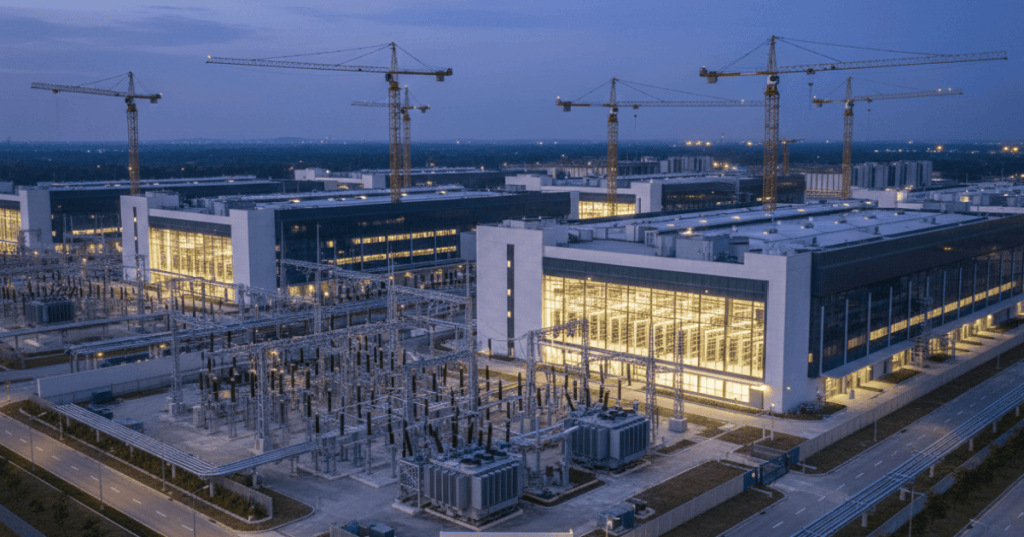
DayOne Data Centers has filed for a U.S. initial public offering after one of the fastest growth spurts in the hyperscale infrastructure sector: first-half 2026 revenue reached $512.0 million, up 238% from $151.5 million a year earlier.
Reuters reported that the Singapore-headquartered operator filed for a Nasdaq listing under the proposed symbol DODC. The filing comes as AI and cloud companies continue to demand larger blocks of power and data-center capacity across Asia-Pacific and Europe.
Revenue Is Surging, but the Business Is Still Losing Money
DayOne’s revenue growth is real, but so is the cost of scaling. Its net loss widened from $12.6 million in the first half of 2025 to $77.2 million in the first half of 2026. Cost of revenue climbed to $375.6 million as power consumption, depreciation and operating capacity all increased.
The company also spent heavily on construction. Payments and prepayments for property, equipment, land-use rights and construction-related deposits reached $3.11 billion in the first six months of 2026 alone.
That is the central tension in the filing: DayOne is growing fast enough to attract public-market attention, but the infrastructure required to support that growth demands billions of dollars before the associated revenue fully arrives.
DayOne Has 2.3 GW of Bookings
In its Form F-1 registration statement, DayOne said it had approximately 2.3 GW of bookings as of September 20, 2026. The company expects substantially all of that booked capacity to be delivered by the end of 2028.
The filing also puts a price on that promise: DayOne estimates it will cost about $11.4 billion to complete those bookings after accounting for spending already made through June 30. That figure is far larger than current annual revenue and helps explain why access to public equity markets could matter even after several large private fundraising rounds.
This kind of capital intensity is becoming normal across hyperscale development. BitcoinVersus.Tech recently covered BlackRock-backed AIP’s reported interest in a $25 billion STACK Asia transaction, another example of how data-center platforms are being valued as long-duration infrastructure rather than ordinary real estate.
Capacity Has Expanded Almost Eightfold Since 2024
DayOne reported 962 MW of capacity in service as of September 20, 2026, compared with 126 MW at the end of 2024. Capacity under construction reached another 1,328 MW, and the company said that construction pipeline was 99.3% pre-committed.
The expansion is concentrated in fast-growing regional clusters, especially Johor in Malaysia, Batam in Indonesia, Thailand, Singapore and newer European markets. The strategy resembles the wider hyperscale race BitcoinVersus.Tech has been tracking through projects such as TCS HyperVault’s planned 1 GW Hyderabad campus.
Customer Demand Is Strong, but Concentration Risk Is Real
DayOne’s customer base is small by design because hyperscale contracts are enormous. The filing says it had bookings from 15 customers as of September 20, with three hyperscale customers each using the platform across multiple markets for roughly 200 MW or more.
That creates attractive long-term contracted revenue but also concentration risk. The company disclosed that one customer generated about $354.2 million of first-half 2026 revenue, while another generated roughly $77.3 million.
Large hyperscalers can accelerate a platform quickly, but losing or delaying even one major deployment can materially affect utilization, cash flow and construction timing. BitcoinVersus.Tech has seen the same scale dynamic in Anthropic’s move into a planned 2.16 GW Australian AI campus, where individual anchor customers can reshape an entire regional buildout.
The IPO Is Really About Financing the Next 1.3 GW
DayOne’s biggest challenge is no longer proving that customers want the capacity. The company already has more capacity under construction than in service, and most of that construction has already been pre-committed.
The harder question is how efficiently it can finance and deliver that capacity while interest expense, depreciation, power costs and construction commitments keep rising. The filing shows $4.94 billion of unconditional purchase commitments related to data-center development as of June 30, on top of the broader $11.4 billion estimated cost to complete booked projects.
The Bigger Point
DayOne’s IPO filing is a useful snapshot of the AI infrastructure boom from the operator’s side. Revenue can triple quickly when new megawatts come online, but the capital has to be committed long before those buildings begin producing revenue.
That makes the proposed Nasdaq listing less about celebrating $512 million of six-month revenue and more about funding the gap between today’s operating footprint and tomorrow’s 2.3 GW contracted platform. DayOne has already proved it can win hyperscale demand. Public investors will have to decide whether its buildout economics can keep pace with that demand.
BitcoinVersus.Tech
Advertisement
Editor’s Note
DayOne’s IPO price range and final offering size were not included in the initial filing reviewed for this story. Capacity, revenue, loss and construction figures above are taken from the company’s filed registration statement unless otherwise attributed.
We volunteer daily to help ensure the credibility of the information on this platform is Verifiably True. If you would like to support our research initiatives, please donate here: 3C9o19EH5HSiwEPyCTmEKzxhNCbo2X6TTb
BitcoinVersus.tech is not a financial advisor. Content is provided for informational purposes.


Leave a Reply