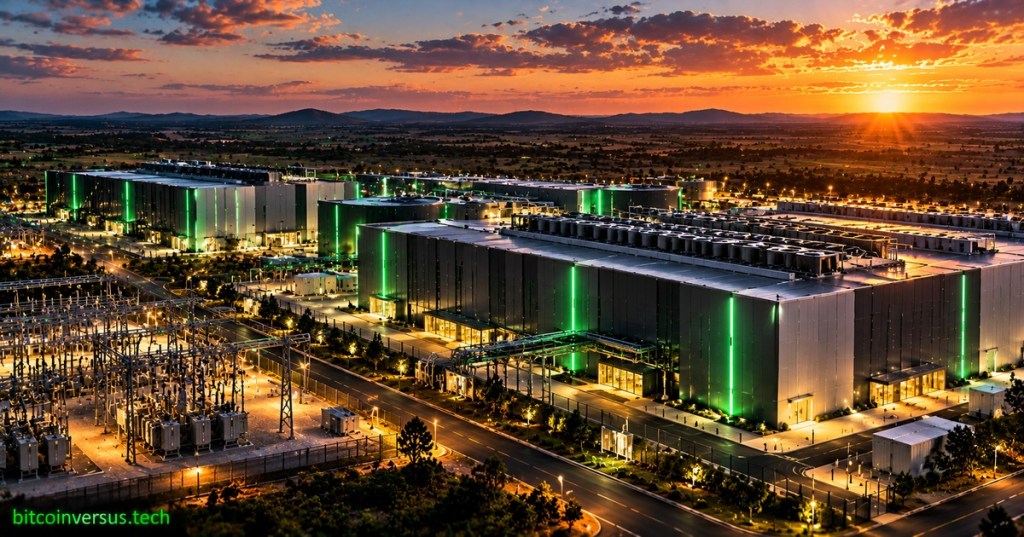
Anthropic has signed its first Australian data-center lease, taking capacity at the planned Western Downs Digital Park in Queensland as AI companies push inference infrastructure closer to major regional user bases. The proposed campus is designed to reach 2.16 GW of total power capacity, putting it in the same scale class as the largest AI infrastructure projects now being planned worldwide.
Reuters reported that Anthropic’s agreement is tied to a Zerra DC campus roughly 250 kilometers from Brisbane, with initial operations targeted for 2027. The project is expected to support Claude inference workloads rather than model training, which means the facility would primarily serve live user requests and production AI applications.
The Australian Financial Review highlighted the lease on X as part of the accelerating competition for large blocks of AI-ready power and data-center capacity in Australia.
Why 2.16 GW is a different class of data center
A 2.16 GW campus is not simply a larger version of a conventional enterprise data center. At full buildout, its electrical demand would be measured on the scale of major generation assets, requiring transmission capacity, substations, backup systems, long-term energy contracts and staged construction that can take years to complete.
That scale helps explain why AI data-center development is increasingly being planned beside power infrastructure rather than around traditional office or telecom geography. BitcoinVersus recently covered JERA, Dell and RHAELM placing a 400 MW AI campus beside a Japanese power plant, a smaller project that follows the same power-first logic.
Inference, not training, changes the operating profile
The Western Downs capacity is expected to support inference rather than training. Training tends to arrive in very large scheduled compute runs, while inference follows customer demand continuously: prompts, API calls, agent workloads and enterprise applications can rise and fall through the day as users interact with deployed models.
That makes utilization, latency and geographic proximity increasingly important. A regional inference site can reduce dependence on distant facilities while giving the operator more options for routing production workloads across multiple geographic zones.
The grid connection is as important as the servers
The project sits in a region already shaped by large energy infrastructure, including dispatchable generation and high-voltage transmission. That does not make a 2.16 GW load trivial, but it explains why developers are looking outside the largest coastal cities for sites where power, land and transmission corridors can be assembled at campus scale.
This power question is becoming central to AI infrastructure globally. Google, NVIDIA and Emerald AI are separately pushing flexible data-center demand as a way to fit more compute onto constrained grids, showing that power availability is now shaping both where AI campuses are built and how they operate.
Cooling and water use are part of the approval story
The proposed Western Downs design is expected to emphasize closed-loop and air-cooled systems rather than large evaporative cooling towers. That matters in regional Australia because water use can become as politically important as electricity demand when a project reaches hyperscale proportions.
ABC News reported that the project still faces regulatory and local approval steps and that Anthropic’s agreement is tied to only part of the broader proposed campus. The distinction matters: a lease agreement can establish a major anchor tenant without guaranteeing that every stage of a multiyear campus will be built on the original schedule.
AI infrastructure is moving from racks to regions
The scale of current AI systems means data-center planning is no longer only about rack density. Developers increasingly have to coordinate utility-scale power, fiber routes, cooling systems, land, planning approvals, backup generation and long-duration construction schedules before a GPU cluster can serve a single production request.
That operational constraint is visible even inside existing facilities. Lambda’s work fitting 19 Blackwell nodes into a 16-node power budget shows the same problem at rack scale: every additional unit of compute has to fit inside a physical envelope defined by power and heat.
Anthropic’s first Australian lease therefore matters less because it adds another pin to a data-center map and more because it shows where the AI buildout is heading. The next generation of inference capacity is being designed as regional infrastructure, with power systems and planning approvals becoming as strategic as the accelerators themselves.
BitcoinVersus.Tech
Advertisement
Editor’s Note:
We volunteer daily to ensure the credibility of the information on this platform is Verifiably True. If you would like to support our research initiatives, please donate here: 3C9o19EH5HSiwEPyCTmEKzxhNCbo2X6TTb
BitcoinVersus.tech is not a financial advisor. This media platform reports on financial subjects purely for informational purposes.


Leave a Reply