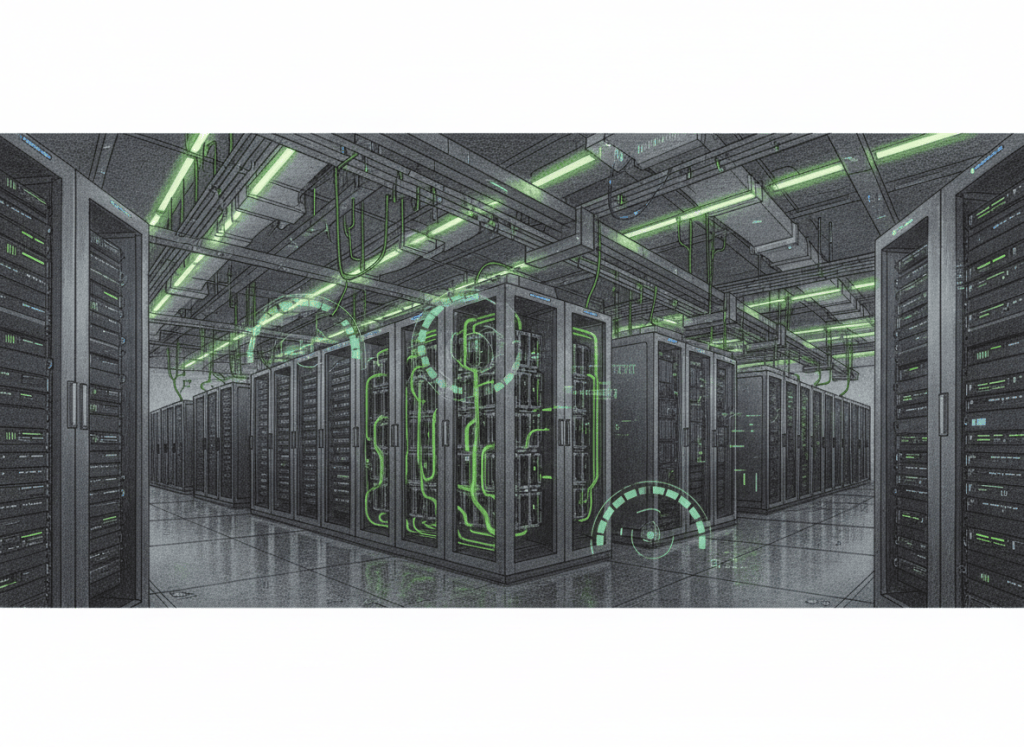
Lambda has demonstrated a different way to expand AI-compute capacity when new megawatts are hard to obtain: use software and facility telemetry to run more GPU nodes inside the power budget already available.
In NVIDIA’s Lambda case study, the cloud provider tested DSX MaxLPS on NVIDIA HGX B200 systems and operated 19 nodes inside the aggregate power envelope normally assigned to 16. NVIDIA reports the configuration increased cluster-wide token throughput by 24% while improving performance per watt by 23%.
The result matters because data-center power is increasingly a deployment constraint rather than a background utility. A facility may have floor space, racks and customer demand while still being unable to add more accelerators because the electrical service, transformers or utility allocation are already at their practical limit.
The stranded-power problem becomes usable GPU capacity
Traditional capacity planning leaves headroom between a facility’s theoretical maximum and the amount of critical compute operators are comfortable running continuously. That buffer protects against load spikes, infrastructure losses and equipment behavior that can change from workload to workload.
The Register’s analysis of the DSX demonstration notes that the approach depends on better communication between computing systems and the physical data-center stack, including power and cooling equipment. The attraction is straightforward: if operators have a more accurate view of real-time demand, they can use capacity that would otherwise remain stranded.
NVIDIA framed that objective earlier in its official DSX MaxLPS post on X, saying the platform could increase GPU capacity inside a fixed power budget by coordinating power allocation, performance-per-watt techniques and thermal design.
More tokens from the same electrical envelope
Lambda’s proof of concept is notable because the gain came from cluster utilization rather than a new generation of GPU silicon. The 19-node configuration added three nodes to the same aggregate power budget, turning facility-level efficiency into additional inference output.
That changes how AI-factory efficiency can be measured. BitcoinVersus.Tech recently covered Trane’s 250 MW zero-water cooling design for NVIDIA AI factories, where cooling architecture determines how much dense compute a site can support. DSX MaxLPS attacks the same constraint from the power-management side.
The urgency is visible at grid scale. BitcoinVersus.Tech also reported on the projected U.S. data-center power shortfall, a gap that makes every recovered megawatt increasingly valuable to operators trying to bring AI capacity online before new generation and transmission can be built.
AI factories are becoming grid-aware machines
The broader DSX strategy extends beyond fitting more compute into an existing limit. NVIDIA is also pushing data-center systems toward closer coordination with utilities, so noncritical workloads can respond to periods of grid stress while high-priority work continues.
That direction mirrors the infrastructure model BitcoinVersus.Tech examined in Crusoe’s proposal for AI data centers to operate as grid assets. In both cases, the data center is no longer treated as a static electrical load. Compute scheduling, cooling, power delivery and grid conditions become parts of one operating system.
There is still an important limit to the claim. Lambda’s result is a proof of concept on a specific HGX B200 deployment, not evidence that every facility can gain exactly 24% more throughput. Workload shape, cooling architecture, electrical topology and operational headroom will determine how much capacity can actually be recovered at another site.
But the engineering direction is clear: when new megawatts are slow to arrive, the next AI-capacity upgrade may come from extracting more useful compute from the megawatts a data center already has.
BitcoinVersus.Tech
Advertisement
BitcoinVersus.Tech Editor’s Note:
We volunteer daily to ensure the credibility of the information on this platform is Verifiably True. If you would like to support to help further secure the integrity of our research initiatives, please donate here: 3C9o19EH5HSiwEPyCTmEKzxhNCbo2X6TTb
BitcoinVersus.tech is not a financial advisor. This media platform reports on financial subjects purely for informational purposes.


Leave a Reply