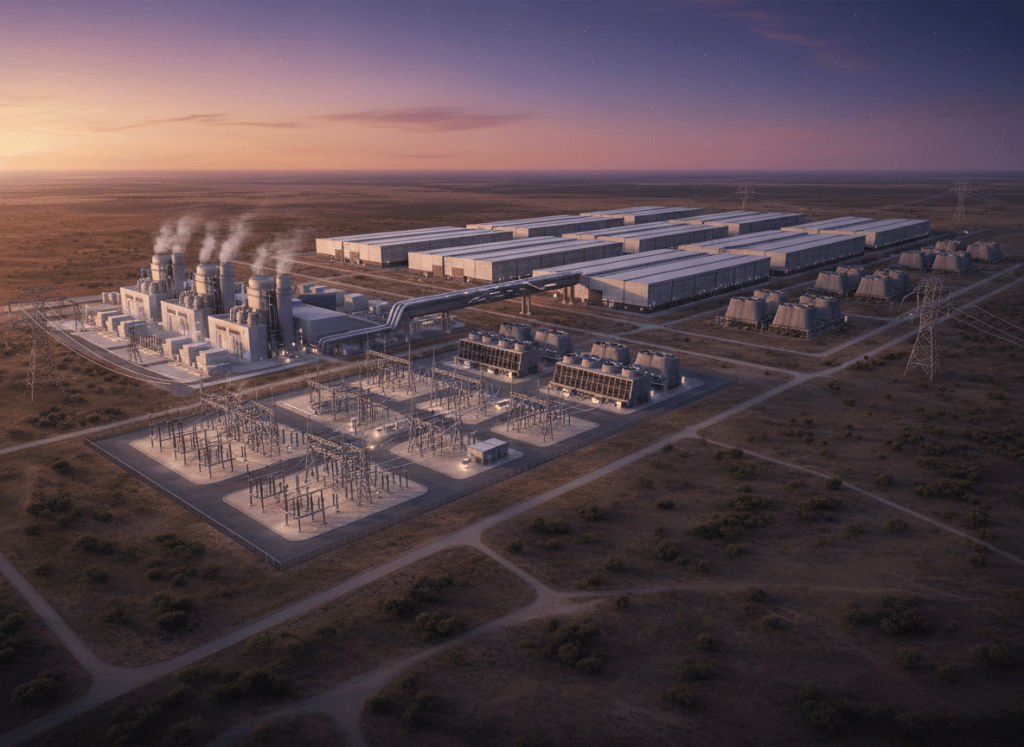
Texas is getting a new version of the “bring your own power” data-center model at enormous scale: 6.47 GW of planned gas generation beside a privately funded 5 GW digital infrastructure campus.
Project Star, announced September 30 for Encinal in South Texas, is a planned ₿258,594 ($22.3 billion) energy infrastructure campus being developed by Related Companies and NextEra Energy Resources with Lewis Energy Group. The Republic of Korea and the U.S. Department of Commerce selected the project as part of a strategic investment program.
6.47 GW of generation is being built around a 5 GW data-center load
According to the primary Project Star announcement, the energy campus is designed for 6.47 GW of natural-gas generation. That power is intended to directly support an adjacent 5 GW data-center campus being developed by Related Digital, while generation above the data center’s requirements can be delivered back to the grid.
This is not simply a utility adding another power plant and hoping new load appears later. The generation and compute campuses are being planned together around a known class of customer: hyperscale digital infrastructure.
The project formalizes the “data centers bring their own generation” model
The developers explicitly position Project Star as consistent with Texas policy pressure for very large data centers to add generation rather than rely entirely on existing ERCOT capacity. Related Digital says the neighboring compute campus will be privately funded, while the power project is designed to add new generation for the new load and still contribute excess electricity to the wider system.
An official administration video post on X highlighted the Encinal project during the broader U.S.–Korea energy announcement.
NextEra, Related and Lewis split the stack
NextEra Energy Resources and Related Companies plan to develop, build and operate the generation. Lewis Energy Group is expected to provide the site and associated infrastructure, including natural-gas supply and produced water. Related Digital is developing the neighboring data-center campus.
That division of labor matters because AI infrastructure is increasingly becoming a vertically coordinated industrial project. Land, fuel, water, generation, electrical infrastructure, cooling and compute deployment all have to arrive on compatible schedules.
First power is targeted for 2029, with full operation planned later
Reuters reported that the Encinal project is one of the major energy investments included in the U.S.–Korea package. The primary project materials say initial generating resources could begin operating as early as 2029, subject to permitting and approvals, while Korean government materials target full operation in 2032.
Those dates are important. Project Star is an announced development project, not 6.47 GW of generation already available today. The engineering, permitting, fuel, water, transmission and data-center construction work still has to be executed.
A 5 GW compute campus changes the scale of data-center engineering
A 5 GW campus is no longer well described as a collection of server buildings. It behaves more like a new industrial district whose electrical system happens to terminate in compute. Substations, generation, cooling, water systems, network connectivity and fuel infrastructure become first-order design constraints.
BitcoinVersus.Tech recently examined Schneider, Wärtsilä and Stanley building a generator-to-chip power path for AI, Trane’s 3.5 MW 800V DC chiller architecture for dense AI facilities, and HPE’s rack-scale AMD Helios order for Vultr. Project Star connects all three layers: generation, facility infrastructure and compute demand.
Excess generation is the part ERCOT will watch
The project’s most consequential grid claim may be that generation above the data center’s requirements can flow back into ERCOT. If the campus actually adds more dispatchable capacity than its own load requires at a given moment, the architecture could differ materially from a large data center that simply arrives as a new multi-gigawatt demand block.
That benefit will depend on the final electrical design, operating agreements, generation availability and how much capacity remains after the adjacent compute load is served. The announced capacity numbers establish the intended architecture, not guaranteed future grid exports.
AI is turning power development into part of the compute stack
Project Star is another signal that hyperscale AI can no longer treat electricity as an external utility problem. When compute campuses are measured in gigawatts, developers increasingly have to secure generation, fuel and electrical infrastructure at the same time they secure racks and accelerators.
The competitive advantage may therefore shift toward sites where power development and data-center development can move as one project. Encinal is an unusually large test of that thesis.
BitcoinVersus.Tech
Advertisement
Editor’s Note
We volunteer daily to ensure the credibility of the information on this platform is Verifiably True. If you would like to support to help further secure the integrity of our research initiatives, please donate here: 3C9o19EH5HSiwEPyCTmEKzxhNCbo2X6TTb
BitcoinVersus.tech is not a financial advisor. This media platform reports on financial subjects purely for informational purposes.


Leave a Reply