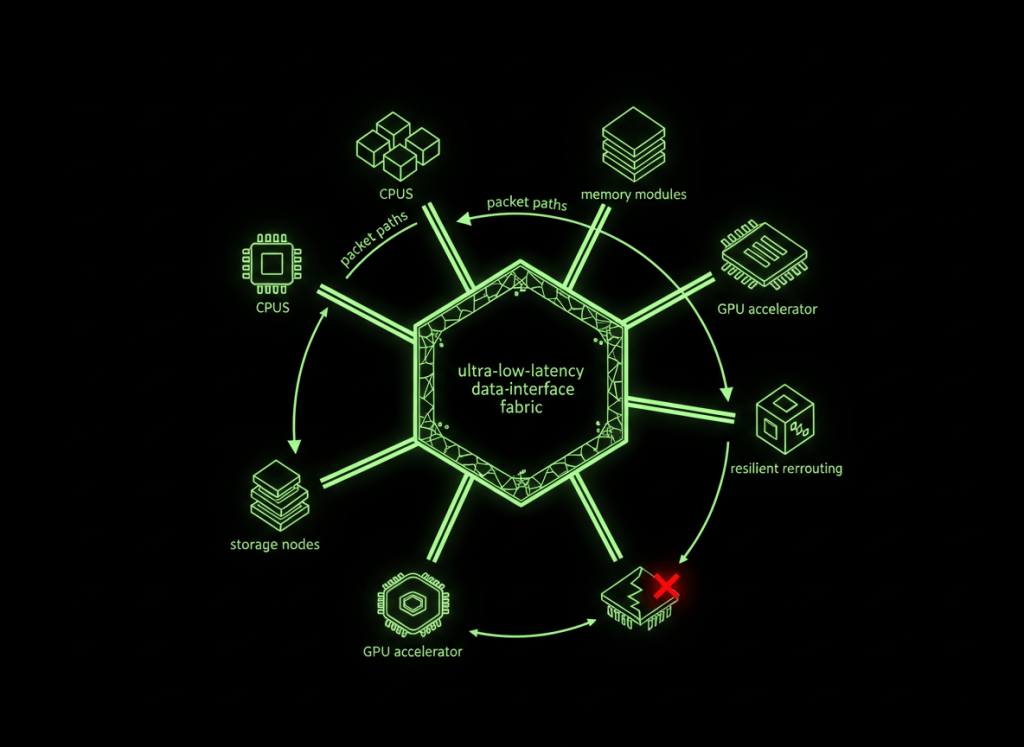
Delos Data is making a contrarian bet on AI infrastructure: the next major bottleneck may not be the accelerator. It may be the network trying to keep all of the accelerators, CPUs, memory and storage fed at once.
The Palo Alto startup, founded by Intel veterans, announced more than ₿1,159.61 ($100 million) in funding on September 15 to expand a networking architecture built for heterogeneous AI inference systems rather than racks dominated by one accelerator vendor.
Delos says the network is becoming the AI chokepoint
In its September 15 funding announcement, Delos said Matrix, Playground, Socratic Partners, Capricorn’s Technology Impact Fund, Matter Venture Partners and IAG participated in the financing. Former Intel CEO Pat Gelsinger is also among the investors backing the company.
The thesis is built around the changing shape of inference. Instead of one uniform cluster doing one job, agentic workloads can remain active for long periods while pulling from GPUs, XPUs, CPUs, memory and storage made by different vendors. Delos argues that those systems increasingly spend expensive compute cycles waiting for data movement and recovering from failures.
Delos summarized the pitch in its funding and product announcement on X: the network is the next chokepoint, and the company is targeting dramatically lower latency and higher efficiency with a new data-interface layer.
One data interface, three form factors
Delos’s Nonstop AI Data Interface is planned in three forms: an I/O chiplet rated above 30 Tbps for GPUs, XPUs and accelerators; a near-packaged-optics version rated above 10 Tbps; and a card form rated above 400 Gbps for CPUs, flash and memory endpoints.
The design sits between each endpoint and the network. That position is supposed to let the interface detect failures quickly and recover in hardware when an accelerator dies, a link breaks or a software update interrupts part of the system.
The 10× claims are targets, not independent benchmarks
Delos says its interface can deliver 10× lower latency, 10× stronger resiliency and 10× higher scale than what endpoints can achieve today. Those figures are company-reported targets. Public materials do not yet provide independent third-party benchmark results or a named production customer validating those claims at large scale.
That distinction matters because networking claims often depend heavily on topology, workload, failure behavior, endpoint mix and how performance is measured. The more important near-term question is whether Delos can demonstrate consistent gains when the system is under the messy conditions of real agentic inference rather than a controlled lab configuration.
Reuters says the startup is betting against vendor lock-in
Reuters reported that Delos was founded by veterans of Intel and is targeting a market that is becoming more heterogeneous as AMD, Cerebras and other accelerator vendors gain traction alongside NVIDIA. The startup’s strategy is to make data movement work across that mixture rather than optimize only for one vendor’s stack.
That puts Delos in the same strategic fight now reshaping AI infrastructure: compute is still critical, but more of the performance battle is moving into memory, networking and optical interconnects.
The network becomes more valuable when expensive chips sit idle
The economics are straightforward. An accelerator that is waiting for data is still consuming capital. If a networking layer can keep more endpoints busy, recover from failures without stalling the workload and let operators mix hardware more freely, it can increase the useful output of infrastructure already purchased.
That is why the Delos thesis pairs naturally with BitcoinVersus.Tech’s recent coverage of HPE landing a ₿13,915.32 ($1.2 billion) Vultr order for AMD Helios AI racks, Volantis raising ₿1,020.46 ($88 million) to move AI memory traffic with light, and Mixture-of-Kittens extracting more throughput from 512 GPUs through software-level communication and synchronization changes.
Agentic inference could turn networking into the scarce resource
Training clusters are large, but they are comparatively structured. Agentic inference can be more chaotic: long-running workflows, tool calls, memory retrieval, multiple models and persistent sessions all compete for data movement while hardware failures become statistically routine at scale.
If that workload mix grows the way Delos expects, the winners may not be determined only by who builds the fastest accelerator. The companies that keep a heterogeneous fleet of accelerators, memory and storage continuously useful could capture an increasingly important layer of the AI stack.
BitcoinVersus.Tech
Advertisement
Editor’s Note
We volunteer daily to ensure the credibility of the information on this platform is Verifiably True. If you would like to support to help further secure the integrity of our research initiatives, please donate here: 3C9o19EH5HSiwEPyCTmEKzxhNCbo2X6TTb
BitcoinVersus.tech is not a financial advisor. This media platform reports on financial subjects purely for informational purposes.


Leave a Reply