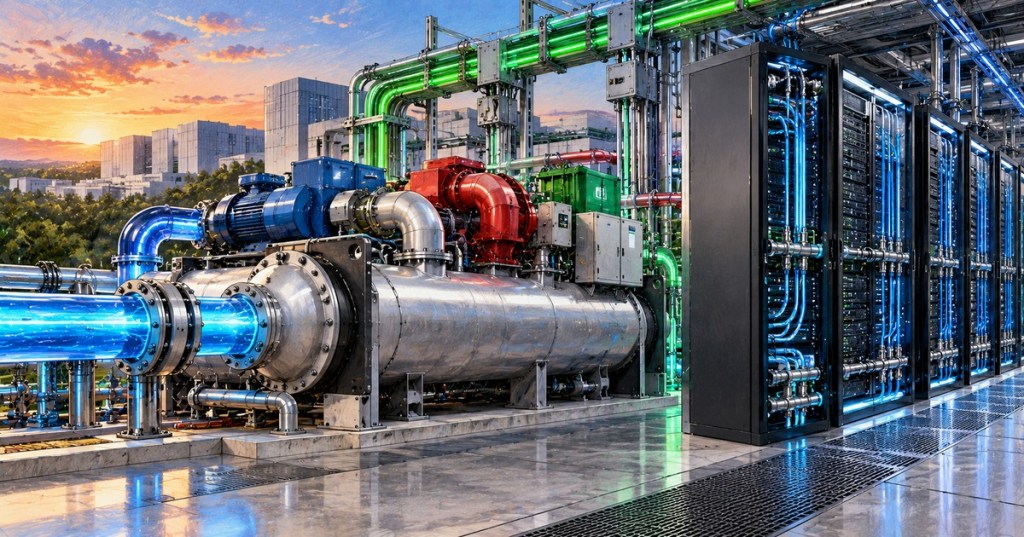
AI data centers are pushing power and cooling systems into territory where even small conversion losses matter. Trane Technologies says it has now demonstrated an 800-volt direct-current chiller architecture designed to remove some of those losses before electricity ever reaches the compute racks.
In a laboratory demonstration, Trane Technologies worked with Eaton and Danfoss to modify a high-efficiency chiller for an 800 VDC feed. The proof-of-concept delivered more than 1,000 tons, or 3.5 MW, of cooling capacity while showing potential for up to a 2% system-efficiency improvement over a conventional AC configuration.
The idea is straightforward: conventional cooling plants repeatedly convert electrical power before it reaches compressor drives, pumps and fans. Feeding the mechanical cooling system directly with high-voltage DC can eliminate conversion stages and their associated losses. That makes the demonstration particularly relevant as the industry moves toward the same 800 VDC architecture increasingly discussed for high-density AI racks.
Independent coverage of the test confirmed the 3.5 MW capacity and the company’s stated efficiency target. Trane estimates that, in a representative 200 MW data center, the potential gain could free as much as 1.8 MW for additional computing rather than facility overhead.
The demonstration extends a cooling push already visible across the sector. BitcoinVersus.Tech recently covered Trane’s 250 MW zero-water cooling design for NVIDIA AI factories, while UL’s new direct-to-chip cooling certification shows how quickly liquid-cooling infrastructure is becoming standardized.
A story-specific X post highlighted the 800-volt chiller demonstration as the announcement circulated Wednesday.
For additional context on the same 800 VDC transition, Delta and NVIDIA explain how high-voltage direct-current distribution can reduce repeated power-conversion stages while supporting denser AI infrastructure.
Cooling Becomes Part of the Power Architecture
The important change is not simply a larger chiller. Power distribution and thermal management are beginning to merge into one system-design problem. Trane, Eaton and Danfoss are testing whether the cooling plant itself can participate in a DC-native facility instead of remaining an AC island beside increasingly DC-oriented compute infrastructure.
That shift matters as rack designs grow more power dense. The new demonstration sits alongside systems such as HPE’s AMD Helios deployment for Vultr, where rack-scale accelerators, networking and liquid cooling increasingly have to be engineered as one platform.
Trane describes the 800 VDC system as a proof-of-concept rather than a commercial deployment. The claimed efficiency improvement therefore should not be read as a guaranteed field result. What has been demonstrated is that a large chiller can operate from the emerging high-voltage DC architecture while delivering multi-megawatt cooling capacity.
Editor’s Note
BitcoinVersus.Tech reports on computing infrastructure, semiconductors, AI hardware, energy systems and Bitcoin mining. Product performance claims in this article are attributed to the manufacturer and should be evaluated against independent field data as deployments mature.
If our reporting helps you, you can support BitcoinVersus.Tech with a Bitcoin donation: 3C9o19EH5HSiwEPyCTmEKzxhNCbo2X6TTb
BitcoinVersus.tech is not a financial advisor. This media platform reports on financial subjects purely for informational purposes.


Leave a Reply