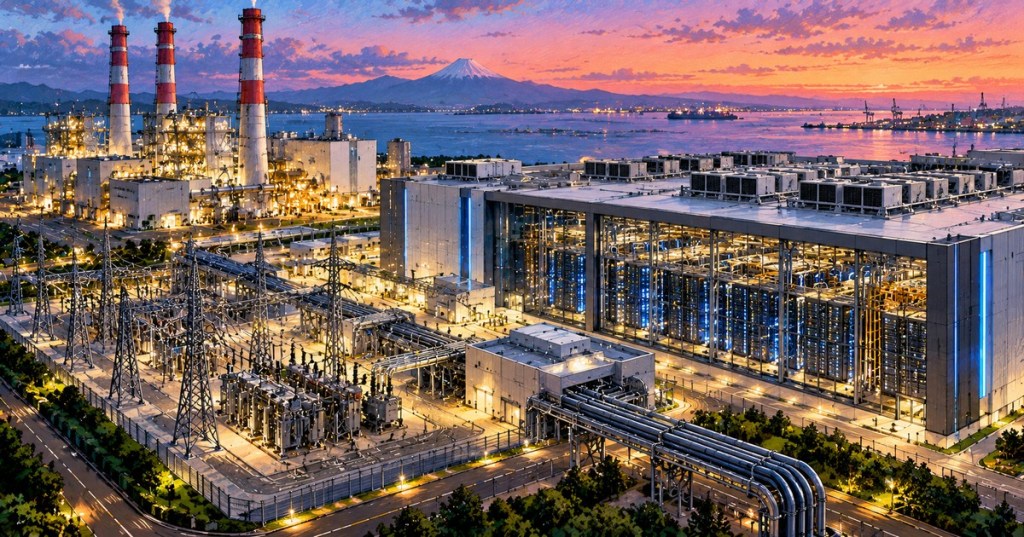
Japan’s AI infrastructure race is moving directly beside the power plant. JERA, Dell Technologies and RHAELM have signed a memorandum of understanding built around a planned AI data center in Chiba with up to 400 megawatts of power capacity and expected capital deployment exceeding $15 billion.
According to JERA’s announcement, the project is being developed at the Chiba Thermal Power Station and is designed to sit behind the meter from JERA’s operating generation asset. That architecture is meant to shorten the path between electricity generation and AI compute rather than waiting for the full timetable of a conventional grid-connected development.
The physical scale matters. JERA says the Chiba project could become Japan’s largest single-site AI infrastructure deployment and one of Asia’s largest. RHAELM is leading project delivery, Dell is supplying standardized rack-scale AI infrastructure through the Dell AI Factory, and Apollo Global Management intends to participate as a strategic investment and financing partner for RHAELM.
The project has also begun circulating across infrastructure-focused social media. WOLF Financial highlighted the Chiba build, including its planned 400 MW scale, Dell compute layer and dedicated JERA power.
Power Becomes Part of the AI Stack
The Chiba plan is another example of data-center engineering moving beyond the server rack. BitcoinVersus.Tech recently examined how 800-volt DC cooling can reclaim electrical capacity for compute, while a separate project showed how rack-scale AI systems are becoming enormous infrastructure purchases. Chiba combines that compute layer with the energy source itself.
Dell’s AI Factory is the compute standard named in the project. This Dell Technologies video explains how rack-scale AI infrastructure integrates compute, networking, power and cooling as a single engineered system—the same kind of standardized deployment model the Chiba partnership intends to repeat at large scale.
Reuters reported that phased operation is targeted for 2028, with the full 400 MW capacity expected in 2029. JERA is expected to supply that capacity under a long-term power arrangement while Dell supplies rack-scale AI infrastructure.
JERA says it already produces roughly one-third of Japan’s electricity and operates across LNG procurement, shipping, import infrastructure and generation. Its proposal is effectively to turn that existing energy footprint into an AI-development advantage: locate compute next to dependable generation, standardize the electrical and compute architecture, then reproduce the model elsewhere.
That approach also connects with the broader pressure BitcoinVersus.Tech has tracked around AI companies securing enormous blocks of overseas compute capacity. The limiting resource is increasingly not only the accelerator. It is the complete chain of land, generation, electrical distribution, cooling, networking and rack-scale hardware required to keep accelerators running.
For Chiba, the most consequential feature may therefore be the least glamorous: proximity to power. If the behind-the-meter model performs as planned, the project could become a template for putting future AI factories where large-scale generation already exists instead of forcing every new cluster to wait on the conventional grid-development cycle.
Editor’s Note
BitcoinVersus.Tech follows the infrastructure beneath AI, Bitcoin mining, semiconductors and high-density computing. Independent technical reporting takes time and resources. Readers who want to support the work can donate Bitcoin to:
3C9o19EH5HSiwEPyCTmEKzxhNCbo2X6TTb
BitcoinVersus.tech is not a financial advisor. This media platform reports on financial subjects purely for informational purposes.


Leave a Reply