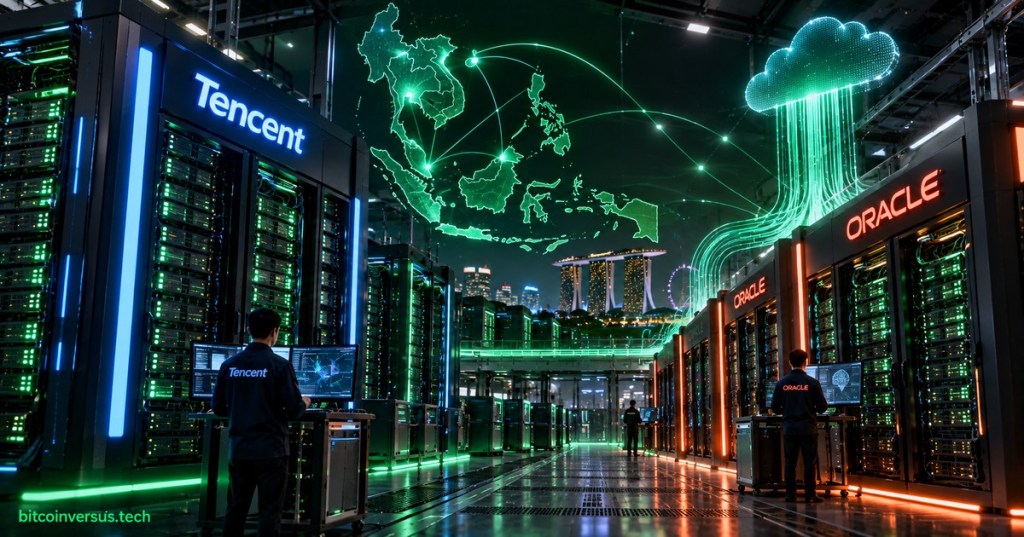
Tencent has reportedly signed its largest overseas computing lease yet, securing access to roughly 100,000 advanced AI chips through Oracle data centers in Southeast Asia as the Chinese technology group accelerates spending on artificial intelligence infrastructure.
According to people familiar with the agreement, the five-year Oracle lease is estimated at about $7 billion and includes an upfront payment of roughly 30%. The arrangement gives Tencent access to advanced processors outside mainland China while it expands training capacity for Hunyuan models and agentic AI products.
The scale is notable even against the wider AI infrastructure boom. Oracle has already emerged as a major intermediary between chip suppliers, data-center developers and frontier-model companies, a role illustrated by its involvement in large NVIDIA-backed AI data-center projects.
The Financial Times report on X points to a broader shift in how constrained AI compute is acquired. Instead of waiting for every accelerator to be installed inside a domestic facility, a technology company can lease large blocks of already deployed capacity abroad and consume the hardware as infrastructure.
AI Compute Crosses Borders
The reported deal also lands against an unusually complicated chip-supply backdrop. In August, Reuters reported that Tencent and ByteDance had each received about 10,000 NVIDIA H200 processors in mainland China, while Chinese regulators were directing much of their larger approved allocations toward Hong Kong.
That context helps explain why overseas data centers matter. Restrictions on high-end accelerators have made geography part of AI infrastructure design. A company may need to optimize not only model architecture, networking and power, but also where compute physically resides and under which export rules it can be accessed. BitcoinVersus.Tech has tracked the same pressure through the evolving restrictions on NVIDIA AI chips for China.
Tencent Is Spending for Scale
The reported Oracle lease comes as Tencent sharply increases infrastructure investment. The Financial Times said second-quarter capital expenditure climbed 176% year over year to Rmb53 billion, or about $7.9 billion, as the company paid for AI infrastructure and computing resources.
For Oracle, a contract of this scale would reinforce its position as a supplier of enormous AI compute blocks rather than simply conventional enterprise cloud capacity. The company is already participating in data-center deployments built around hundreds of thousands of accelerators, including the broader infrastructure buildout represented by NVIDIA and OpenAI’s UAE data-center plans.
For Tencent, 100,000 advanced processors could translate into a substantial expansion of training and inference capacity for Hunyuan, WeChat’s emerging AI agents and enterprise products such as WorkBuddy. More importantly, the arrangement shows how the AI hardware race is becoming a race for access to complete data-center systems: chips, power, networking, cooling and regulatory geography bundled together.
BitcoinVersus.Tech
Advertisement
Editor’s Note
BitcoinVersus.Tech covers Bitcoin, AI hardware, semiconductors, data centers, energy systems and the infrastructure connecting them.
If our reporting is useful, you can support independent BitcoinVersus.Tech coverage with a Bitcoin donation: 3C9o19EH5HSiwEPyCTmEKzxhNCbo2X6TTb
BitcoinVersus.tech is not a financial advisor. This media platform reports on financial subjects purely for informational purposes.


Leave a Reply