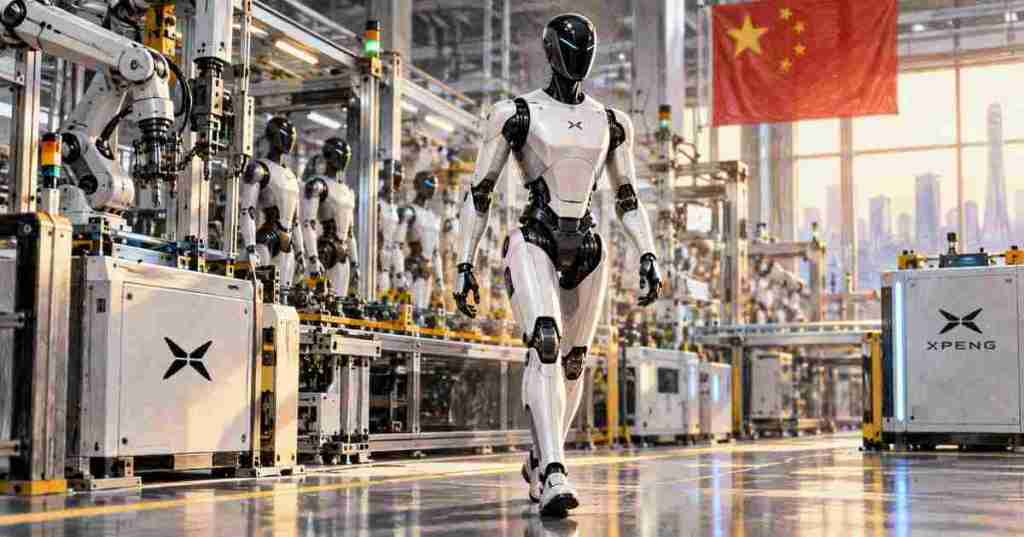
XPENG has crossed a line that humanoid robotics companies talk about constantly but rarely demonstrate: moving from prototype theater into a dedicated manufacturing process. On September 8, the company commissioned production lines for its IRON humanoid robot, and the first finished unit autonomously walked off the line under its own power.
XPENG said in its production announcement that more than 80% of the line’s core processes are automated. The company describes the facility as a bridge from R&D prototyping to manufacturing at scale, with mass production targeted by the end of 2026 and commercial launches and deliveries planned for 2027.
Chairman and CEO He Xiaopeng framed the milestone more personally in a September 9 post, saying the robot production line was officially running and that XPENG had entered a new chapter.
The Factory Is the Story
IRON itself is not new. XPENG unveiled the latest generation in 2025, and humanoid demonstrations are now common across the industry. What changed in September is the manufacturing infrastructure around it. A robot that can walk across a stage is one thing. A line that can repeatedly assemble, test and release finished robots is a different engineering problem.
That distinction matters because humanoid robotics is increasingly becoming a manufacturing race. BitcoinVersus.Tech recently covered Agility Robotics’ Digit 5, another attempt to turn humanoids into repeatable industrial products instead of one-off research machines.
Independent reporting says the line uses automotive-grade quality systems and was designed for rapid capacity expansion. CnEVPost also reports that IRON has 76 degrees of freedom, 21 in each hand, and three in-house Turing AI chips delivering up to 2,250 TOPS of effective compute.
More Than 80% Automation Changes the Economics
The line’s automation level may be more consequential than the robot’s first autonomous walk. Human-like machines are mechanically complex, with large numbers of joints, actuators, sensors, wiring paths and calibration steps. If XPENG can automate most of those core operations, the company can attack consistency and throughput at the same time.
The scale challenge is visible across the broader robotics market. BitcoinVersus.Tech recently reported that more than five million industrial robots are already operating in factories. Humanoids now have to prove they can be manufactured with something approaching the same discipline.
XPENG says initial mass-production units will be deployed in its own stores and campuses before broader commercial deliveries. That gives the company a controlled environment to collect operational data, improve reliability and build a service model before asking outside customers to run the robots independently.
Cars Gave XPENG a Manufacturing Head Start
Automakers have a structural advantage in humanoid robotics because they already understand high-volume electromechanical assembly, quality control, supply chains, power electronics, batteries, perception systems and embedded compute. IRON lets XPENG reuse that industrial base in a different body shape.
That same transition toward physical AI is drawing capital across the sector. BitcoinVersus.Tech recently covered MISUMI’s $50 million robotics and Physical AI fund, another sign that investment is moving from pure software intelligence toward machines that have to work in the physical world.
The next milestone is therefore not another walking video. It is whether XPENG can move from one robot walking off the line to hundreds or thousands doing it with predictable quality, predictable cost and predictable uptime. The company has given itself the rest of 2026 to start answering that question.
Editor’s Note:
We volunteer daily to ensure the credibility of the information on this platform is Verifiably True. If you would like to support our research initiatives, please donate here: 3C9o19EH5HSiwEPyCTmEKzxhNCbo2X6TTb
BitcoinVersus.tech is not a financial advisor. This media platform reports on financial subjects purely for informational purposes.


Leave a Reply