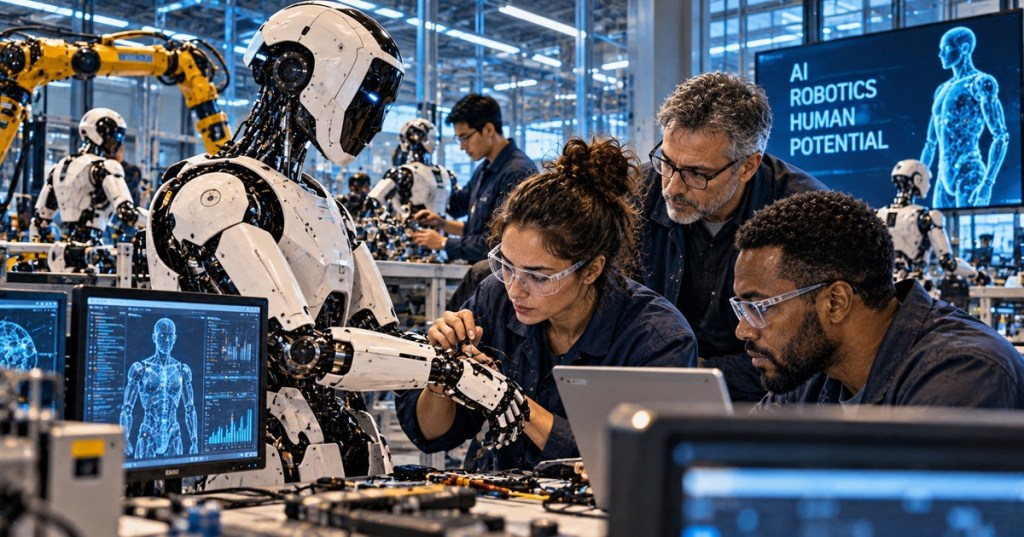
Humanoid robots are moving out of cages and into warehouses, factories and other spaces shared with people. NVIDIA’s answer to the safety problem is Halos for Robotics, a full-stack system meant to give robot makers a more structured path from experimental autonomy to certifiable deployment.
The bigger shift is that robot safety can no longer depend on a single emergency stop. Modern physical-AI systems combine sensors, perception models, planning software, motion control and increasingly powerful onboard compute. A failure in any one layer can create a real-world hazard.
What Halos Actually Does
NVIDIA describes Halos for Robotics as an end-to-end functional-safety platform spanning hardware, operating software, sensing, runtime safeguards and certification support. The stack includes IGX Thor industrial compute, Halos OS, Halos Core, the Holoscan Sensor Bridge and an outside-in safety blueprint that can use external sensors to monitor the space around a robot.
The underlying idea is separation. A robot’s main AI system may be doing perception, reasoning and task execution, while an independent safety domain keeps watching for hazards and can intervene if the primary system behaves incorrectly. NVIDIA’s official Halos announcement says the system builds on safety engineering originally developed for autonomous vehicles.
That connection matters because autonomous vehicles already forced engineers to confront many of the same questions: redundant sensing, deterministic safety paths, fail-safe behavior and what should happen when machine-learning software becomes uncertain.
Why This Matters Now
There are already more than 5 million industrial robots working in factories, but most traditional systems are highly constrained and operate inside carefully engineered environments. Humanoids are different: they are being designed to move through spaces built for people and perform a much wider range of tasks.
BitcoinVersus has also tracked the economics behind that transition. Actuators can account for 40–60% of humanoid hardware cost, while companies such as XPENG are already working toward production lines built for humanoid scale. The hardware is getting closer to mass production, which makes safety architecture more urgent rather than less.
Safety Has to Work Outside the AI Model
A central lesson from physical AI is that safety cannot be delegated entirely to the same model that is controlling the machine. If the planner, perception system or learned policy fails, the safety mechanism has to remain available independently.
That is similar to other engineering domains where protection systems are intentionally isolated from normal control logic. In robotics, the challenge is harder because the environment changes constantly and people can enter the workspace without warning.
NVIDIA says Halos is being designed around functional-safety frameworks that connect with standards such as ISO 10218 for industrial robot safety and related machinery standards. The company is also working with certification organizations and robot developers including Agility Robotics.
The Real Test Is Deployment
The difficult part is not demonstrating that a robot can stop in a controlled demo. The difficult part is proving that the safety system still behaves correctly after thousands of hours of operation, software updates, changing workloads, sensor failures and unpredictable human behavior.
That is why the transition from prototype robots to large-scale deployment is increasingly an infrastructure and validation problem, not only an AI-model problem. The same trend is visible in driverless trucking, where autonomy has to operate inside a larger system of monitoring, operational constraints and fallback behavior.
Bottom Line
NVIDIA Halos is important because it treats physical-AI safety as a stack instead of a feature. As humanoid and mobile robots begin sharing real workspaces with people, the companies that can prove predictable failure behavior may have as much of an advantage as the companies with the smartest models.
Editor’s Note: This article covers engineering and safety architecture for robotics. It does not imply that any specific humanoid platform has completed every certification required for a particular workplace or jurisdiction.


Leave a Reply