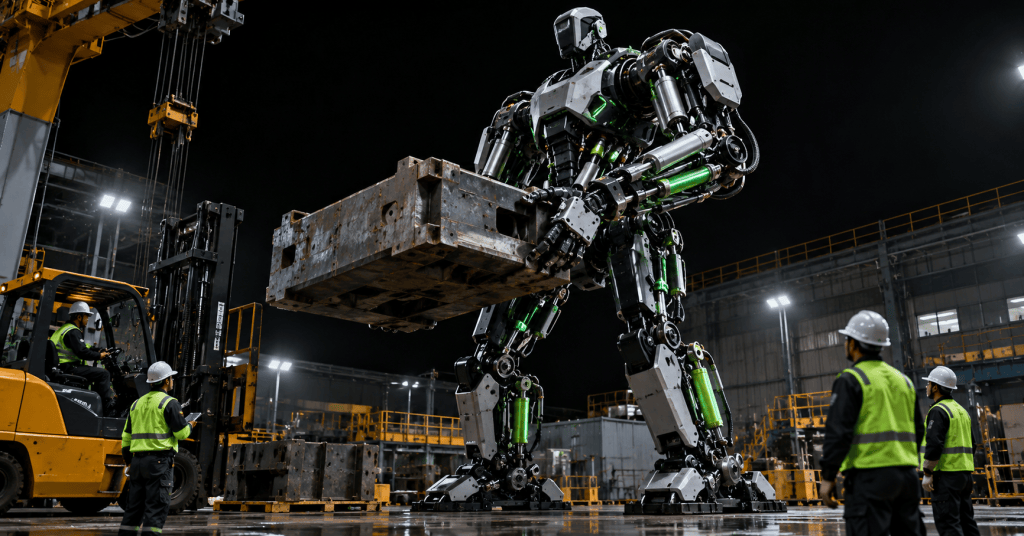
China’s humanoid-robot race has moved into a much heavier weight class. Beijing-based NeodraDynamics Robotics has shown Neo1, a roughly 4-meter-tall hydraulic-electric humanoid designed for heavy industrial work, with a company-stated mass of 1.2 metric tons and a combined dual-arm payload of 500 kilograms.
Those figures convert to about 2,646 pounds of robot and a claimed 1,102-pound two-arm payload. That is slightly different from the viral “2,400-pound” description circulating online, but the lifting figure is essentially correct when converted from NeodraDynamics’ stated 500 kg specification. The figures come from NeodraDynamics’ official CIIF announcement and should still be treated as manufacturer claims until independently validated under sustained industrial use.
The machine drew wider attention after Polymarket posted footage of the giant robot, describing it as a 13-foot humanoid capable of lifting more than 1,000 pounds.
A humanoid built more like heavy equipment
Neo1 is not primarily aimed at household chores or lightweight warehouse picking. NeodraDynamics is positioning it for heavy-component assembly, cargo handling, mining, nuclear-related work, disaster response, deep-sea maintenance and other environments where a human-sized electric robot may not have enough force.
The robot uses a hydraulic-electric hybrid architecture. NeodraDynamics says Neo1 has 41 active degrees of freedom; 39 joints use the company’s miniature digital hydraulic linear actuators, while two forearm rotational joints use electric drives. The company says each hydraulic actuator weighs about one kilogram and can generate ton-level continuous thrust.
That design puts Neo1 in a different branch of the humanoid race than many machines in BitcoinVersus’ Top 7 Humanoid Robots in 2026. Instead of optimizing first for human-scale mobility, Neo1 is being optimized around force, ruggedness and industrial reach.
What the 1,102-pound figure actually means
The headline number needs one qualification: NeodraDynamics describes 500 kg as a dual-arm collaborative payload. That does not automatically mean the robot can pick up a 1,102-pound object in every pose, at every reach distance or while moving at full speed. Industrial payload ratings depend heavily on posture, center of mass, acceleration, stability and duty cycle.
For now, the best interpretation is that Neo1’s two-arm system is rated by its manufacturer for a combined 500 kg payload. Independent robotics database DEPLOY likewise records the 500 kg figure as company-stated and notes that it has no verified commercial deployments on file as of October 2026.
That distinction matters because heavy-load humanoids face difficult mechanical problems that do not appear in short trade-show demonstrations. A robot handling hundreds of kilograms has to control structural flex, hydraulic pressure, foot loading, ground contact, thermal buildup and emergency stopping without turning a payload error into a major safety incident.
Precision is almost as important as strength
NeodraDynamics also claims repeated positioning accuracy of ±0.005 mm in its latest CIIF release. If that level of repeatability can be sustained under realistic loads, vibration and long operating cycles, it would be a significant engineering achievement because heavy machinery normally trades some precision for force and ruggedness.
The larger robotics industry is increasingly trying to solve the same problem from different directions. Schaeffler recently built a humanoid robot gym to train machines against real industrial tasks, while NVIDIA is developing safety systems intended to make humanoid robots safer around people. Neo1 adds another question: how do those safety and control systems scale when the robot itself weighs more than a small car?
Why hydraulics are back in the conversation
Hydraulics have powered excavators, loaders, industrial presses and other heavy machinery for decades because pressurized fluid can generate enormous force from comparatively compact actuators. The tradeoff has traditionally been complexity: pumps, valves, seals, fluid management, noise and maintenance all add engineering burden.
Many modern humanoid companies have therefore favored electric actuators. Neo1 is making the opposite bet. NeodraDynamics argues that a digitally controlled hydraulic system can preserve the force advantage of heavy machinery while gaining enough electronic control and sensing precision to operate like a modern robot.
JD Industrial could be the more important part of the reveal
Neo1 was shown with JD Industrial at the 2026 China International Industry Fair. The partnership is important because a robot this large only becomes commercially meaningful if it can move from exhibition floors into repeatable industrial workflows.
NeodraDynamics says the companies plan to match the platform with real use cases and pilot applications. Heavy assembly, logistics, mining and infrastructure maintenance could all benefit from a machine able to combine human-like manipulation with far greater force, but those applications will require uptime, maintainability and operating economics that have not yet been demonstrated publicly.
The unanswered questions
Several specifications are still missing from the public picture. NeodraDynamics has not published a commercial price, mass-production schedule, complete power-consumption profile or independently verified long-duration duty cycle. Walking speed, runtime and performance while carrying maximum payload are also critical if Neo1 is expected to work outside highly controlled demonstrations.
Those gaps do not make the machine insignificant. They simply separate what has been physically shown from what has been proven at scale. A 4-meter, 1.2-ton humanoid is already a major mechanical platform; proving that it can safely and economically move half-ton-class loads for thousands of hours is the much harder milestone.
Robotics may be splitting into weight classes
Neo1 suggests that the future of humanoid robotics may not converge on one ideal human-sized body. Smaller electric robots can fit existing factories, homes and warehouses. Larger hydraulic-electric machines could occupy a category closer to mobile industrial equipment, built for jobs where physical strength matters more than fitting through an ordinary doorway.
If NeodraDynamics can validate its stated figures in real deployments, Neo1 would represent more than a giant humanoid demonstration. It would be evidence that embodied AI can move beyond matching human strength and begin combining the adaptability of a two-armed robot with the force of heavy machinery.
BitcoinVersus.Tech Editor’s Note:
We volunteer daily to ensure the credibility of the information on this platform is Verifiably True. If you would like to support to help further secure the integrity of our research initiatives, please donate using the QR code provided.

For best QR-code scanning results, please scan this donation code from a desktop or larger screen. Mobile screens may prevent camera recognition.
BitcoinVersus.tech is not a financial advisor. This media platform reports on financial and technology subjects purely for informational purposes.


Leave a Reply