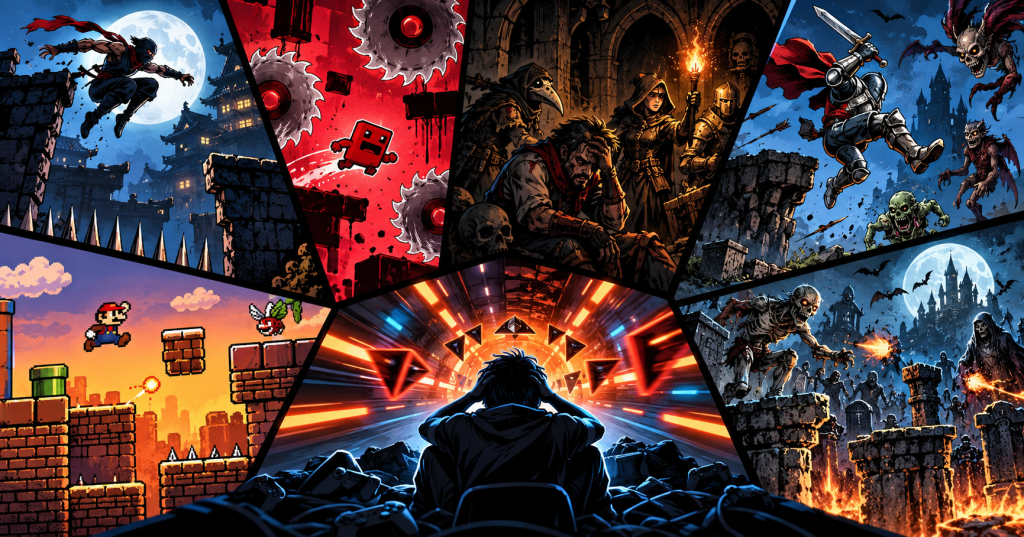
Some games are difficult because of one boss or one level. Others make demanding timing, limited recovery, punishing mistakes and repeated failure part of the entire experience.
This countdown follows a 2024 analysis reported by SciFiPulse that used user-voted difficulty scores from GameFAQs and required more than 400 votes per game. It is therefore a player-rated sample rather than a universal measurement of difficulty. GameFAQs still describes the NES version of Ghosts ’n Goblins as overwhelmingly “Unforgiving,” which helps explain why it leads this particular ranking.
Difficulty also shows how much game design has changed. BitcoinVersus has examined the engineering behind GTA 6’s dense open world, whether coding agents can build playable games, and the most anticipated games after GTA Six. These seven classics show another side of design: how little room a game can give the player before difficulty becomes its defining feature.
7. Ninja Gaiden — 4.56/5
Ninja Gaiden turns movement itself into a test. Enemies rush Ryu from multiple directions, knockback can send him directly into pits, and late-game stages combine respawning enemies with narrow jumps and relentless pressure. Reaching the final bosses does not end the punishment: failure can send the player backward through earlier sections.
6. Super Meat Boy — 4.59/5
Super Meat Boy removes lengthy punishment but demands extraordinary precision. Levels are short and restarts are nearly instant, encouraging players to repeat jumps, wall slides and obstacle patterns until the sequence becomes muscle memory. Saw blades and other instant-kill hazards leave almost no room for positioning errors.
5. Darkest Dungeon — 4.61/5
Darkest Dungeon attacks the player’s planning rather than reflexes. Heroes accumulate stress, disease, injuries and negative traits while resources disappear. A manageable expedition can deteriorate through several poor decisions or unlucky encounters, and permanent character loss makes every retreat-or-continue choice matter.
4. Super Ghouls ’n Ghosts — 4.63/5
Arthur can lose his armor after a single hit, jumps require commitment, and enemies attack aggressively. Successful players have to learn precise positioning rather than relying on midair corrections. Even reaching the apparent ending is not enough: completing the full challenge requires another trip through the game.
3. Super Mario Bros.: The Lost Levels — 4.64/5
Nintendo took the familiar mechanics of the original Super Mario Bros. and built levels for players who had already mastered them. Poison mushrooms, demanding jumps, hostile wind, aggressive enemies and backward warp zones turn familiar Mario rules against the player. The result remains one of Nintendo’s most demanding platformers.
2. Battletoads — 4.67/5
Battletoads constantly changes what skill it demands. Beat-’em-up combat gives way to racing, climbing and obstacle sequences, with the Turbo Tunnel becoming one of gaming’s most famous reflex tests. Its barriers arrive rapidly enough that memorization becomes almost as important as reaction time.
1. Ghosts ’n Goblins — 4.76/5
At number one is Capcom’s Ghosts ’n Goblins. Arthur can withstand very little damage, enemies arrive continuously, jumps demand commitment and finishing the adventure once does not deliver the true conclusion. Players must complete another loop, turning an already demanding action-platformer into an endurance test.
Difficulty Is Part of the Design
What connects these games is not one specific mechanic. Ninja Gaiden tests reaction and recovery, Super Meat Boy tests precision, Darkest Dungeon tests planning, and Battletoads keeps changing the rules. Ghosts ’n Goblins combines limited survivability, aggressive enemies and repeated completion requirements strongly enough to take the top position in this player-rated dataset.
The ranking is not a universal law: different players struggle with different genres, and newer games can be difficult in very different ways. But using hundreds of player difficulty ratings gives this countdown a measurable foundation instead of choosing seven famous hard games by reputation alone.
BitcoinVersus.Tech Editor’s Note:
We volunteer daily to ensure the credibility of the information on this platform is Verifiably True. If you would like to support to help further secure the integrity of our research initiatives, please donate using the QR code provided

For best QR-code scanning results, please scan this donation code from a desktop or larger screen. Mobile screens may prevent camera recognition.
BitcoinVersus.tech is not a financial advisor. This media platform reports on financial subjects purely for informational purposes.


Leave a Reply