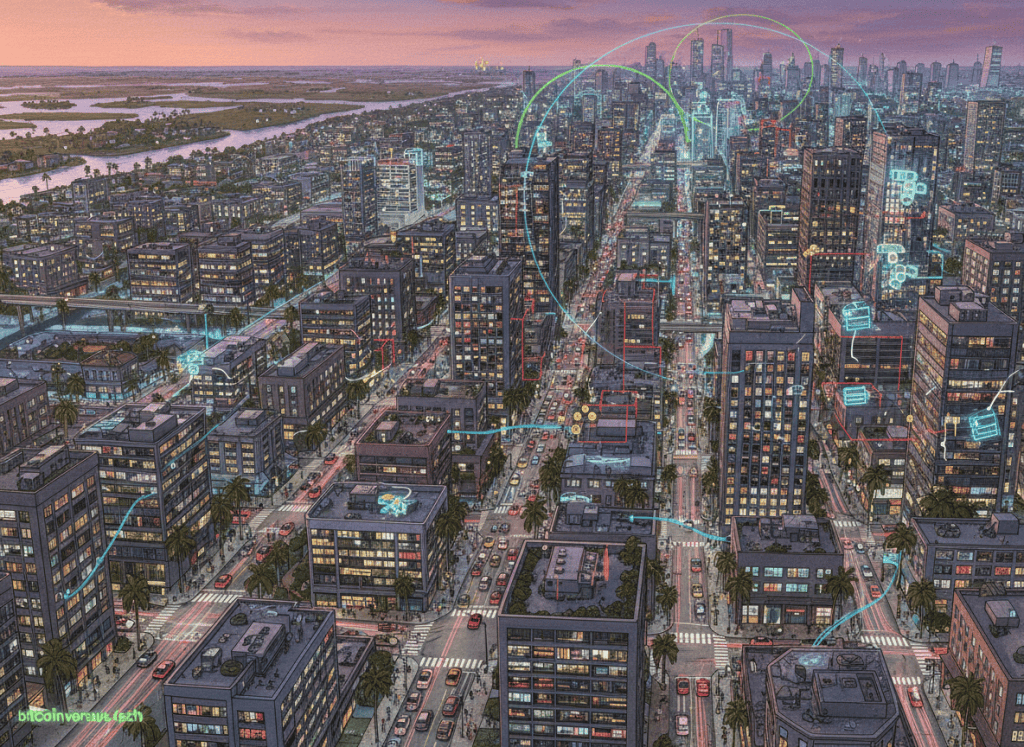
Grand Theft Auto VI’s newest technical story may be less about map size than about how much Rockstar is trying to keep alive inside that map at once.
Rockstar’s official Extended Look describes GTA VI as the series’ biggest and most immersive evolution yet, and the footage shows a Leonida packed with traffic, pedestrians, beaches, nightlife, highways, interiors and environmental detail.
A recent GTA Series Videos post summarized the new Game Informer reporting around Leonida’s scale, density, interaction and interiors. The specific public status is embedded below.
Rockstar says it is pushing scale and density at the same time
GamesRadar reports that Rockstar head of development Aaron Garbut told Game Informer the studio normally has to trade scale against detail or interaction, but GTA VI is trying to increase all of them together: scope, scale, detail, interaction and density.
That is a programming problem as much as an art problem. A larger map is relatively easy to describe on paper. A denser map is harder because every additional pedestrian, vehicle, interior, animation, audio source, physics object and mission trigger can create more CPU work, more memory pressure and more data that must be streamed from storage.
Open-world density is really a scheduling problem
Rockstar has not published GTA VI’s engine code, so any implementation discussion must remain engineering analysis rather than a claim about its private source. But a dense open world has a familiar set of technical constraints.
The engine has to decide which assets should be in memory, which NPCs need full simulation, which distant objects can fall back to cheaper logic, which animations need to run at full fidelity, and how quickly nearby streets or buildings must become interactive as the player moves.
That is why open-world engines rely on ideas such as spatial partitioning, level-of-detail systems, occlusion, asynchronous asset loading and simulation budgets. The goal is not to simulate the entire map at maximum fidelity every frame. The goal is to make the player believe the world remains coherent while computational effort follows them through it.
Streaming has to work at car speed, not walking speed
Grand Theft Auto creates a particularly difficult case because the player can cross a city quickly. A system that feels fine while walking can fail when a sports car covers several blocks in seconds. Texture sets, traffic populations, collision, audio, navigation data and mission state all have to arrive before the player notices they were ever missing.
Rockstar has been solving versions of that problem for decades. BitcoinVersus.tech previously looked at Grand Theft Auto III reverse engineering in C++, where even an older GTA world demonstrates how many systems must cooperate to keep a city navigable and responsive.
More density means more simulation tiers
A believable city does not need every NPC to run the same expensive behavior model at all distances. A nearby character might require animation, collision, pathfinding, perception and dialogue. A character several blocks away may only need a lightweight population record until the player gets close.
The same principle applies to vehicles and interiors. A nearby car may need detailed suspension, traffic AI, collision and audio. A distant car can often be represented with a cheaper state. Buildings can use high-detail interiors only when they are relevant, while the rest of the city stays on lower-cost representations.
That kind of tiered simulation is one reason the new wanted-system story matters too. BitcoinVersus.tech recently examined GTA VI’s more reactive wanted logic, where player appearance, vehicles and state appear to feed other gameplay systems. Density becomes more expensive when the world’s objects are not just scenery but sources of information and interaction.
The engine has to protect frame time
The most important resource in a real-time game is not simply memory or storage. It is frame time. If too many systems perform expensive work during the same frame, the result is stutter even when average performance looks acceptable.
That means a dense engine needs job scheduling and priority rules. Navigation updates, world streaming, animation, physics, traffic logic and rendering cannot all spike at once. Modern engines distribute work across CPU threads and spread some updates across multiple frames, while the renderer uses visibility and level-of-detail systems to keep GPU cost under control.
Open-source engine development makes the same tradeoffs visible at a smaller scale. BitcoinVersus.tech’s coverage of Crown Engine 0.65 shows how scene management and tooling sit underneath what players experience as a seamless game world.
Density is only valuable if it stays interactive
The important distinction is between visual density and systemic density. A street can be crowded with static detail and still feel artificial. The harder target is a street where traffic responds, pedestrians move believably, doors and spaces connect to gameplay, weather changes the scene and mission systems can interrupt the normal simulation without breaking it.
Garbut’s comments suggest Rockstar is explicitly targeting that combination rather than choosing one side of the usual tradeoff. If GTA VI succeeds, the technical achievement will not be that Leonida contains a huge number of objects. It will be that the engine can stream, schedule and simulate enough of those objects at the right fidelity to make a very large world still feel dense at street level.
Editor’s Note
We volunteer daily to ensure the credibility of the information on this platform is Verifiably True. If you would like to support to help further secure the integrity of our research initiatives, please donate here: 3C9o19EH5HSiwEPyCTmEKzxhNCbo2X6TTb
BitcoinVersus.tech is not a financial advisor. This media platform reports on financial subjects purely for informational purposes.


Leave a Reply