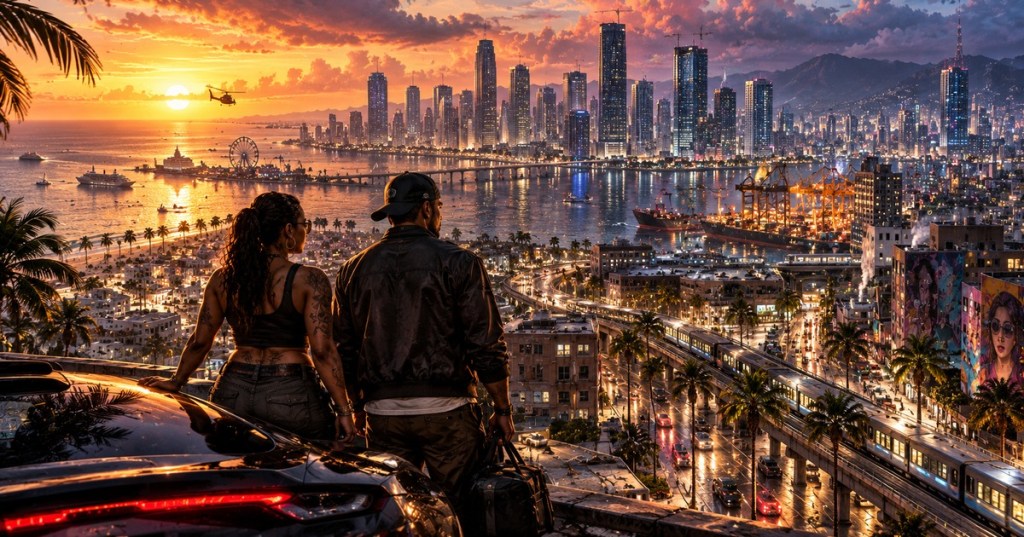
What will Grand Theft Auto VII actually look and feel like? The safest answer is that nobody outside Rockstar has a confirmed design to show. As of October 21, 2026, Rockstar has not announced GTA VII, its setting, production schedule or release date. Nevertheless, the combination of 29 years of Grand Theft Auto history, the approaching release of GTA VI and new comments from Rockstar’s technical leadership gives us enough evidence to make a grounded prediction.
Our editorial forecast: GTA VII’s defining achievement may not be another dramatic jump in polygon count. It could be a city that behaves more convincingly over time: traffic that adapts to incidents, residents who notice repeated actions, businesses with persistent schedules and missions that accommodate more than one workable solution. These are predictions, not leaked features.
Key Takeaways
- Official status: Rockstar has not announced GTA VII or a release date.
- Historical pattern: Each numbered generation changed the relationship between player, world and story.
- Most plausible leap: Denser simulation, responsive NPCs and more persistent consequences rather than map size alone.
- Key production evidence: Rockstar says GTA VI’s technology could accelerate later projects, not necessarily GTA VII.
- What remains speculative: Location, generative dialogue, destructibility, online economy and launch hardware.
Where We Actually Stand In October 2026
The immediate benchmark is Grand Theft Auto VI, scheduled for November 19, 2026 on PlayStation 5 and Xbox Series X|S. Rockstar says its Leonida setting, including Vice City, marks its most immersive expansion of the series yet. The company also confirmed that its August 27 extended look was captured entirely from in-game PlayStation 5 footage. Neither demonstration establishes what GTA VII will contain.
The Full GTA History From 1997 To GTA VI
The original Grand Theft Auto arrived in 1997 as a top-down crime game. The premise was already recognizably GTA: explore a city, steal vehicles, complete criminal jobs and pursue freedom between missions. But nearly everything about how the city was represented would change.
GTA III (2001) transformed that overhead foundation into a continuously explorable 3D Liberty City. Vice City (2002) showed that distinctive period design, music and atmosphere could give a familiar technical foundation a new identity. San Andreas (2004) expanded the scope to three cities, countryside and deeper character customization. The contemporary GameSpot review of San Andreas documents how the statewide approach changed what players expected from an open world.
GTA IV (2008) emphasized a weightier simulation, urban realism and a more grounded story. GTA V (2013) brought three switchable protagonists, blockbuster heists, an expansive Los Santos and the enduring commercial life of GTA Online. Across these releases, the real pattern is not simply that maps grew. The interaction between world, story and technology became more ambitious.
That is why GTA VII should be evaluated against the franchise’s history of redesigning the experience, not just against GTA VI’s image quality. A perfectly rendered storefront that cannot be entered may contribute less to player immersion than a modest-looking shop with meaningful people, schedules and consequences.
The Clue From Rockstar’s Own Developers
There is also an important production clue. In Jason Schreier’s October 14 Bloomberg investigation, Rockstar technical leader Phil Hooker described GTA VI’s engine, tools and team as a foundation that should make later productions faster. Rockstar leaders discussed building outward using completed systems rather than rebuilding the technical stack for every subsequent project.
That is encouraging, but it does not mean a particular GTA VII date has been approved. The developers discussed Rockstar’s next production, which might be a different title, expansion or experiment. We should not turn a statement about reusable tools into a promise of GTA VII by 2030 or 2035.
What GTA VII Might Look Like
One of our strongest visual predictions is that GTA VII will look more like a highly refined descendant of GTA VI than a wholly foreign visual generation. Improved materials, lighting, weather transitions, animation blending, facial performance and distant-object rendering could matter more than raw resolution. Artists will still need to decide where realism serves the story and where stylization makes a city memorable.
The technical problem is visible in BitcoinVersus.Tech’s earlier examination of GTA VI’s density, streaming and simulation constraints. A screen full of believable traffic, people, reflections and interiors demands far more than attractive textures. It places simultaneous loads on rendering, CPU scheduling, animation, memory, storage bandwidth and asset streaming. Faster future hardware helps, but cannot erase the expense of designing interesting spaces.
Where Might The Next GTA Take Place?
For a setting, our leading concept is one richly simulated metropolitan region with several connected districts, rather than a miniature model of every American city. Liberty City with a larger surrounding region, a fresh Chicago-inspired metropolis or an expanded San Fierro/Las Venturas corridor could all work creatively. None is confirmed. Fan proposals involving multiple states are exciting, but a giant map only improves play when its locations contain meaningful activity.
Imagine leaving a crowded commuter rail station at dusk. Construction changes a street’s traffic pattern. A neighborhood business closes after a local power failure. Pedestrians react differently to a rainstorm, a sports celebration or a crime committed nearby. The world does not need to simulate every resident at full fidelity all day; it needs convincing continuity when the player returns.
Will The Characters Have Artificial Intelligence?
Artificial intelligence may be the most misunderstood part of this forecast. It would be tempting to promise that GTA VII characters will use unrestricted large language models, hold infinite conversations and remember every player choice. But the costs, latency, content controls, localization, consistency and narrative-quality problems are significant. Rockstar has announced no such GTA VII feature.
A more credible pathway is hybrid game AI: traditional scripted missions and authored dialogue supported by improved scheduling, navigation, behavioral state, procedural animation and carefully constrained language systems where they add value. Our earlier investigation into AI’s potential benefits in video games explains why smarter in-game behavior and AI-assisted production are different claims.
Police response is an especially interesting case. BitcoinVersus.Tech’s earlier analysis of GTA VI’s wanted-system design explored how rules, perception and information flow can make pursuit feel more systemic. A hypothetical GTA VII could extend this with witnesses, evidence persistence, surveillance, jurisdictional coordination and meaningful choices between evasion, negotiation and confrontation. None of those additions should be presented as confirmed or inferred from isolated trailer frames.
Physics, Destruction And A World That Remembers
Cars, weather and buildings offer another possible frontier. Better vehicle suspension, water effects and selective destruction could make spectacular scenes feel less prearranged. But a fully destructible metropolis would create extraordinary challenges for navigation, mission scripting, multiplayer synchronization and save-game consistency. Selective destruction with dependable recovery rules is a more practical forecast than an entire city collapsing dynamically.
The Online World, Ownership And Player Creativity
Could GTA VII allow players to operate legitimate businesses, create neighborhoods or even influence a local economy? Possibly, especially through a future online component. Our March 2023 article on GTA and potential Bitcoin-linked game economies shows how long players have been thinking about virtual ownership and monetization. That older commentary should not be mistaken for an announcement that Rockstar will use cryptocurrency or digital assets in GTA VII.
The commercially sensible prediction is a stronger distinction between authored single-player storytelling and persistent community worlds. Rockstar could preserve a tightly directed crime narrative while improving online social activities, role-play tools and discoverable player creations. Community experimentation with AI-assisted PC game modding illustrates what creators can now attempt, but it does not establish that Rockstar will provide official modding tools or support.
Why Handcrafted Storytelling Must Remain
The bigger risk is creative: a simulated city that produces endless chores, bland dialogue or repetitive encounters is not automatically more fun. Great GTA games satirize specific places, personalities, entertainment cultures and power structures. New technology should give writers more control over meaningful stories, not replace their judgment with an infinite supply of disposable conversations.
How Long Would GTA VII Take To Develop?
Cost and time pose similar restraints. Rockstar’s unusually long GTA V-to-VI interval is real, yet a second thirteen-year gap is not inevitable. The relevant questions are whether its current engine can be reused efficiently, how much additional content must be hand-authored and whether future hardware targets force major architectural redesigns. Take-Two’s published release outlook confirms the immediate GTA VI timeline, not a GTA VII budget or schedule.
What GTA Fans Are Asking
Community reaction reflects that uncertainty. Some fans favor several connected cities. Others want the next game to arrive faster and keep the handcrafted detail they associate with Rockstar. A recent discussion explicitly asks whether generative AI could transform open worlds without weakening their authorship. Those debates are useful evidence of audience expectations, not proof of any internal development plan.
Our Confidence Assessment
For our forecast, the highest-confidence possibilities are richer crowd behavior, improved lighting and animation, more connected interiors and continued reuse of core production technology. Medium-confidence ideas include multi-city regional design and more persistent law-enforcement or social systems. Lower-confidence predictions include conversational AI for every NPC, fully destructible districts, a continent-scale map or a specific launch decade.
How To Judge A Future GTA
The test should be straightforward: how many of a player’s choices can the world acknowledge without breaking the narrative, how consistently do systems behave across a long session, and how well does the game perform on ordinary shipping hardware? Player freedom, mission variety and memorable writing deserve as much scrutiny as visual comparisons.
Conclusion
Our conclusion: GTA VII’s future may be defined less by how much of a city the player can see than by how much of it genuinely responds. Rockstar has spent decades making its worlds feel bigger, richer and more cinematic. The next worthwhile leap would make those worlds more consequential. Until the company announces GTA VII, that remains an evidence-based editorial possibility—not a promise.
BitcoinVersus.Tech Editor’s Note: We volunteer daily to ensure the credibility of the information on this platform is Verifiably True. If you would like to support to help further secure the integrity of our research initiatives, please donate using the QR code provided

For best QR-code scanning results, please scan this donation code from a desktop or larger screen. Mobile screens may prevent camera recognition.


Leave a Reply