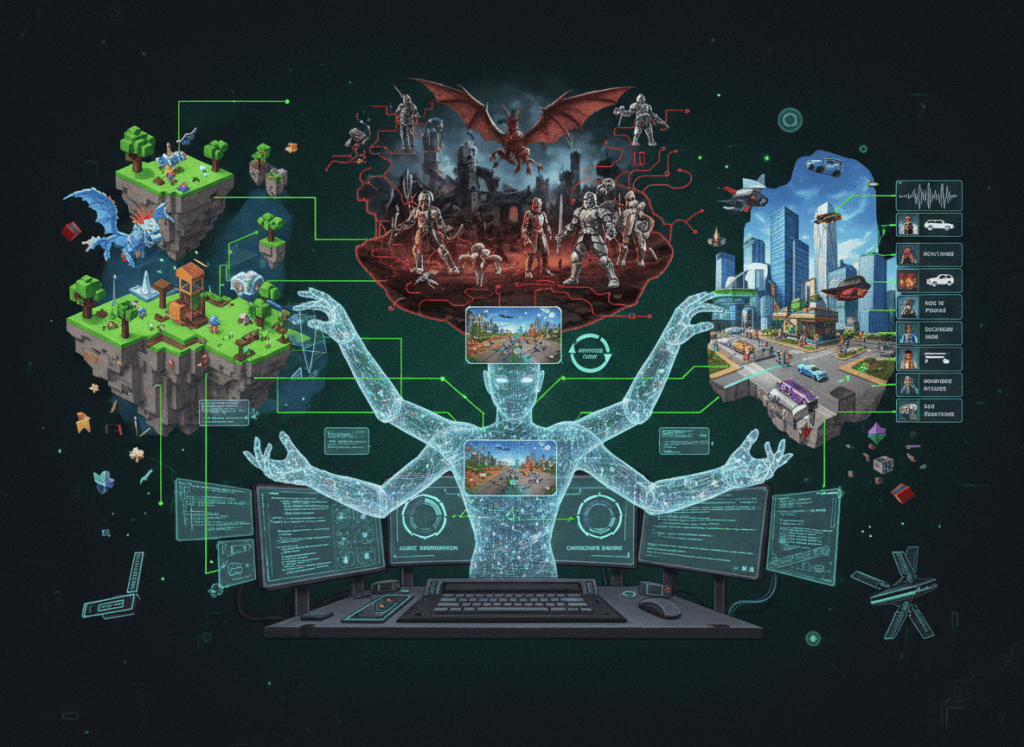
The viral game-mashup wave is getting stranger fast: block-based worlds appearing inside modern action games, familiar mechanics crossing into completely different genres, and creators stitching together software that was never designed to coexist. The interesting part is no longer just the crossover—it is the tooling making these experiments faster to build.
An October 1 Instagram post from Evolving AI pulled several of those mashups into one carousel and pointed to a broader trend: AI coding agents are starting to handle parts of the modding workflow that once required long stretches of engine research, scripting, asset preparation and manual testing.
One tool at the center of that conversation is universal-modder, an open-source project from Rehan Sheikh. Its goal is to give AI coding agents a repeatable way to identify a game’s technical structure, choose an appropriate modding path, create assets, build a working change, test it in the running game, record a showcase and document what worked.
Sheikh introduced the toolkit in an X post announcing universal-modder after packaging lessons from AI-assisted Terraria and Age of Empires II projects.
This is more than asking AI to write a script
The technical jump is orchestration. A normal coding assistant can generate a function when the developer already knows what needs to change. A game-modding agent has to understand the environment first, prepare the right assets, make the change and then verify that the result actually runs.
Universal-modder’s public documentation describes a workflow that includes engine identification, modding-route selection, asset generation, automated screenshots, game-window testing, packaging and a shared knowledge base. It also supports more than Claude Code: the project lists Codex, Cursor, Gemini CLI, GitHub Copilot and other compatible coding agents.
Minecraft × GTA V is one documented example
One of the project’s documented examples combines Minecraft-style gameplay with GTA V story mode. The two environments exchange enough information for Minecraft visuals and interactions to appear inside the GTA world, creating the kind of crossover that would normally require a large amount of custom integration work.
Sheikh later posted a direct demonstration of that project:
Not every viral crossover came from universal-modder
That distinction matters. The Instagram carousel also shows projects from other creators using different techniques. VideoCardz documented the wider mashup wave, including Minecraft running inside Elden Ring and several other cross-game experiments, while noting that AI’s exact role varies from project to project.
So the accurate story is not that one AI tool created every crossover. It is that better tooling, open modding ecosystems and AI coding agents are converging at the same time, reducing the amount of repetitive work required to experiment with games.
AI is moving from code completion to runtime verification
The most important piece may be automated testing. The toolkit can launch a game, capture screenshots and verify whether a mod actually works. That closes a loop that code-generation systems often struggle with: source code can look plausible and still fail once it reaches a real runtime.
That is closely related to the problem BitcoinVersus.tech covered in SWE-Game’s executable game benchmark, where the question is not simply whether an agent writes plausible code, but whether the resulting game actually runs and behaves correctly.
The same trend appears at a higher level in Meta’s natural-language game creation tools. In both cases, the interface between an idea and an interactive result is getting shorter.
And for traditional developers, projects such as Godot 4.8’s development tooling show the other side of the same shift: engines and editor workflows are becoming increasingly automation-friendly.
Modding may be one of AI coding’s clearest gaming use cases
Mods are unusually well suited to coding agents. The goal is concrete, the runtime gives immediate visual feedback, existing modding communities provide technical documentation, and success can often be verified by simply launching the game and exercising the new behavior.
The result is a new creator workflow: describe a mechanic, let an agent build a first version, then iterate on something that is already playable. Human modders still make the design decisions and solve the hard edge cases, but the time spent on repetitive setup and testing can shrink dramatically.
If the October 2026 crossover wave is any indication, AI-assisted modding is moving quickly from novelty clips toward reusable infrastructure.
BitcoinVersus.Tech
Advertisement
Editor’s Note
We volunteer daily to ensure the credibility of the information on this platform is Verifiably True. If you would like to support to help further secure the integrity of our research initiatives, please donate here: 3C9o19EH5HSiwEPyCTmEKzxhNCbo2X6TTb
BitcoinVersus.tech is not a financial advisor. This media platform reports on financial subjects purely for informational purposes.


Leave a Reply