Quantum computing does not have an NVIDIA yet. It does not even have agreement on what the winning quantum transistor should look like.
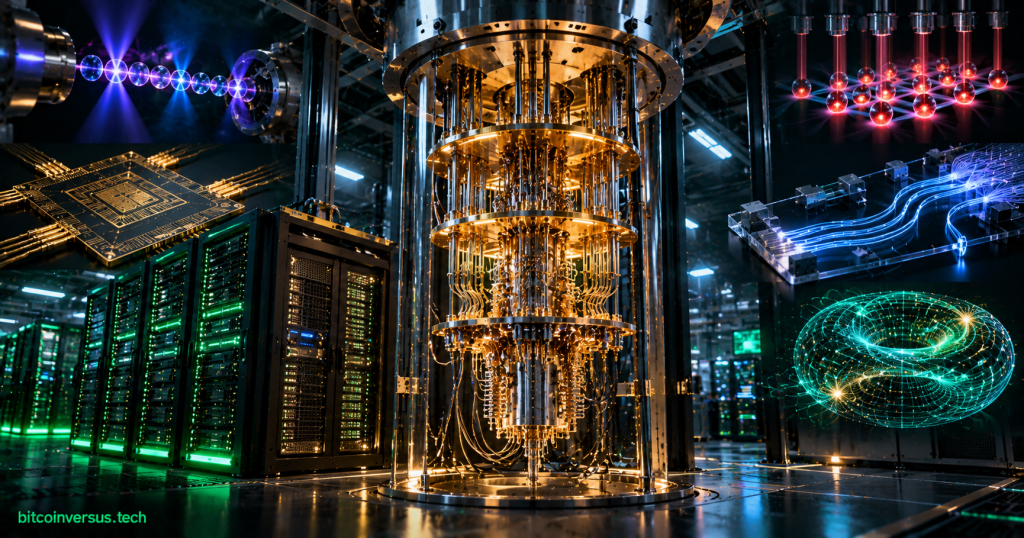
That is what makes the industry unusually interesting in 2026. Billions of dollars are flowing into machines built around radically different physical ideas: superconducting circuits cooled near absolute zero, trapped ions suspended with electromagnetic fields, neutral atoms held by lasers, photons routed through optical hardware, semiconductor spins, and Microsoft’s topological approach.
The feature video below from deep-tech investor Leo Cui is a useful map of that entire competitive landscape rather than a pitch for a single machine.
There is still no single quantum architecture
Classical computing eventually converged around semiconductor logic. Quantum computing is still in the period before that convergence. IBM and Google have pushed superconducting qubits. IonQ and Quantinuum use trapped ions. Neutral-atom companies manipulate arrays of atoms with lasers. Photonic companies encode information into light. Other teams are betting on silicon spins or topological states.
Each architecture trades one engineering problem for another. Superconducting systems can execute gates quickly but demand extreme cryogenics and fight coherence errors. Trapped ions offer excellent fidelity and connectivity but have different speed and scaling constraints. Photonics can exploit mature optical infrastructure but faces demanding source, detector and loss requirements. Neutral atoms can form enormous configurable arrays, but useful fault-tolerant computation still requires substantial control and error-correction engineering.
Error correction is becoming the real benchmark
The industry is increasingly moving beyond raw physical-qubit counts. What matters is whether useful logical qubits can execute long computations while errors are detected and corrected fast enough to keep the machine running.
IonQ recently reported an end-to-end real-time quantum error decoder running on a standard CPU. Its benchmark modeled as many as 408 logical qubits across more than 31.5 million quantum operations, with the company reporting as little as 0.02% additional execution time from decoding. That does not mean a 408-logical-qubit commercial machine suddenly exists; it demonstrates the classical decoding architecture against simulated fault-tolerant workloads.
That distinction matters. BitcoinVersus previously covered IonQ’s Superion 256 deployment into NVIDIA’s quantum research environment, where quantum processors and accelerated classical hardware are being treated as parts of one hybrid system rather than competing computers.
Quantum computers are becoming systems, not science projects
The hardware surrounding the qubit is becoming as strategically important as the qubit itself: cryogenics, control electronics, lasers, microwave systems, photonic interconnects, packaging, classical accelerators and specialized fabrication all have to scale together.
IBM’s recent roadmap illustrates the systems problem. The company has connected modular cryogenic systems as part of its effort to build fault-tolerant machines that can eventually link many quantum chips, while its broader research program is pushing quantum-classical workflows rather than treating the QPU as a standalone replacement for conventional computing.
That manufacturing layer is why SkyWater’s new merchant quantum foundry is significant. If quantum hardware moves from laboratory devices toward repeatable products, fabrication, packaging and process control become an industrial supply-chain problem.
AI and quantum are starting to share the same machine room
The most plausible near-term quantum computer may not look like a mysterious silver chandelier replacing a data center. It may look like a specialized accelerator attached to conventional CPUs and GPUs, invoked only for workloads where quantum circuits provide an advantage.
NVIDIA is leaning directly into that hybrid model. We recently examined NVIDIA Ising and the use of AI to improve quantum-computing workflows. The same GPUs driving the AI boom can also simulate quantum systems, compile circuits, decode errors and coordinate hybrid algorithms.
The winner may not be one winner
The semiconductor industry standardized around a remarkably dominant computing substrate. Quantum may evolve differently. Chemistry might favor one architecture, sensing another, networking another and large fault-tolerant computation another. Some platforms may disappear; others may become specialized accelerators rather than universal computers.
That is the key takeaway from viewing the industry as a whole: the quantum race is not simply about who has the most qubits. It is a contest over which physical system can combine fidelity, scale, speed, manufacturability, error correction, networking and cost into something customers can repeatedly use.
BitcoinVersus.Tech
Advertisement
Editor’s Note
This feature uses the supplied industry explainer video as a starting point and independently contextualizes the major quantum-computing architectures and recent fault-tolerance developments. No single hardware architecture has yet been established as the universal commercial winner.
Support independent BitcoinVersus.Tech reporting with Bitcoin donations at: 3C9o19EH5HSiwEPyCTmEKzxhNCbo2X6TTb
BitcoinVersus.tech is not a financial advisor. This media platform reports on financial subjects purely for informational purposes.


Leave a Reply