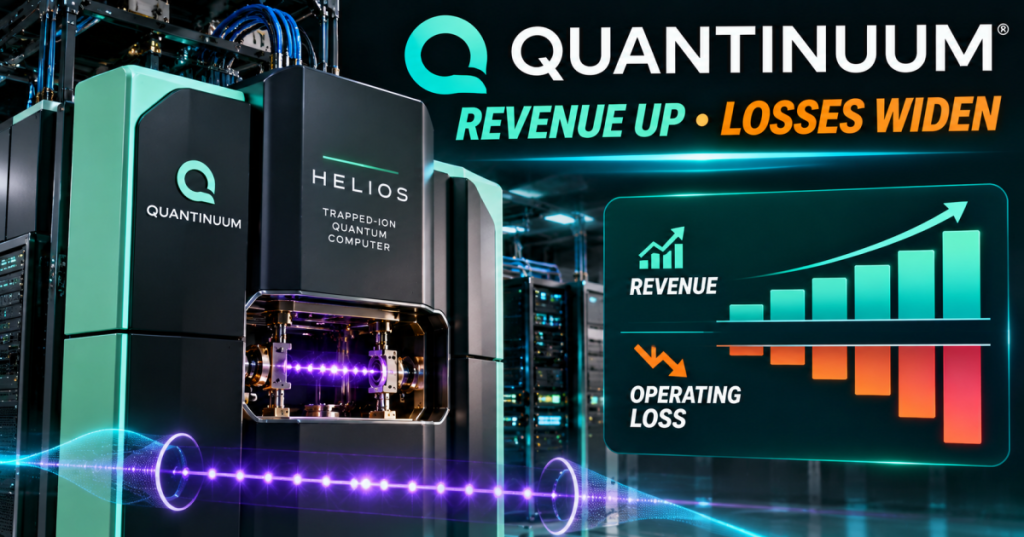
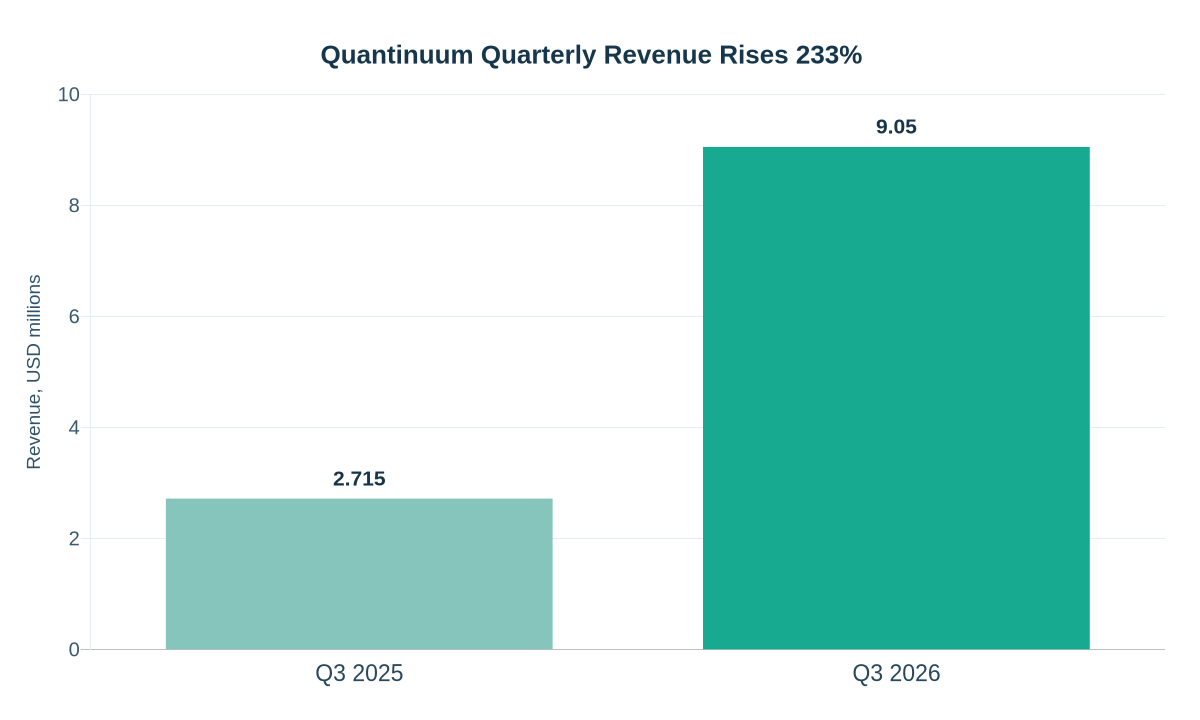
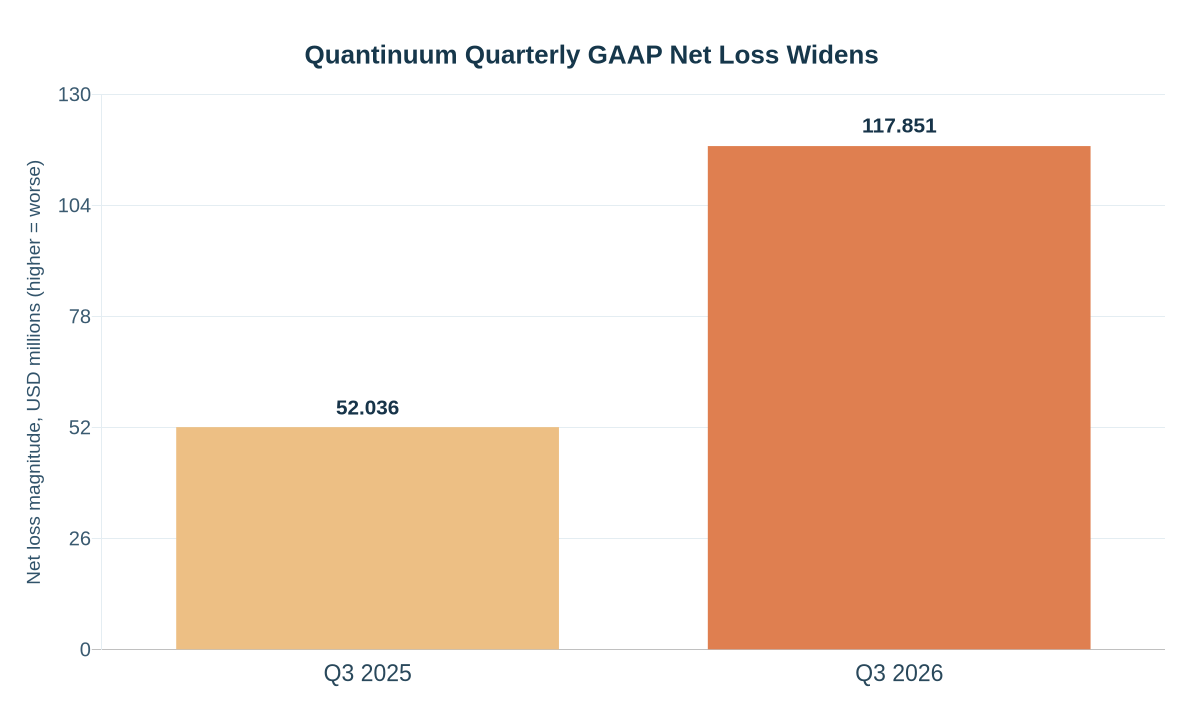
Quantum-computing company Quantinuum reported $9.05 million in third-quarter 2026 revenue, up 233% from $2.715 million a year earlier, but its GAAP net loss widened to $117.85 million. The loss had been $52.04 million in the 2025 quarter. In its November 5 earnings release, the company also increased its 2026 revenue guidance to $31 million–$34 million, while advancing plans for more capable trapped-ion quantum computers.
A quantum computer stores information in quantum bits, or qubits, rather than conventional binary bits. Quantinuum uses electrically trapped atomic ions, controlled with laser and electronic systems, and relies on classical computing to calibrate operations and decode errors. Commercial usefulness depends on reliable computation at scale, not simply increasing the physical qubit count.
Quarterly sales rise, but losses widen
Quantinuum’s reported third-quarter revenue increased by $6.335 million from the prior-year quarter. Management attributed commercial momentum to customer agreements, wider distribution and adoption of Nexus, the cloud developer platform used to program and execute quantum jobs. Nexus reached 215 organizations, nearly 20% above the preceding quarter, while job submissions increased tenfold during the twelve months through August compared with the earlier twelve-month period.
The financial improvement has limits. For the first nine months of 2026, total revenue was $22.285 million, below $23.908 million in the same 2025 period. A strong individual quarter therefore does not establish continuous growth across the entire year. Quantinuum separately reported $1.94 billion in cash and equivalents at September 30, providing resources for its expensive hardware-development program.
Quarterly research and development expenses increased to $97.482 million from $42.382 million. The company reported a GAAP net loss of $117.851 million, compared with $52.036 million a year earlier; adjusted EBITDA was a separate $80 million loss, compared with $45 million. Adjusted EBITDA excludes accounting items and cannot replace the GAAP result when evaluating profitability.
Error correction is the engineering bottleneck
Quantinuum’s existing Helios machine is available commercially, but the company’s later systems remain on a roadmap. An October error-correction demonstration achieved 99.9995% logical-memory fidelity under reported test conditions—equivalent to approximately five uncorrectable memory errors per million operations. Logical-memory fidelity does not mean every possible quantum algorithm now runs with the same reliability.
Sol, targeted for the second half of 2027, is planned to support development toward 100 logical qubits. Apollo, proposed for 2029, targets broader fault-tolerant computing. Both milestones are forecasts, not completed or commercially deployed installations. The distinction also matters when evaluating rival approaches, previously examined in BitcoinVersus.Tech’s comparison of quantum architectures.
Other laboratories are attempting different approaches to error correction. Earlier BitcoinVersus.Tech coverage examined IBM and AMD’s correction platform, Google’s Willow error-reduction results and SkyWater’s quantum manufacturing services. Different benchmark tasks, error definitions and hardware technologies make direct numerical leadership claims difficult without matching tests.
Commercial adoption still faces a long path
The new funding guidance points to growing demand, but revenue remains small relative to research expenditure. Customer agreements do not establish that every proposed application—drug design, materials research or financial modeling—has achieved a demonstrated advantage over conventional supercomputers. Hardware yield, system availability, quantum error correction and software integration remain major obstacles.
Quantinuum’s latest quarter therefore shows two developments simultaneously: measurable sales traction and increasingly expensive investment in future quantum hardware. Whether Nexus adoption becomes sustainable earnings will depend on commercially valuable workloads, cost control and technical validation beyond laboratory benchmarks.
Primary sources: Quantinuum Q3 2026 earnings and unaudited financial statements; Quantinuum’s October 19 logical-memory error-correction report; Quantinuum’s Nexus and hardware roadmap; commercial Helios technical specifications; and the archived CNBC Television CEO interview.
Editor’s Note: Revenue, net losses, expense figures and guidance are taken from Quantinuum’s November 5, 2026 earnings documents. The quarterly amounts are GAAP unless otherwise labeled. Reported logical-memory fidelity is a specific experimental benchmark rather than universal fault tolerance. Sol and Apollo schedules are company targets. The CNBC video dates to 2025 and provides historical context; the featured artwork is a conceptual illustration, not a photograph of a deployed system.
Support BitcoinVersus.Tech
Support independent reporting with an optional 5,000-satoshi contribution using the original BitcoinVersus.Tech donation QR below. On a phone, open the article on a second screen to scan with a compatible Bitcoin wallet, or use your wallet’s image-scanning option if available. Confirm the recipient and amount before payment.

We volunteer daily to ensure the information on this platform is Verifiably True. If you would like to support the research, please scan QR code.


Leave a Reply