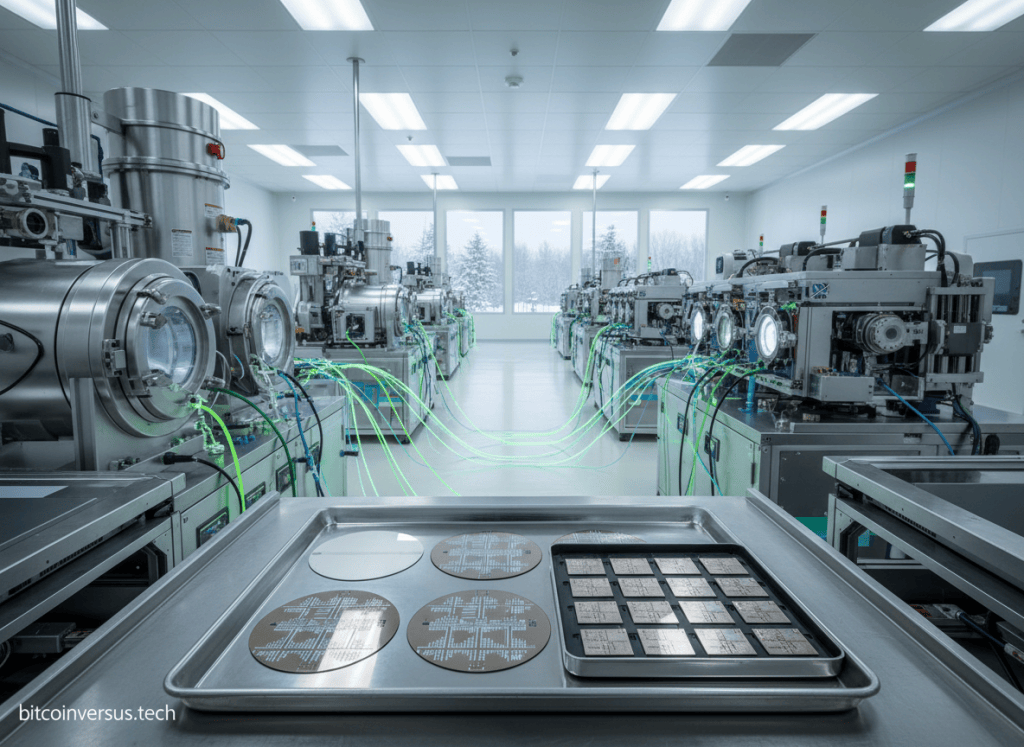
SkyWater Technology has launched a dedicated merchant quantum foundry business designed to move quantum hardware from laboratory-scale breakthroughs into repeatable semiconductor manufacturing.
The new SkyWater Quantum Solutions operation was introduced in an September 8 IonQ post and is being led by Dr. Mihir Bhaskar, who previously led advanced R&D at IonQ and co-founded quantum-photonics company Lightsynq.
SkyWater’s official announcement says the new business will provide process development, device integration, characterization and manufacturing support across quantum computing, networking, sensing and timing.
Quantum hardware is running into a manufacturing problem
Quantum computing research often focuses on qubit counts, coherence, error correction and algorithmic performance. But scaling a laboratory device into a commercial system creates a different problem: the materials, interconnects, photonics, packaging and fabrication steps have to become repeatable.
That is where SkyWater is positioning the new business. Instead of selling one quantum computer, the foundry is offering manufacturing infrastructure that multiple quantum companies can use to industrialize their own devices.
The Quantum Insider’s independent coverage describes the launch as a dedicated quantum semiconductor manufacturing business spanning superconducting devices, photonics and integration capabilities.
SC250 targets superconducting quantum hardware
One of the new foundry platforms is SC250, a superconducting technology platform aimed at high-density cryogenic interconnect and control.
Superconducting quantum systems operate at extremely low temperatures, which makes signal routing, control electronics, packaging and physical integration difficult. Scaling qubit counts is not only a matter of fabricating more quantum devices; the system also needs a practical way to connect and control them inside a cryogenic environment.
SkyWater says SC250 can be combined with its heterogeneous-integration and advanced-packaging capabilities so customers can bring additional materials, active devices and interfaces into a larger quantum system.
That manufacturing layer complements the system-level work BitcoinVersus.tech covered in IonQ’s Superion 256 integration with NVIDIA’s accelerated quantum research environment, where the quantum processor is only one part of a much larger compute stack.
SP90 brings silicon-nitride photonics into the foundry stack
The second core platform is SP90, a low-loss silicon-nitride photonics process for quantum applications.
Quantum systems increasingly use photons for communication, routing and control because optical links can move quantum information across chips, modules and eventually networks. SkyWater says SP90 can be combined with capabilities acquired through Nexus Photonics, including heterogeneous integration of III-V materials with silicon photonics.
Those materials can support active components such as lasers, amplifiers, modulators and photodetectors on photonic chips. SkyWater says the broader platform can serve photonic, trapped-ion and neutral-atom quantum systems as well as quantum networks and sensors.
The merchant model matters because SkyWater is not only serving IonQ
IonQ now owns SkyWater, but the foundry says the Quantum Solutions business will continue to serve outside customers under its merchant-foundry model.
SkyWater says customer programs will remain separated through established information-security, intellectual-property protection and program-firewalling practices. That is important because competing quantum companies may need access to the same manufacturing infrastructure without exposing proprietary device designs to one another.
Qolab is an early test of the superconducting platform
SkyWater also announced a development program with Qolab, the superconducting quantum-computing company co-founded by physicist John Martinis.
The program will combine Qolab’s quantum-hardware work with SkyWater process development and manufacturing. SkyWater says the effort will use SC250 to advance Qolab’s Quantum System-in-Package concept, which is designed to pull more cryogenic control hardware into a compact integrated package.
The strategy resembles a broader semiconductor trend: as computing systems become more complex, more of the performance problem moves into integration and packaging. BitcoinVersus.tech recently covered Amkor’s massive Arizona advanced-packaging expansion, where packaging capacity is becoming strategic infrastructure for AI chips.
Quantum foundries need flexible process development
Classical semiconductor manufacturing benefits from enormous standardization. Quantum hardware is earlier in its development cycle, with companies pursuing trapped ions, superconducting circuits, photonics, neutral atoms and other architectures.
That means a quantum foundry cannot rely on one fixed process flow for every customer. SkyWater says programs can range from individual process modules to customized engagements involving integration, characterization and manufacturing support.
Its broader U.S. manufacturing role also connects to another trend BitcoinVersus.tech has tracked: moving specialized semiconductor processes into domestic foundries. Navitas’ Gen 5 GaNFast move into GlobalFoundries production showed how access to qualified domestic manufacturing can become part of a technology company’s scaling strategy.
The next quantum bottleneck may be repeatability
The most important part of SkyWater Quantum Solutions is not a single qubit number. It is the attempt to make exotic quantum devices manufacturable with controlled processes, repeatable wafers, packaging options and a supplier model that can support multiple customers.
Quantum computing still has major physics and error-correction challenges ahead. But if those systems improve, the industry will also need a manufacturing base capable of building them repeatedly instead of treating every device like a one-off laboratory experiment.
SkyWater is betting that quantum hardware is reaching the point where fabrication infrastructure itself becomes a product. If that transition continues, merchant foundries could become as important to the quantum industry as specialized chip foundries and packaging houses are to conventional computing.
BitcoinVersus.Tech
Advertisement
BitcoinVersus.Tech Editor’s Note:
We volunteer daily to ensure the credibility of the information on this platform is Verifiably True. If you would like to support to help further secure the integrity of our research initiatives, please donate here: 3C9o19EH5HSiwEPyCTmEKzxhNCbo2X6TTb
BitcoinVersus.tech is not a financial advisor. This media platform reports on financial subjects purely for informational purposes.


Leave a Reply