By Jules Porter | October 10, 2026
Xanadu and GlobalFoundries have signed a multiyear agreement to manufacture key photonic quantum-computing components on a 300 mm semiconductor production line in Malta, New York. Announced October 6, the agreement aims to move specialized light-based chips and detectors from research processes toward repeatable, industrial-scale fabrication. It does not mean a fault-tolerant quantum computer has already entered mass production.
In their joint announcement, the companies identify two initial priorities: ultra-low-loss silicon nitride (SiN) photonics and superconducting nanowire single-photon detectors (SNSPDs). Independent coverage by Optics.org confirms the manufacturing focus.
What the Factory Will Make
Silicon-nitride optical circuits guide photons with very low propagation loss, helping quantum information travel across integrated chips. Superconducting nanowire detectors register extremely faint light signals and support photon-number-resolving measurement systems. Those are different jobs: one moves and manipulates light; the other detects it.
Xanadu’s architecture uses photons rather than conventional transistor logic to encode and process quantum states. Making the components at wafer scale is one step toward the thousands or millions of components a future error-corrected system could require.
Xanadu’s own technical explanation of photonic quantum computing and its optical-chip architecture.
Why 300 mm Matters
A 300 mm wafer has 2.25 times the geometric surface area of a 200 mm wafer, because area scales with the square of diameter: (300 ÷ 200)² = 2.25. That does not guarantee 2.25 times as many good chips. Edge exclusion, die dimensions, defect density, yield and process compatibility all affect actual output.
The value of GlobalFoundries’ platform is not only wafer diameter. Established production systems offer repeatable lithography, process control, metrology and wafer handling. A quantum device that works once in a laboratory still needs reproducible performance across many devices and wafers before it can support commercial systems.
The Critical Difference Between a Partnership and Production
Neither company disclosed a firm high-volume shipment date, device yields, unit costs or a customer delivery schedule. The immediate work is process transfer and industrialization. The partners expect to develop components for future fault-tolerant demonstrations and quantum data centers, but those remain forward-looking objectives.
The new agreement expands on their earlier 2022 collaboration, which also targeted photonic devices on GlobalFoundries’ 300 mm platform. The 2026 milestone is therefore a deeper manufacturing commitment rather than the first time the companies have worked together.
Quantum Hardware Is Becoming a Semiconductor Supply-Chain Story
Building quantum computers at scale requires more than demonstrating a qubit. Manufacturers must solve component uniformity, optical loss, packaging, electrical control, cryogenic detector integration and testing. Xanadu’s detectors are superconducting even though much of its photonic computing architecture can operate at room temperature.
That distinction is important: describing the entire machine as needing no cryogenic infrastructure would be misleading. The optical processing approach may reduce some cooling burdens, but superconducting detectors still impose demanding thermal requirements.
ExplainingComputers reviews photonic quantum systems, including Xanadu, in the wider quantum-hardware landscape.
BitcoinVersus.Tech has already covered GlobalFoundries’ silicon-photonics integration with SMART Photonics and SkyWater’s new quantum foundry business. Together, these efforts show that specialized semiconductor manufacturing is becoming part of the competitive race to commercialize quantum systems.
What to Watch Next
The meaningful milestones will be measured device loss, detector performance, manufacturing yield, packaged-module reliability and actual system demonstrations. A 300 mm production agreement establishes a manufacturing pathway; it does not yet establish quantum advantage on a commercially useful workload.
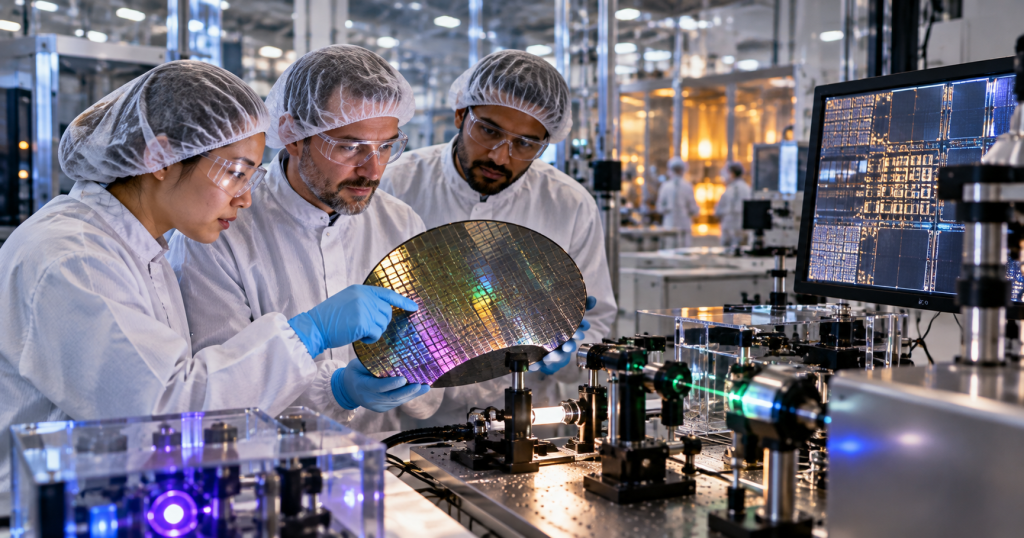
Editor’s Note: The companies have not disclosed contract value, production yield or a commercial launch date. The featured image is original editorial artwork, not a photograph of the GlobalFoundries factory. Embedded discussions are community reactions, not independent validation of the technology.
BitcoinVersus.Tech covers semiconductors, quantum computing, AI hardware and infrastructure. Donations: 3C9o19EH5HSiwEPyCTmEKzxhNCbo2X6TTb. This article is informational, not investment advice.


Leave a Reply