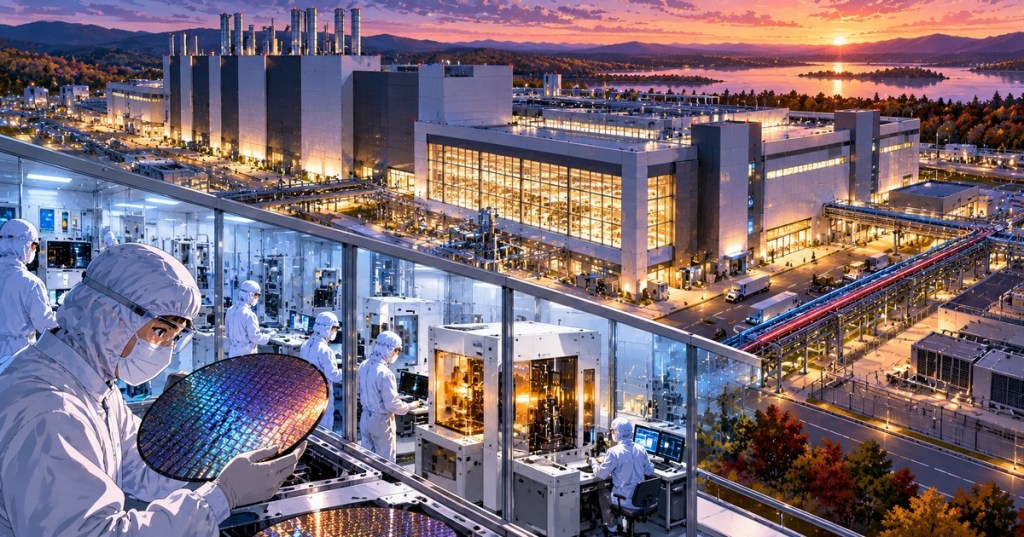
GlobalFoundries will operate two new semiconductor fabs at its Malta, New York, campus under a U.S.-Japan initiative providing up to $21 billion in investment. GlobalFoundries announced the project on October 14, saying Japan will provide the investment while the company supplies the manufacturing technology, operating expertise and fab management.
The first phase is approximately $10 billion for a new 300mm wafer fab expected to come online in 2029. A second investment of roughly $10 billion would fund another fab. GlobalFoundries says each facility could add about 900,000 300mm wafers of annual U.S. manufacturing capacity when fully operational.
Semiconductor-industry discussion focuses on the scale of the investment, staffing needs and the unusual structure of Japan funding capacity operated by GlobalFoundries.
The first fab is scheduled for 2029
GlobalFoundries expects to break ground on the first fab later in 2026. The Malta site is already permitted and can reuse existing infrastructure, which should shorten part of the construction process. The company says the broader project could support about 27,000 construction and ecosystem jobs plus more than 1,000 skilled manufacturing jobs in New York’s Capital Region.
CNBC’s visit to GlobalFoundries in Malta explains the company’s role in U.S. semiconductor manufacturing and the types of chips produced at the site.
The funding structure is unusual
The project is tied to the U.S.-Japan trade and investment agreement reached by the Trump administration. Japan is providing the investment capital, while GlobalFoundries will build and operate the fabs and license its manufacturing technology. Reuters reports that the U.S. government will also take an additional roughly 4% stake in GlobalFoundries through a separate agreement, bringing its total ownership to about 7%.
That equity arrangement is separate from the Japanese investment in the fabs. The political argument for the project is supply-chain security and domestic manufacturing capacity; the commercial test will be whether the new capacity attracts enough long-term customers to justify two very large greenfield factories.
Local reaction in the Albany region centers on construction, technical jobs, utilities and the expansion of the existing semiconductor ecosystem around Malta.
Customers are already lining up
Renesas says it is planning around the new New York capacity as an extension of its own production footprint. Apple, Cirrus Logic and General Motors also publicly backed the expansion. The factories are expected to focus on the differentiated and foundational chips GlobalFoundries specializes in rather than the most advanced leading-edge logic nodes.
CNBC International’s interview with GlobalFoundries CEO Tim Breen examines why the company competes through scale and differentiated technologies rather than leading-edge logic.
The announcement also connects directly with GlobalFoundries’ recent expansion into AI infrastructure. BitcoinVersus.Tech has covered its $2 billion TSMC silicon-interposer agreement in New York, its work with Xanadu on photonic quantum-chip manufacturing, and the broader push toward advanced semiconductor manufacturing and packaging.
The confirmed story is a major capacity expansion with funding and an operator now identified. The first fab still has to be built, qualified and ramped before the projected 2029 start, while the second fab remains dependent on the additional investment moving forward.
BitcoinVersus.Tech Editor’s Note:
We volunteer daily to ensure the credibility of the information on this platform is Verifiably True. If you would like to support to help further secure the integrity of our research initiatives, please donate using the QR code provided

For best QR-code scanning results, please scan this donation code from a desktop or larger screen. Mobile screens may prevent camera recognition.


Leave a Reply