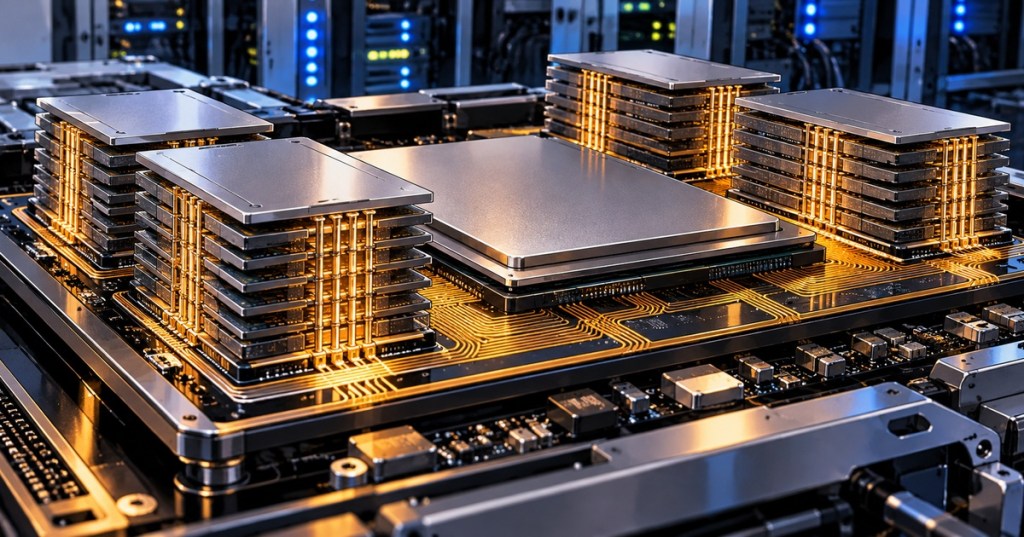
HBM, or High Bandwidth Memory, is a type of DRAM built to move huge amounts of data between memory and a processor. It is especially important in AI accelerators and high-performance computing, where a fast GPU is only useful if memory can feed it quickly enough.
How HBM works
Instead of spreading memory chips across a circuit board like ordinary DDR modules, HBM stacks multiple DRAM dies vertically. Tiny through-silicon vias, or TSVs, carry signals through the stack. The memory is then placed very close to the GPU or accelerator, usually through advanced packaging and a silicon interposer.
Micron describes HBM as 3D-stacked SDRAM connected through thousands of TSVs and microbumps. A typical HBM interface is dramatically wider than DDR, allowing more data to move in parallel rather than relying only on higher clock speeds.
HBM vs. normal RAM
DDR memory is cheaper, removable and excellent for general-purpose system memory. HBM is more expensive and harder to package, but it offers far more bandwidth per package and usually better energy efficiency per bit moved. It is closer to VRAM than ordinary desktop RAM because it sits directly beside the compute device it serves.
Why AI uses so much HBM
AI models constantly move weights, activations and cached data between memory and compute units. If memory cannot keep up, expensive accelerator cores sit idle. That is why the HBM boom has become a major part of the AI hardware market, and why advanced silicon interposers matter almost as much as the memory chips themselves.
The easiest way to remember HBM is this: DDR gives a computer lots of general-purpose memory; HBM gives a processor an extremely wide, short path to data.
BitcoinVersus.Tech Editor’s Note:
We volunteer daily to ensure the credibility of the information on this platform is Verifiably True. If you would like to support to help further secure the integrity of our research initiatives, please donate using the QR code provided

For best QR-code scanning results, please scan this donation code from a desktop or larger screen. Mobile screens may prevent camera recognition.
BitcoinVersus.Tech provides technical education and analysis for informational purposes only.


Leave a Reply