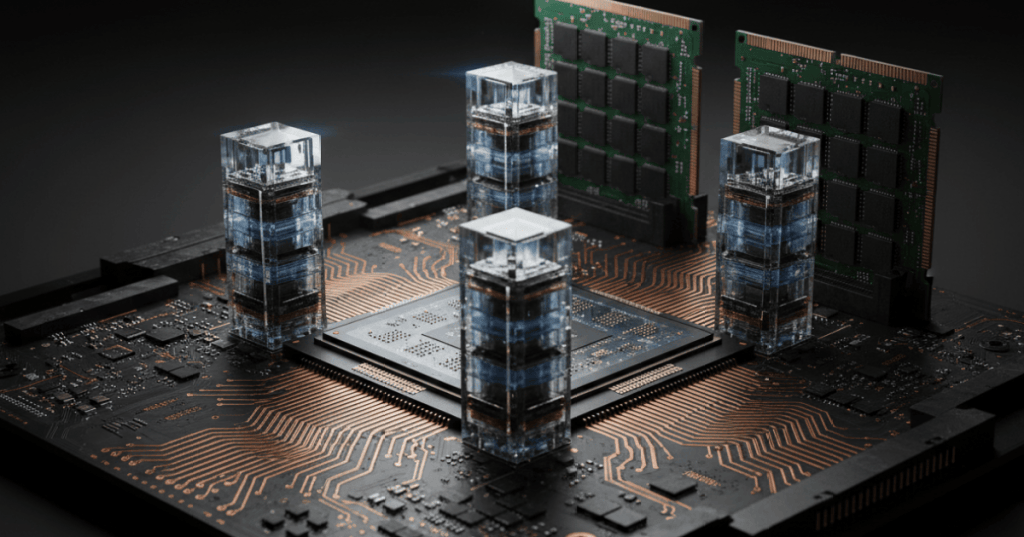
High-bandwidth memory has become one of the most valuable components in the AI hardware stack, but the effect is no longer confined to NVIDIA accelerators or specialized AI servers. As memory manufacturers devote more wafer capacity to HBM, the same production base available for conventional DRAM is being squeezed. Samsung now expects HBM to consume nearly 30% of industry DRAM wafer capacity in 2027, up from roughly 20% today, according to Reuters.
That helps explain why the AI memory boom can show up in the price of ordinary RAM. HBM and standard DRAM are different products, but they compete for overlapping wafer capacity, advanced processes and manufacturing resources. When suppliers prioritize HBM for AI accelerators, fewer resources can be available for DDR5, server RDIMMs and other conventional DRAM products.
TrendForce says expanding AI-server demand is keeping HBM and conventional DRAM in direct competition for limited advanced-process and wafer capacity. The research firm expects that constraint to remain important through 2027 and has raised its 2027 HBM blended average-selling-price outlook to a 121% year-over-year increase.
Software researcher Daniel Lemire recently highlighted the broader memory-price reversal on X, pointing out how sharply the long-term decline in RAM cost has reversed during the AI infrastructure cycle. The important distinction is that HBM is not a magic switch that independently sets every RAM price; it is one of the strongest forces increasing competition for the DRAM manufacturing pool.
Why HBM Consumes So Much of the DRAM Supply Chain
HBM reaches extreme bandwidth by stacking multiple DRAM dies and placing them close to an accelerator through advanced packaging. That architecture can move far more data in parallel than conventional memory interfaces, which is why it has become essential for training and inference systems that would otherwise leave expensive GPUs and ASICs waiting on data.
The tradeoff is manufacturing intensity. HBM uses large DRAM dies, multiple stacked layers, base dies, through-silicon vias and demanding packaging steps. As HBM4 and later generations increase capacity and complexity, the industry cannot instantly create enough new fabs, tools and qualified output to prevent competition with conventional DRAM.
AI Is Turning Memory Into an Infrastructure Constraint
The pressure is visible across the rest of the memory market. BitcoinVersus.Tech recently covered Micron’s record quarter as AI memory demand surged, including the company’s warning that memory supply is becoming a major infrastructure constraint. The issue is not only accelerator HBM. AI systems also need enormous pools of CPU-attached memory, storage and cache capacity.
At the product level, SK hynix is preparing HBM4 for mass production while conventional server memory keeps scaling upward in capacity and speed. Micron, for example, has demonstrated a 512GB DDR5 server module running at up to 9,200 MT/s. Those products all draw on a memory industry trying to expand faster than new fabrication capacity can arrive.
For PC buyers, server operators and data-center engineers, the practical takeaway is straightforward: the price of ordinary memory can now be influenced by demand originating far outside the PC market. A hyperscaler ordering HBM-heavy AI systems does not buy the same DIMM as a desktop user, but both markets ultimately depend on a relatively concentrated group of DRAM manufacturers allocating finite capital, wafers and process capacity.
That makes HBM one of the clearest examples of AI infrastructure demand spilling into the broader technology economy. The accelerators may get the headlines, but the competition underneath them is increasingly about who can secure enough memory capacity—and how much everyone else has to pay for what remains.
BitcoinVersus.Tech
Advertisement
Editor’s Note
We volunteer daily to ensure the credibility of the information on this platform is Verifiably True. If you would like to support to help further secure the integrity of our research initiatives, please donate here: 3C9o19EH5HSiwEPyCTmEKzxhNCbo2X6TTb
BitcoinVersus.tech is not a financial advisor. This media platform reports on financial subjects purely for informational purposes.


Leave a Reply