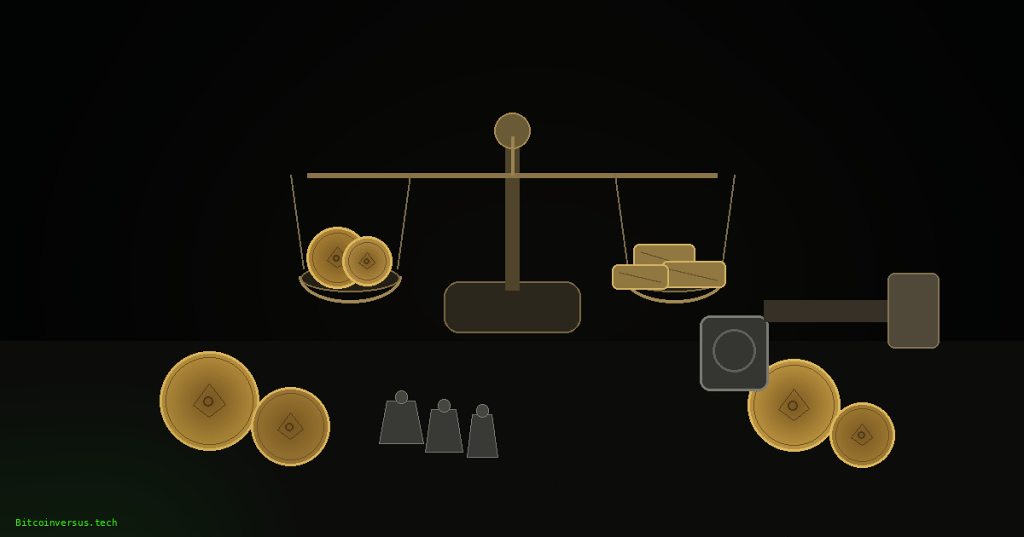
Coinage changed monetary exchange by turning weighed metal into standardized units that carried visible information about weight, authority, denomination, and expected quality. A coin was not merely a piece of metal. It was a compact verification technology.
OSHistory.003 continues the History of Money, Technology & Bitcoin sequence after OSHistory.002: Commodity Money — Why Some Goods Work Better as Money. That lesson ended with the central problem of weighed metal: every transaction could require measuring weight, testing purity, and deciding whether the metal was genuine. Standardized coinage reduced those repeated verification costs.
The sequence begins with OSHistory.001: The Coincidence of Wants, which explains why exchange benefits from a widely accepted intermediary. Coinage is one historical technology for making that intermediary easier to recognize, count, and transfer.
From weighed metal to standardized units
Before stamped coins became widespread, precious metals could circulate by weight. A payment in silver or gold therefore raised several practical questions: How heavy is the piece? What is its purity? Has it been clipped or adulterated? Is the scale reliable? Does the counterparty accept the same unit?
Standardized coinage addressed these questions by combining a controlled quantity of metal with a recognizable mark. The mark did not eliminate the need for trust; it changed where trust was placed. Instead of testing every piece from first principles, users could often rely on a mint, ruler, city, merchant, or other issuing authority whose reputation stood behind the coin.
MIT: money as a system of shared records and trust
The earliest widely recognized coinage
The earliest coins are generally associated with western Anatolia during the seventh and sixth centuries BCE. The British Museum’s Money Gallery describes early Lydian coins made from electrum, a naturally occurring gold-silver alloy, around 650 BCE. These coins were irregular in shape but produced according to strict weight standards and marked with designs and punches.
Reference: British Museum — Money Gallery: The Beginnings of Coinage.
Early coinage therefore introduced a critical idea: standardization does not require visual uniformity. A coin can look irregular while still conforming to a defined weight system.
Weight standards
A coinage system depends on agreed units. If a full unit has a target weight, fractional denominations can be defined as portions of that unit.
A simplified denomination relationship can be expressed as:
fractional coin weight = standard unit weight × denomination fraction
If a hypothetical standard unit weighs 14 grams, a half-unit would target 7 grams and a quarter-unit 3.5 grams, subject to the mint’s tolerance and actual historical standard.
The British Museum catalog includes Lydian electrum staters and fractional staters identified by a Lydo-Milesian weight standard. The important engineering principle is not the specific ancient unit but the move from arbitrary lumps of metal toward repeatable denominations.
Purity and fineness
Weight alone is insufficient when the monetary metal can be alloyed. A 10-gram object made from nearly pure silver is not equivalent to a 10-gram object containing much less silver.
Metal purity is often expressed as fineness:
fine metal content = gross weight × fineness
A 10-gram coin at 90% fineness contains 9 grams of the designated metal. This distinction becomes central to later debates about debasement, clipping, and the difference between face value and metal content.
Why a mint matters
A mint centralizes several activities that would otherwise be repeated by individual traders:
- acquiring or receiving metal;
- refining or testing purity;
- measuring weight;
- forming blanks or flans;
- striking or casting designs;
- enforcing denomination standards;
- rejecting defective pieces;
- communicating the authority behind the issue.
The Smithsonian National Museum of American History explains that coins may be cast in molds or struck between dies. Historically, coins were struck by hand with hammers before minting became increasingly mechanized from the sixteenth century onward.
Reference: Smithsonian — Minting and Printing Money.
A die is an information-bearing tool
A coin die carries a negative image that becomes a positive design when struck into the metal. The resulting design can communicate more than decoration.
- issuing authority;
- denomination;
- religious or civic identity;
- political legitimacy;
- date or mint location;
- assurance of conformity to a standard.
Coinage therefore joined metallurgy with information. The physical object carried both commodity value and a visible claim about who issued it and what it represented.
Coinage and the growth of markets
Standardized units can reduce the time required to settle transactions. Rather than weighing and testing every payment from scratch, buyers and sellers can count recognized denominations when confidence in the issuer is sufficiently high.
Yale’s Introduction to Ancient Greek History notes that precious metal circulated by weight before coinage and connects expanding trade and colonization with changing forms of wealth and market activity. See Open Yale Courses — The Greek Renaissance: Colonization and Tyranny.
The historical relationship between coinage and markets should not be simplified into a claim that coins created trade. Long-distance trade, credit, accounting, and metal exchange already existed. Coinage added another standardization layer to those systems.
A museum view of the history of money
Authority and verification
A stamp is useful only if participants believe it means something. Coinage therefore depends on the credibility of an issuer and the ability of users to recognize genuine pieces.
That creates a new monetary tradeoff:
- standardization reduces private verification work;
- but reliance on the issuer increases;
- counterfeiters can imitate trusted marks;
- issuers can change metal content or standards;
- users may respond by weighing, clipping tests, assaying, or discounting suspect coins.
Coinage is therefore not the end of verification. It is a shift from continuous raw-material verification toward institutional and brand-like verification.
Counterfeiting
A standardized coin creates an obvious target for imitation. Counterfeiters can attempt to reproduce the shape and design while substituting cheaper metal, plating a base-metal core, reducing weight, or copying an issuer’s marks.
Anti-counterfeiting responses have included:
- more complex dies;
- edge designs and lettering;
- controlled alloys;
- standardized diameters and weights;
- official mint marks;
- legal penalties;
- assaying and weighing tools;
- later mechanized production with tighter tolerances.
Clipping and wear
Coins made from valuable metal can lose mass over time through normal wear or deliberate clipping. If many small amounts are shaved from coin edges, metal can be accumulated while the reduced coins continue circulating at their stated denomination.
Milled or patterned edges later made clipping easier to detect. The edge became another verification surface.
Seigniorage
Seigniorage is the economic gain associated with issuing money. In a modern simplified definition, the St. Louis Fed describes seigniorage as the difference between the face value of money and the cost to produce it.
Reference: Federal Reserve Bank of St. Louis — The Economics Behind Coin Production.
Historical coinage systems were more complicated because minting fees, metal content, legal valuation, state finance, and market valuation could differ. The central concept remains useful: whoever controls monetary issuance may receive an economic benefit from transforming metal or another base into officially accepted money.
Face value and metal value
A commodity coin can have several related values:
- face or tariff value: the amount at which the coin is officially accepted;
- metal value: the market value of the contained precious metal;
- exchange value: the amount counterparties actually accept in a transaction;
- numismatic value: a later collector value unrelated to normal circulation.
These values can diverge. When metal value rises above official face value, coins may be melted, exported, or hoarded. When official value substantially exceeds metal content, confidence depends more strongly on legal, political, and monetary institutions.
Debasement
Debasement occurs when the precious-metal content of a coin is reduced while the coin continues to circulate under an established denomination or official valuation.
This can be achieved by reducing weight, lowering fineness, or both. Debasement can increase the number of coins produced from a fixed quantity of precious metal, which may provide fiscal relief to an issuer. It can also reduce confidence, alter prices, and encourage users to sort coins by quality.
Debasement is not identical to inflation, although the two can interact. The economic effect depends on how much money is issued, how quickly metal content changes, whether nominal prices adjust, whether coins circulate by tale or by weight, and what alternatives users have.
Counting by tale versus weighing
A monetary system can move between two practices:
- payment by weight: the metal’s measured mass and purity dominate;
- payment by tale: recognized coins are counted by denomination.
Successful standardization encourages payment by tale because users spend less time reweighing each piece. Loss of confidence pushes behavior back toward weighing, assaying, discounting, or rejecting coins.
Modern minting as precision manufacturing
Minting as manufacturing technology
Modern coin production shows how far the original standardization problem developed. A contemporary mint controls alloy composition, blank dimensions, annealing, surface preparation, rim formation, striking pressure, die condition, inspection, and packaging.
The core engineering goal remains recognizable from ancient coinage: produce a large number of monetary units that can be identified quickly and treated as sufficiently interchangeable for ordinary exchange.
Coinage as a communications network
Coins also carried information across geographic space. A design could communicate the ruler, city, religion, military power, political regime, or cultural symbols of an issuer. Because coins circulated far beyond the mint, they became durable mass-distribution media.
The monetary object therefore performed at least two information functions at once:
- verification information about the payment instrument;
- symbolic information about the issuer.
Why coinage matters to the later history of money
Coinage established several patterns that continue in later monetary systems:
- standard units;
- issuer identity;
- authentication marks;
- denominations;
- official monetary production;
- seigniorage;
- counterfeit resistance;
- tension between intrinsic content and nominal value;
- state or institutional control of issuance.
Paper notes, bank deposits, electronic balances, and Bitcoin solve different monetary problems, but all can be studied through the same deeper questions: What is the unit? Who or what defines validity? How is duplication prevented? How is supply changed? What evidence allows a recipient to accept payment without independently reconstructing its entire history?
Next OSHistory video source: paper money
The next OSHistory step should draw from the Extra History: Paper Money playlist, especially the episodes on origins of exchange, early paper-money systems, and the transition from commodity backing toward state-enforced paper claims.
Exercises
- Explain how standardized coinage reduces the transaction costs of using weighed metal.
- A coin weighs 8 grams at 92.5% fineness. Calculate the fine-metal content.
- List three forms of information a mint mark or coin design can communicate.
- Compare payment by weight with payment by tale.
- Explain why clipping is easier to detect when a coin has a patterned edge.
- Describe the difference between face value and metal value.
- Explain how debasement can increase the number of coins produced from a fixed quantity of precious metal.
- Construct a verification checklist for accepting an unfamiliar historical coin: weight, dimensions, metal, design, issuer, and provenance.
Knowledge check
What major problem did standardized coinage reduce?
The repeated need to weigh, assay, and authenticate every piece of monetary metal independently.
Where are the earliest widely recognized struck coins generally associated?
Western Anatolia, especially Lydia and nearby regions, during the seventh and sixth centuries BCE.
What is fineness?
The proportion of a coin or metal object made from the designated precious metal.
What does a mint provide beyond physical coin production?
Standardization, authentication, issuer identity, denomination control, and a reputation that can reduce private verification costs.
What is seigniorage?
The economic gain associated with issuing money; in a modern simplified definition, the difference between face value and production cost.
What is debasement?
A reduction in the precious-metal content of coinage while the coin continues to circulate under an established denomination or official valuation.
Why can a coin still require trust even when it contains valuable metal?
Users must trust or verify weight, fineness, authenticity, denomination, and the issuer’s adherence to its stated standard.
Why is coinage also an information technology?
Its physical marks communicate standardized claims about the monetary object and often about the authority that issued it.
Key takeaway
Standardized coinage converted metal into a faster-verifying monetary instrument. Defined weights and fineness, recognizable dies, mint authority, denominations, and manufacturing controls reduced the cost of exchange while creating new institutional risks such as debasement, counterfeiting, and abuse of issuance power. Coinage therefore marks a major step in the history of money because it fused commodity, measurement, manufacturing, authentication, and political authority into one portable object.
The next historical development follows naturally from this tension between metal and claims: representative money and receipts that circulate because they promise redemption into an underlying asset.
Historical note: Monetary development did not follow one universal sequence in every society. Coins, weighed metal, credit, accounting systems, commodity money, and other payment arrangements frequently coexisted.
Display note: this lesson uses standard Gutenberg paragraphs, headings, lists, formulas, and media embeds only. No decorative text-box or callout-box layout is used.
BitcoinVersus.Tech
Advertisement
Editor’s Note:
We volunteer daily to ensure the credibility of the information on this platform is Verifiably True. If you would like to support our research initiatives, please donate here: 3C9o19EH5HSiwEPyCTmEKzxhNCbo2X6TTb
BitcoinVersus.tech is not a financial advisor. This media platform reports on financial subjects purely for informational purposes.


Leave a Reply