Before asking what money is, start with a simpler question: what makes trade difficult when there is no commonly accepted thing to trade through?
This is the first lesson in OSHistory — History of Money, Technology & Bitcoin. We begin with one of the most useful ideas in economics for understanding why a medium of exchange can make trade easier: the coincidence of wants, often called the double coincidence of wants.
The idea in one sentence
A direct barter trade works only when each person has something the other person wants at the same time.
Person A has: grain
Person A wants: shoes

Person B has: shoes
Person B wants: grain

Result: trade is possible.
That is a coincidence of wants: the two wants line up.
What happens when the wants do not line up?
Person A has: grain
Person A wants: shoes

Person B has: shoes
Person B wants: a hammer

Result: direct trade fails.
Person A wants what Person B has, but Person B does not want what Person A is offering. Both people may be perfectly willing to trade, yet they still cannot make the direct exchange.
The Federal Reserve Bank of St. Louis describes this problem as the double coincidence of wants: for barter to work, each participant must want what the other participant is offering. That matching requirement creates search costs and makes exchange less efficient.
Video 1: The double coincidence of wants
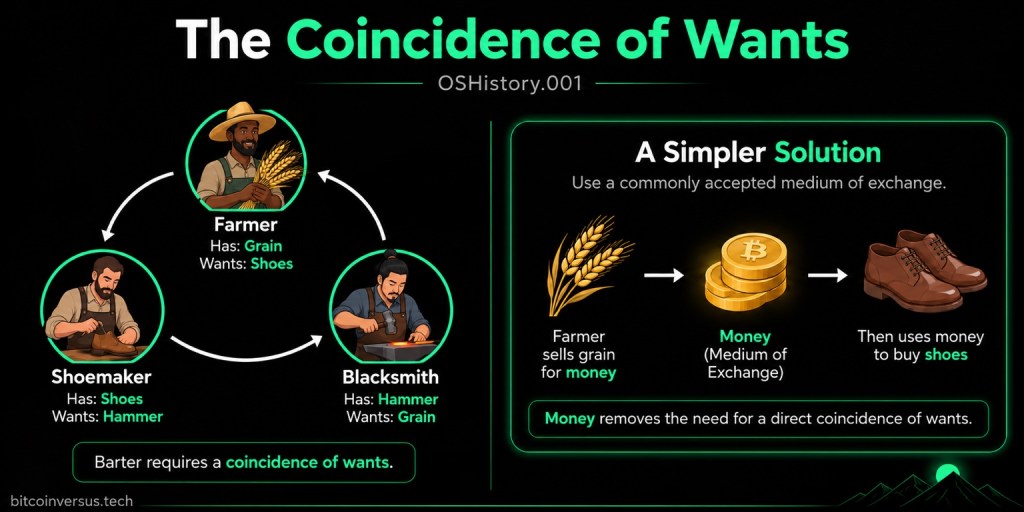
A three-person example makes the problem obvious
Imagine three people:
- Ada grows wheat and wants boots.
- Ben makes boots and wants a hammer.
- Cora makes hammers and wants wheat.
Everyone has something useful. Everyone wants something useful. But no pair has a direct two-way match.
Ada:  wheat  → wants boots
Ben:   boots  → wants hammer
Cora:  hammer → wants wheat

No direct pair matches both wants.
They can still trade, but the process becomes more complicated. Ada might first trade wheat for something Ben is willing to accept, then use that item to obtain boots. As the number of people and goods grows, finding the right chain of trades can become increasingly difficult.
A medium of exchange changes the problem
Now introduce something that many people are willing to accept—not because everyone wants to consume it immediately, but because they expect other people to accept it later.
Without a common medium:
Wheat → ? → ? → Boots

With a commonly accepted medium:
Wheat → Medium of exchange → Boots
This does not mean the medium magically creates value. It means the medium can separate two sides of a transaction.
- You can sell what you have to one person.
- You can later buy what you want from someone else.
- The seller does not need to want the exact product or service you personally produce.
An IMF discussion of money and exchange explains the same basic advantage: a widely accepted medium of exchange can eliminate the costly requirement to find someone who simultaneously has what you want and wants what you have.
Reference: IMF — Private Finance and Public Policy.
Video 2: What money actually does
Why “medium of exchange” matters most here
Money is often taught as having three major functions:
- Medium of exchange — something people commonly accept in payment.
- Unit of account — a common way to quote and compare prices.
- Store of value — something that can carry purchasing power into the future, although not always perfectly.
The coincidence-of-wants problem is mainly about the first function. A widely accepted medium of exchange reduces the need for every buyer and seller to have perfectly matching wants.
The hidden cost: searching for the right trader
The problem is not simply that barter is “old” or inconvenient. The deeper issue is search.
If you make chairs and need food, you must find a food producer who currently wants chairs. If that person wants shoes instead, you may need another trade first. Every additional match takes time, information, negotiation, transportation, and trust.
More goods + more people
        ↓
More possible combinations of wants
        ↓
Harder to find exact barter matches
        ↓
Higher search and coordination costs
A critical history note: do not oversimplify barter
The coincidence-of-wants model is useful, but it should not be turned into a fake universal history.
It is common to hear a neat story that all societies began with pure barter, then invented commodity money, then coins, then paper money. Real economic history is more complicated. Human societies have also used credit, debt, accounting, gift exchange, obligations, commodity payments, state money, and many mixed systems.
So this lesson is not claiming that every society historically passed through the same pure-barter stage. Instead, it is teaching an economic coordination problem: whenever exchange depends on direct swaps, mismatched wants can make trade harder.
Video 3: Money, debt, and the barter-history debate
What makes something useful as a medium of exchange?
For something to reduce coincidence-of-wants friction, people need good reasons to expect that other people will accept it.
- Recognizability: people can identify what it is.
- Acceptability: enough people are willing to receive it.
- Transferability: it can move from one owner to another.
- Divisibility: it can support differently sized transactions.
- Durability: it does not immediately spoil or disappear.
- Scarcity or controlled supply: users have some reason to believe it will not be created without limit.
Different forms of money solve these properties in different ways. Later OSHistory lessons will compare commodity money, metal coinage, ledgers, bank money, fiat currency, digital payment systems, and eventually Bitcoin.
Why this matters for technology
Money is not only an economic idea. It is also an information and coordination technology.
A medium of exchange communicates something important very quickly:
"I accept this from you
because I expect someone else
will accept it from me later."
Once that expectation becomes widespread, trade no longer requires the buyer and seller to want each other’s exact goods. That is a major reduction in coordination complexity.
Why this eventually matters for Bitcoin
Bitcoin appears much later in this history, so we should not jump ahead and call it the answer to every earlier monetary problem. But the coincidence-of-wants lesson gives us a foundation for asking the right questions later:
- Why do people accept one thing in exchange for another?
- How does a monetary network gain acceptance?
- How do scarcity, verification, transfer, settlement, and trust affect monetary systems?
- What changes when value can be transferred digitally without moving a physical object?
Those questions will follow us through the entire OSHistory series.
Quick practice
- You have apples and want a jacket. The jacket maker wants apples. Is there a coincidence of wants?
- You have apples and want a jacket. The jacket maker wants a bicycle. Why can direct barter fail?
- Explain how a generally accepted medium of exchange can allow the apple grower and jacket maker to trade without wanting each other’s goods directly.
- Name one cost created by having to search for exact barter partners.
- Explain why the coincidence-of-wants model does not prove that every historical society began with pure barter.
Knowledge check
1. What is a double coincidence of wants?
It is a situation where each participant in a direct exchange wants what the other participant is offering.
2. Why can barter become difficult?
Because finding someone who has exactly what you want and simultaneously wants exactly what you have can require significant search and coordination.
3. What monetary function most directly reduces this problem?
The medium-of-exchange function.
4. Does this lesson claim that every civilization began as a pure barter economy?
No. The coincidence-of-wants problem is an economic model of direct exchange, while actual monetary history includes barter, credit, debt, accounting, gifts, commodity payments, state currencies, and mixed systems.
Key takeaway
The coincidence-of-wants problem explains why direct exchange can be difficult even when everyone wants to trade. A widely accepted medium of exchange reduces that matching problem by allowing people to sell to one person and buy from another.
This is the starting point for OSHistory. From here, the series can move into the earliest documented monetary systems, commodity money, accounting and ledgers, coinage, banking, fiat currency, electronic money, and eventually Bitcoin.
Display note: the flow diagrams in this lesson are plain-text educational diagrams, not simulated terminals. No terminal color palette is being represented or invented.


Leave a Reply