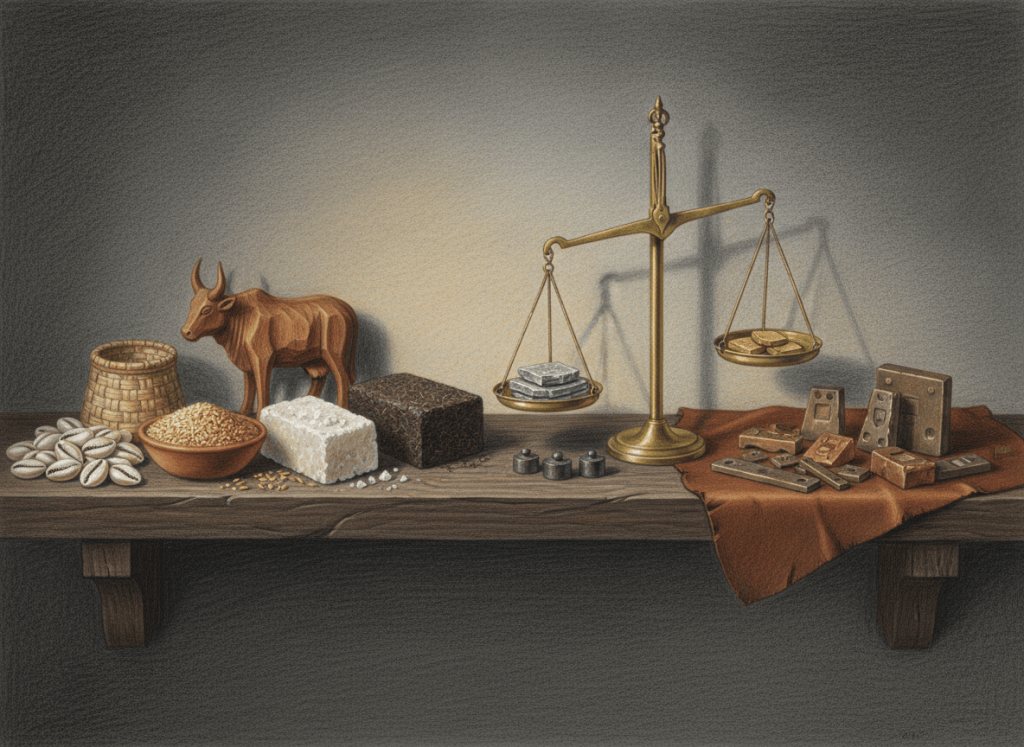
Commodity money emerges when a good is valued not only for immediate use, but also because it is widely accepted in exchange. Some goods perform this role better than others because their physical and economic properties reduce the friction of trade.
OSHistory.002 continues the History of Money, Technology & Bitcoin sequence after OSHistory.001: The Coincidence of Wants. The first lesson explained why direct exchange can fail when wants do not match. This lesson examines why certain goods have repeatedly been adopted as media of exchange and why durability, portability, divisibility, recognizability, scarcity, and acceptability matter.
Commodity money in one sentence
Commodity money is a physical good that circulates as money while also possessing value or usefulness apart from its monetary role.
Historical examples have included livestock, grain, salt, tea, shells, copper, silver, gold, and other locally important goods. No single item became money everywhere, and no single sequence describes every society.
1. Money is a function, not one particular material
Money is commonly described through three functions:
- Medium of exchange: accepted in payment for goods and services.
- Unit of account: provides a common way to quote and compare prices.
- Store of value: carries purchasing power across time, although never perfectly.
The Federal Reserve’s educational materials emphasize that successful money also tends to possess practical characteristics such as divisibility, portability, acceptability, scarcity, durability, and relative stability. See Federal Reserve Education: What Is Money?.
Video 1: What makes something useful as money?
2. Commodity money has a nonmonetary use
A defining feature of commodity money is that the underlying item can be useful or desirable apart from exchange.
- Grain can be eaten or planted.
- Salt can preserve and season food.
- Tea can be consumed.
- Livestock can provide food, labor, hides, or breeding stock.
- Copper, silver, and gold can be worked into tools, ornaments, vessels, or other objects.
This does not mean that every unit of commodity money always traded at exactly the same value as its immediate consumption value. Monetary demand can raise the exchange value of a commodity above the value implied by direct use alone.
3. Durability
A monetary good becomes more useful when it survives storage and repeated exchange.
Fresh food can spoil. Livestock can become sick or die. Grain can rot, burn, absorb moisture, or attract pests. Metals and shells are generally more durable, which can make them easier to hold for later exchange.
Durability matters because a medium of exchange often has to preserve value between the moment a good is sold and the moment another good is purchased.
4. Portability
A monetary good must be transferable. Large, heavy, fragile, or living assets impose transportation costs.
Cattle can represent substantial value, but moving a herd is far more difficult than carrying a pouch of shells or a compact quantity of metal. The Federal Reserve’s Functions of Money lesson uses cattle as a useful illustration of why historically used monetary goods can perform poorly on portability and divisibility compared with modern currency.
5. Divisibility
Trade occurs at many different scales. A useful monetary medium must support both large and small transactions without destroying disproportionate value.
A live animal is difficult to divide while preserving the original asset. Grain, salt, shells, and metals can be separated into smaller quantities more easily.
Divisibility also creates an accounting advantage: prices can be expressed in standardized smaller units instead of requiring a completely different good for every transaction size.
6. Uniformity and recognizability
A medium of exchange works better when units are easy to recognize and compare.
Commodity money creates a difficult question: how can quality be verified?
- One bag of grain may contain more moisture or impurities than another.
- One animal may be healthier than another.
- One piece of metal may have greater purity than another.
- Shells can differ in size, condition, or rarity.
Standard weights, measures, purity tests, seals, and eventually coinage reduced some of these verification costs. This is an important bridge from commodity money to standardized metal money.
Video 2: Commodity money versus fiat money
7. Scarcity and supply
A good that can be produced in unlimited quantities at negligible cost is difficult to use as a stable monetary medium. If supply can expand far faster than demand, existing holders can lose purchasing power.
Scarcity does not require a perfectly fixed supply. It means that production or acquisition is constrained enough that the good cannot be multiplied without cost or limit.
Commodity money can still experience supply shocks. New mines, harvests, trade routes, technologies, or political access can sharply change availability. Monetary scarcity is therefore partly technological and geographic.
8. Acceptability is a network property
A physically excellent monetary commodity is not useful if almost nobody accepts it.
Acceptability depends on expectations. A merchant accepts a monetary good partly because other merchants, workers, suppliers, tax authorities, lenders, or trading partners are expected to accept it later.
This creates a network effect: the usefulness of a monetary medium can increase as the number of participants willing to accept it increases.
9. Cowrie shells: portability, durability, and recognizability
Cowrie shells demonstrate how a small physical object can become widely accepted as a medium of exchange. Smithsonian materials describe cowries as durable, portable, and difficult to imitate, with documented use across parts of Asia, Africa, Oceania, and North America.
Reference: Smithsonian National Museum of American History — Forms of Money.
The historical importance of shells also demonstrates that monetary value is not determined solely by industrial usefulness. Social acceptance, scarcity, recognizability, trade networks, and institutional practice can all matter.
10. Grain, salt, tea, and other consumable commodities
Consumable goods can function as money because they have obvious direct usefulness. Grain, salt, dried fish, and tea have all appeared in historical monetary contexts.
These goods also reveal the tradeoffs of commodity money:
- storage can be expensive;
- quality can vary;
- spoilage or degradation can occur;
- transport can be difficult;
- units may require weighing or measurement;
- supply can fluctuate with harvests, climate, and trade access.
11. Metals solve several problems at once
Copper, silver, and gold became especially important monetary materials because metals combine several useful properties:
- high durability;
- relatively high value in compact form;
- divisibility by weight;
- ability to be melted and reshaped;
- recognizable physical characteristics;
- limited extraction rather than effortless production.
Metal money did not begin with perfectly standardized coins. In many contexts, metal circulated by weight. This required scales, measures, purity judgments, and trusted counterparties.
12. Weighed metal creates a verification problem
Suppose a payment requires a measured quantity of silver. Three questions immediately appear:
- Is the weight correct?
- Is the metal really silver?
- What is its purity?
These questions impose transaction costs. Scales, testing methods, merchants, assayers, seals, and eventually official coinage can be understood as technologies for reducing verification costs.
13. Coinage is a standardization technology
A stamped coin can communicate information about weight, authority, denomination, or expected metal content more quickly than an unmarked piece of metal.
Coinage therefore represents more than a new shape for metal. It is a technology for standardization and trust. Later OSHistory lessons examine how states, mints, debasement, counterfeiting, taxation, and political authority became connected to coinage.
Video 3: Types of money — commodity, representative, fiat, and bank money
14. Monetary history is not one universal ladder
The sequence “barter → commodity money → coins → paper” is useful as a classroom simplification but inaccurate as a universal history.
The British Museum’s money collection emphasizes that money has taken many forms over more than four millennia, including coins, banknotes, shells, and other payment technologies. Complex economies also used credit and accounting systems alongside physical media of exchange.
Reference: British Museum — Money Gallery.
Commodity money should therefore be understood as one important family of monetary arrangements, not as a mandatory stage through which every society passed.
15. Different forms of money can coexist
A society can use several monetary technologies at the same time:
- physical commodities for some exchanges;
- coins for standardized payments;
- credit between known parties;
- accounting ledgers for obligations;
- foreign currencies for long-distance trade;
- state-defined units for taxes and contracts.
This coexistence is historically important because monetary systems evolve by layering new technologies on top of existing social and accounting practices.
16. The technology behind commodity money
Commodity money depends on more technology than the commodity itself.
- containers and warehouses for storage;
- roads, ships, and pack animals for transport;
- scales and standardized weights for measurement;
- metallurgy for refining and testing;
- recordkeeping for debts and inventories;
- seals and marks for authentication;
- markets and communication networks for price discovery.
Money and technology are therefore inseparable. A monetary medium becomes more useful when supporting technologies lower the cost of storing, verifying, transporting, dividing, and accounting for it.
17. Comparing several commodity monies
| Commodity | Strengths | Weaknesses |
|---|---|---|
| Cattle | Useful, scarce, recognizable | Poor divisibility, costly transport, biological risk |
| Grain | Useful, divisible, measurable | Spoilage, storage cost, variable quality |
| Salt | Useful, divisible, storable in dry conditions | Bulk, quality differences, regional supply variation |
| Cowries | Portable, durable, recognizable | Value depends strongly on local scarcity and acceptance |
| Silver | Durable, divisible by weight, compact | Requires weighing/purity verification |
| Gold | Highly durable, compact value, workable | Verification and divisibility tools required; supply can still change |
18. Practice exercise
Consider six candidate monetary goods: fresh fish, cattle, grain, cowrie shells, silver, and ordinary stones available everywhere.
- Rank the goods by durability.
- Rank the goods by portability.
- Identify which goods can be divided most easily without destroying disproportionate value.
- Identify which goods require quality or purity verification.
- Explain why an extremely abundant ordinary stone would struggle to function as scarce money.
- Explain why widespread social acceptance can compensate for some physical weaknesses.
- Explain why a commodity with excellent physical properties can still fail as money if few participants accept it.
Knowledge check
1. What is commodity money?
A physical good that circulates as money while also possessing nonmonetary usefulness or desirability.
2. Why does durability matter?
A monetary good often must preserve value between one transaction and a later transaction.
3. Why does divisibility matter?
Exchange occurs at different scales, so useful money must support smaller and larger payments without destroying disproportionate value.
4. Why is scarcity important?
A medium that can be produced without meaningful constraint can suffer rapid supply expansion and loss of purchasing power.
5. Why does recognizability matter?
Participants must be able to identify the item, compare units, and detect unacceptable quality or counterfeits.
6. Why were metals especially important?
They combine durability, divisibility, portability, workability, and relatively constrained supply.
7. Does commodity money prove that every society evolved from barter in the same sequence?
No. Historical economies used many combinations of barter, commodities, credit, ledgers, coins, obligations, and other monetary arrangements.
Key takeaway
Commodity money is a selection problem. Goods become stronger monetary media when they reduce the costs of storage, transport, division, verification, and exchange. Durability, portability, divisibility, recognizability, scarcity, and acceptability help explain why some commodities repeatedly outperformed others as monetary tools.
The next historical step is not a universal stage but a major technological development: standardized metal coinage, which reduced the repeated need to weigh and verify raw metal in every transaction.
BitcoinVersus.Tech
Advertisement
Editor’s Note:
We volunteer daily to ensure the credibility of the information on this platform is Verifiably True. If you would like to support our research initiatives, please donate here: 3C9o19EH5HSiwEPyCTmEKzxhNCbo2X6TTb
BitcoinVersus.tech is not a financial advisor. This media platform reports on financial subjects purely for informational purposes.


Leave a Reply