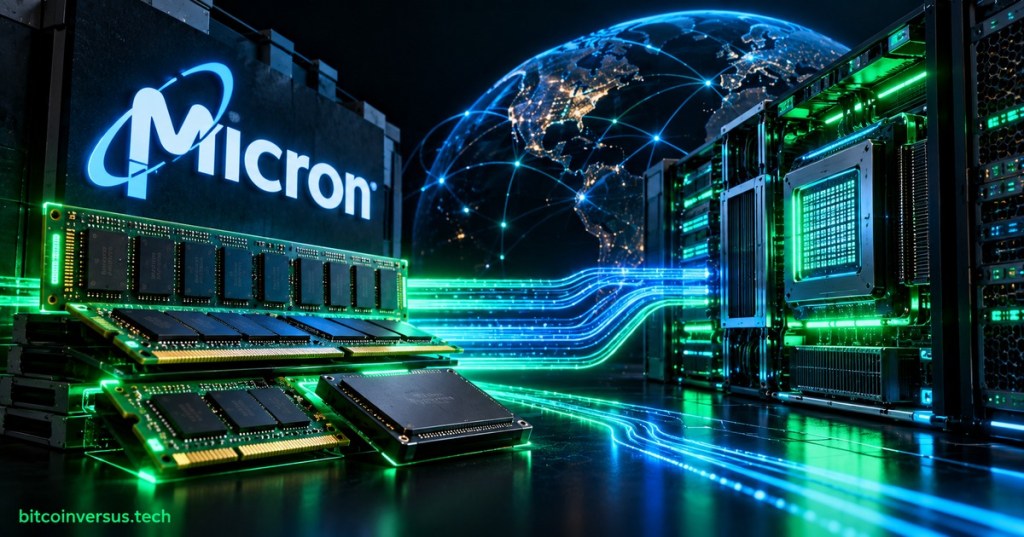
Micron Technology closed fiscal 2026 with a record quarter as demand for memory and storage used in artificial intelligence infrastructure accelerated. The company reported fiscal fourth-quarter revenue of $54.23 billion, up from $41.46 billion in the prior quarter and $11.32 billion a year earlier. Full-year revenue reached $133.19 billion.
The numbers matter beyond Micron’s income statement because memory is becoming a limiting resource for AI systems. Micron guided to $61.5 billion, plus or minus $1.5 billion, of revenue for the first quarter of fiscal 2027. Independent reporting also showed customer commitments under long-term supply agreements rising to $32 billion from $22 billion in June, while remaining performance obligations reached about $150 billion.
Micron President and Chief Operating Officer Manish Bhatia described memory as the chief constraint in AI compared with other frequently discussed limits such as logic and data-center power. The company expects memory and storage supply-demand conditions to be substantially tighter in fiscal 2027 and 2028 than in 2026, while agreements already cover most of Micron’s 2027 high-bandwidth-memory output.
Micron has been making the same infrastructure argument publicly. In September, the company highlighted the rapidly growing KV-cache challenge created by longer-context and agentic AI workloads, where systems must retain and move far more information while models are reasoning and acting.
That pressure is spreading across the memory hierarchy. Earlier in September, Micron argued that HBM, DRAM and NAND increasingly need to operate as a coordinated system rather than independent layers as agentic workloads become more complex.
The Product Pipeline Is Following the Demand
Micron’s product updates show how the company is positioning for the next phase of the buildout. It began sampling 512GB ultra-dense DDR5 RDIMMs capable of speeds up to 9,200 MT/s, a development BitcoinVersus.Tech previously examined in its look at Micron’s 512GB server module. The company also completed multiple customer qualifications for 8,800 MT/s server RDIMMs and said revenue from its server LPDDR SOCAMM portfolio more than doubled sequentially.
Storage is moving closer to the AI execution path as well. Micron said its 7600 PCIe Gen 5 and 9650 PCIe Gen 6 SSDs are shipping to leading customers for KV-cache applications. It also began sampling 1-gamma LPDDR6 products to multiple physical-AI markets.
The competitive picture extends across the industry. SK hynix is preparing HBM4 for mass production, while Applied Materials and KIOXIA are expanding AI-memory research. Those efforts point toward a broader shift: compute growth increasingly depends on how quickly data can be stored, moved and supplied to accelerators.
For data-center operators, the important signal is not simply that a memory vendor posted record financial results. Micron’s contracts, product roadmap and capacity comments suggest memory availability is becoming a planning variable alongside accelerators, networking and power. More capable AI models can demand larger working sets, longer context and faster movement of data between storage, system memory and high-bandwidth memory.
Micron plans to raise fiscal 2027 capital spending above its previous plans, but new capacity takes time to reach meaningful output. That lag helps explain why memory can remain tight even as manufacturers commit billions of dollars to fabs and process transitions. For the AI infrastructure market, the next bottleneck may increasingly be measured not only in GPUs or megawatts, but in how much fast memory can actually be delivered.
BitcoinVersus.Tech
Advertisement
Editor’s Note
We volunteer daily to ensure the credibility of the information on this platform is Verifiably True. If you would like to support to help further secure the integrity of our research initiatives, please donate here: 3C9o19EH5HSiwEPyCTmEKzxhNCbo2X6TTb
BitcoinVersus.tech is not a financial advisor. This media platform reports on financial subjects purely for informational purposes.


Leave a Reply