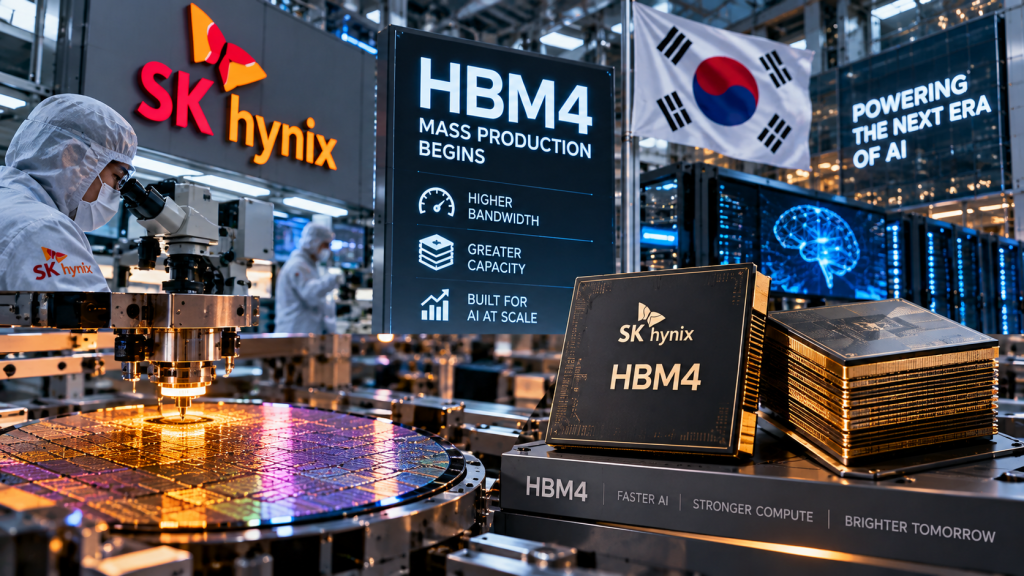
SK hynix says it has completed development of HBM4 and built the industry’s first mass-production system for the next generation of high-bandwidth memory, positioning the chip for the next wave of AI accelerators.
The company announced the milestone on September 12. HBM4 doubles the interface width from 1,024 I/O terminals in HBM3E to 2,048, creating a much wider path between stacked memory and the processors consuming its data.
SK hynix says its HBM4 operates above 10 Gbps per pin, exceeding the JEDEC standard of 8 Gbps, while delivering more than 40% better power efficiency than the previous generation. The company says that performance could raise AI-service performance by as much as 69% in some workloads while reducing data-center power consumption.
The move arrives as memory bandwidth becomes one of AI computing’s central constraints. BitcoinVersus.tech recently covered memory-first AI inference and CXL 3.2 memory expansion, two different attempts to keep processors fed with data as models and context windows grow.
HBM4 also changes the physical architecture. Its 2,048-bit interface gives accelerator designers twice as many data paths as HBM3E. SK hynix says it preserved its proven 1b-nanometer DRAM process and advanced MR-MUF packaging, a manufacturing choice intended to improve yield and maintain production stability as the stack becomes more complex.
That manufacturing challenge connects HBM4 to the broader semiconductor capacity race. Taiwan recently broke ground on a TSMC advanced-packaging hub, while GlobalFoundries and Marvell are expanding U.S. capacity for AI networking silicon.
SK hynix has also been expanding around the edges of HBM. BitcoinVersus.tech recently reported on the company’s push into AI memory beyond HBM and its venture arm’s move into AI data centers and optical interconnects. HBM4 now gives the company a production-ready centerpiece for that broader AI infrastructure strategy.
The key distinction is that SK hynix is not merely announcing a laboratory prototype. It says the mass-production system is ready, putting the focus on customer qualification, production ramp and integration into next-generation accelerators. Actual shipment volumes and customer-specific deployment schedules were not disclosed in the announcement.
Follow BitcoinVersus.tech on X
Editorial note: BitcoinVersus.tech covers the intersection of Bitcoin, technology, computing, energy and emerging infrastructure. This report is based on publicly available reporting and company disclosures.
Disclaimer: This article is for informational purposes only and is not financial or investment advice.


Leave a Reply