Samsung Electronics just put a giant number on the AI memory boom: the company expects roughly $80.2 billion in operating profit for the third quarter of 2026, up 782.5% from a year earlier.
Samsung’s official preliminary guidance puts quarterly sales at about $145.6 billion and operating profit at about $80.2 billion. The company’s full third-quarter results are scheduled for October 29, so the preliminary release does not yet provide a complete divisional breakdown.
But the direction is clear. Reuters reports that surging demand for memory used in AI data centers is the main force behind the earnings jump, with high-bandwidth memory, or HBM, and conventional memory supply remaining tight.
The Numbers Are Huge Even Before the Full Report
Samsung says third-quarter sales should land near $145.6 billion, compared with about $64.3 billion in the same quarter of 2025. Operating profit is expected at $80.2 billion, compared with about $9.1 billion a year earlier. That works out to year-over-year increases of 126.59% in sales and 782.50% in operating profit.
Sequentially, the company is also moving higher. Samsung reported about $128.1 billion in sales and $66.8 billion in operating profit for the second quarter of 2026. The preliminary third-quarter figures therefore point to another step up in both revenue and profit.
Reuters described the result as the highest quarterly operating profit reported by a technology company. Whether that superlative holds across every accounting comparison is less important than the underlying signal: memory has moved from being one component inside a computer to one of the most valuable bottlenecks in the global AI buildout.
HBM Is Where AI Compute Meets the Memory Wall
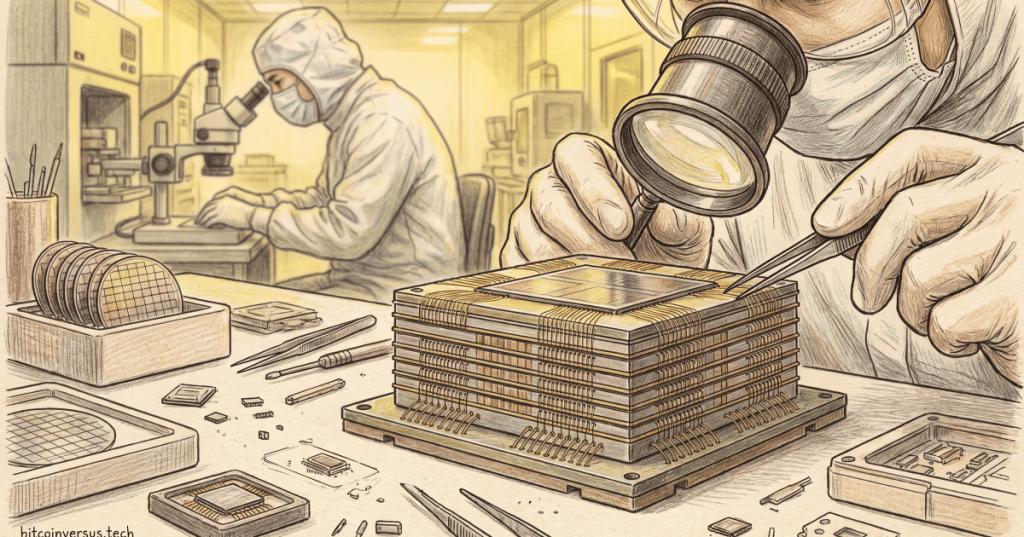
Modern AI accelerators can perform enormous numbers of calculations, but those processors still need a constant stream of model weights and intermediate data. That is why HBM4 and other stacked-memory technologies matter so much: they put very wide, high-speed memory interfaces close to the processor package.
The same basic problem shows up at smaller scale in consumer systems. A GPU’s VRAM has to keep graphics and compute data close enough to prevent the processor from starving. AI servers magnify that memory-bandwidth problem dramatically because they connect many accelerators, large model datasets, and huge pools of high-speed memory.
Samsung is competing directly with SK hynix and Micron for that market. The prize is not only HBM sales. Winning more AI-memory business can pull through demand for DRAM, packaging, test, substrates, and the rest of the infrastructure surrounding accelerator systems.
The AI Boom Is Also Pulling Conventional DRAM Higher
HBM is specialized, but it still consumes manufacturing capacity, engineering attention, packaging resources, and capital that could otherwise support other memory products. That is why the HBM boom has already begun affecting ordinary DRAM pricing and availability.
For PC builders and server operators, the spillover matters. More capacity devoted to AI memory can tighten the supply of conventional RAM, while higher prices for memory components can work their way into servers, workstations, laptops, and graphics cards.
That pressure also reaches storage. NAND flash is a different technology from DRAM and HBM, but the same AI infrastructure cycle is increasing demand across the broader semiconductor and storage stack.
Samsung’s Advantage Is That It Touches Almost Every Layer
Samsung is unusual because it is not only a memory vendor. It also operates a large semiconductor foundry, builds logic chips, develops advanced packaging, sells storage, and manufactures consumer electronics that use many of the same components.
That vertical reach can be powerful when the market is tight. A company that understands memory, logic, advanced chip packaging, and end systems can coordinate product roadmaps in ways a single-product supplier cannot.
Samsung has even pushed its leading-edge manufacturing technology into unusual markets. A recent BitcoinVersus.Tech analysis traced Samsung 3 nm gate-all-around silicon into a WhatsMiner ASIC, showing how the same foundry ecosystem can reach far beyond phones and conventional PCs.
But the Foundry Business Is Still the Weak Spot
The record memory cycle does not mean every Samsung semiconductor business is equally strong. Reuters reports that Samsung’s foundry operation remains loss-making because of low utilization and high fixed costs, even as conditions improve.
That matters because foundries are brutally capital-intensive. A modern semiconductor fab requires cleanrooms, photolithography, deposition, etch, metrology, utilities, process control, and a constant stream of capital spending before a single wafer ships profitably.
Samsung is also competing with TSMC, which remains the dominant pure-play foundry. Memory profits can give Samsung more financial room to invest, but they do not automatically solve yield, utilization, customer trust, or process-technology execution.
Memory Testing and Packaging Become More Valuable Too
As memory gets faster and more densely integrated, the supporting test and packaging chain becomes more important. High-speed interfaces, thermal behavior, signal integrity, and stack reliability all have to work at production scale.
That is why equipment targeting next-generation memory testing and new packaging approaches are increasingly strategic rather than secondary. A bad memory die buried inside an expensive stack can destroy the economics of an entire package.
NVIDIA’s AI Racks Are Part of the Demand Engine
Much of the memory demand ultimately traces back to the growth of large accelerator systems. NVIDIA AI racks combine GPUs, CPUs, high-speed networking, cooling, power delivery, and massive memory bandwidth into systems designed to keep expensive compute silicon busy.
If accelerator deployments keep scaling, memory suppliers do not need every chip price to rise forever to benefit. They need the installed base of AI compute to keep expanding faster than memory capacity can comfortably catch up.
The Risk Is the Memory Industry’s Old Boom-and-Bust Cycle
Memory has always been cyclical. Tight supply drives prices and profits higher, suppliers add capacity, and eventually the market can swing toward oversupply. The current AI cycle looks unusually strong because demand is coming from hyperscale infrastructure and multi-year buildouts, but the old economics have not disappeared.
Reuters says analysts expect the supply-demand imbalance to remain tight into 2028. That would be a long runway by memory-industry standards. But Chinese competition, trade policy, new fab capacity, stronger currencies, and a slowdown in AI infrastructure spending could all change the picture.
What to Watch on October 29
Samsung’s preliminary guidance gives the headline numbers. The October 29 earnings report should show more of the machinery underneath them: memory profitability, HBM progress, foundry utilization, capital spending, pricing expectations, and management’s view of 2027 demand.
The central question is whether this quarter is simply the top of another memory cycle or evidence that AI has permanently raised the strategic value of memory. Right now, Samsung’s numbers argue strongly for the second possibility—but the next several quarters will show how durable that shift really is.
Editor’s Note
Samsung’s October 8 Korea earnings guidance is preliminary. Divisional results and additional management commentary are expected with the full third-quarter report on October 29, 2026.
Support and donation options are available through BitcoinVersus.Tech.
BitcoinVersus.tech is not a financial advisor. Content is provided for informational purposes.


Leave a comment