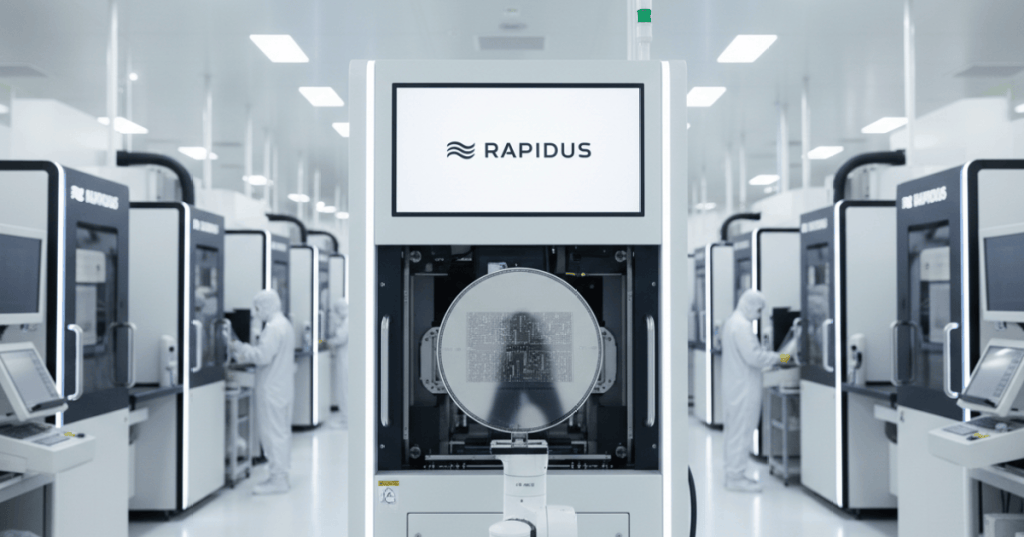
Japan’s Rapidus has moved beyond proving that it can build advanced transistors and into a harder phase of the foundry business: convincing chip designers to actually use its planned 2-nanometer manufacturing process.
Reuters reports that Rapidus, backed by roughly $15 billion in Japanese government support, is trying to secure customers ahead of its planned launch of 2nm contract-chip production in the second half of fiscal 2027. The technological ambition is enormous, but the commercial question is simple: who will fill the fab?
Rapidus CORE Adds 17 Design Partners
On October 5, Rapidus announced Rapidus CORE—short for Collaborative Open Rapid Ecosystem—a framework intended to connect research, electronic design automation, intellectual property, chip design and manufacturing around its advanced foundry process.
The first phase is a group called Design Solution Associates. Its 17 members include Cadence Design Systems, Synopsys, Infosys, HCL Technologies, Wipro, Dai Nippon Printing, TOPPAN and several semiconductor-design specialists across Asia. Rapidus says these companies will provide engineering resources and expertise that help customers move from an early chip concept toward manufacturing.
That design layer matters because a leading-edge fab is not useful by itself. Customers also need mature design tools, reusable IP, verification flows, physical-design expertise and engineers who know how to translate a chip architecture into a manufacturable layout. BitcoinVersus.Tech recently explained the same design-to-fab dependency in our coverage of Siemens and TSMC using AI agents to catch chip-design errors.
The Real Test Is Customers, Not Just Nanometers
Rapidus is pursuing one of the most technically difficult manufacturing transitions in the semiconductor industry. A “2nm” process name does not literally mean every transistor feature measures two nanometers; it identifies a leading-edge process generation designed to improve transistor density, performance and energy efficiency.
But even a successful process must achieve competitive yield. As BitcoinVersus.Tech explains in our wafer-yield guide, the economics of a fab depend heavily on how many functional dies can be recovered from each expensive processed wafer. A technically impressive process with weak yield can still produce chips that are too costly for customers.
Rapidus must therefore solve two problems at once: bring a 2nm process into stable volume manufacturing and build enough customer confidence that companies commit real designs before the factory has years of production history behind it.
TSMC, Samsung and Intel Already Have Ecosystems
The competitive challenge is bigger than transistor technology. TSMC, Samsung and Intel have spent years building relationships among EDA vendors, IP providers, packaging companies, equipment suppliers and chip designers. Those ecosystems reduce the risk of taking a new design from software into silicon.
Rapidus CORE is an attempt to compress that ecosystem-building process. Synopsys and Cadence are particularly important because their design and verification tools sit close to the beginning of many advanced semiconductor projects, while engineering-services firms can help companies that lack large internal design teams.
The race is happening while leading-edge capacity remains strategically valuable. BitcoinVersus.Tech recently reported that TSMC is weighing additional U.S. capacity as AMD seeks more wafers, illustrating how access to advanced manufacturing can become a competitive constraint even for established chip companies.
Why Japan Is Spending So Much
Japan once held roughly half of the global semiconductor market in the 1980s, according to Reuters, but its share has since fallen below 10%. Rapidus is part of a broader national strategy to restore domestic access to leading-edge manufacturing and reduce dependence on a small number of overseas production centers.
The company’s technology relationship with IBM gives it a path toward advanced gate-all-around transistor manufacturing, while the new design ecosystem addresses the other side of the equation: making the process accessible enough for customers to design products around it.
Rapidus Needs Tape-Outs
The 17-company alliance is meaningful infrastructure, but it is not the same thing as commercial traction. The next important milestones are customer commitments, successful design tape-outs, competitive yields and repeat production orders.
That distinction matters because a foundry can have sophisticated equipment and a technically credible process without having enough volume to support the enormous fixed cost of leading-edge manufacturing. Rapidus now has to show that its ecosystem can reduce customer risk enough to put real chips into its production queue.
The Bigger Point
Rapidus CORE shows that Japan’s 2nm project is becoming more than a fab-construction program. It is trying to build the surrounding commercial machinery that turns a process node into an actual foundry business.
The $15 billion question is no longer simply whether Rapidus can manufacture a 2nm transistor. It is whether enough chip companies will trust the tools, yields, schedules and economics to manufacture their products there. Seventeen design partners make that path easier. Customers will determine whether the bet ultimately works.
BitcoinVersus.Tech
Advertisement
Editor’s Note
Rapidus’ production schedule, customer pipeline and government-support figures remain subject to change as the 2nm program advances. This story distinguishes announced ecosystem partnerships from confirmed commercial foundry orders.
We volunteer daily to help ensure the credibility of the information on this platform is Verifiably True. If you would like to support our research initiatives, please donate here: 3C9o19EH5HSiwEPyCTmEKzxhNCbo2X6TTb
BitcoinVersus.tech is not a financial advisor. Content is provided for informational purposes.


Leave a Reply