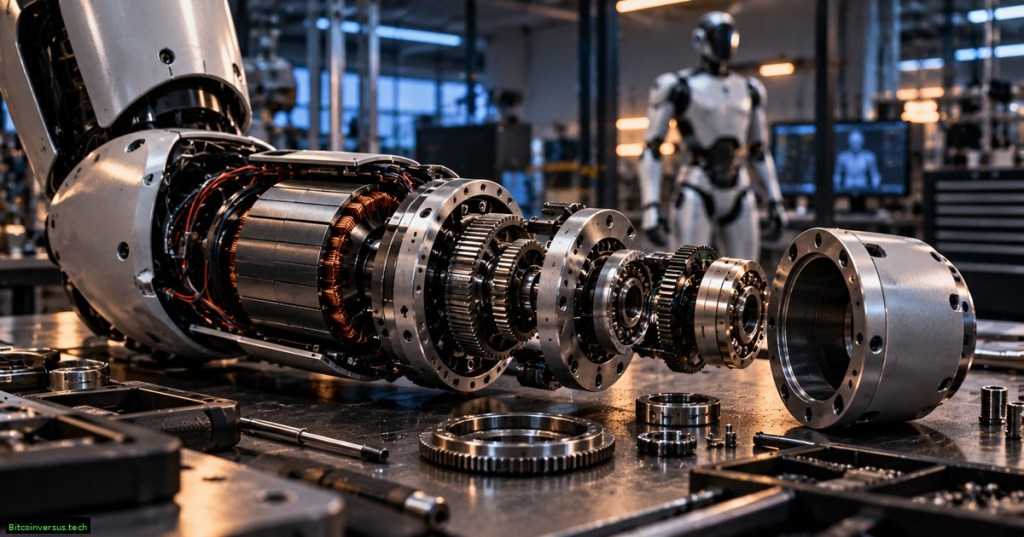
The race to build useful humanoid robots is usually framed as an artificial-intelligence contest. But one of the hardest scaling problems is much more physical: actuators, the compact motor-and-transmission assemblies that turn software commands into movement at a robot’s hips, knees, shoulders, elbows, wrists, and hands.
Apptronik CEO Jeff Cardenas recently warned that the United States lacks enough domestic supply for critical humanoid components such as precision gears. Reporting on his comments estimates that actuation can represent as much as 60% of a humanoid robot’s bill of materials. Independent component research places the broader range around 40–60%, depending on architecture and what is counted inside the joint module.
What an Actuator Actually Does
An actuator converts electrical energy into controlled mechanical motion. A modern humanoid joint may combine a frameless electric motor, precision reducer or roller screw, bearings, encoder, torque sensor, drive electronics, and structural housing. The exact architecture changes by joint because a hip needs different torque, speed, packaging, and shock tolerance than a finger.
This is why a humanoid is not simply a computer with arms and legs. The AI stack can decide that a foot should move, but the actuator stack has to generate the correct torque at the correct speed, repeatedly, without overheating, wearing out, oscillating, or throwing the robot off balance.
The Gearbox Is a Precision-Manufacturing Problem
Rotary humanoid joints commonly use precision reduction systems such as strain-wave, planetary, or cycloidal gearing. A reducer lets a high-speed motor produce the slower, higher-torque motion needed at a robot joint while controlling backlash and positioning error.
Research from Core Matter identifies strain-wave reducer production as a particularly thin part of the U.S. supply chain and reports no U.S. supplier producing them at volume. Domestic options exist at other layers—including motors, screws, and bearings—but the reducer illustrates why simply building a robot assembly plant does not automatically create a domestic component ecosystem.
Apptronik Has Designed More Than 80 Actuators
Apptronik’s actuator work predates today’s humanoid boom. The company says its robot-development history includes generations of custom electric actuators, and its current Apollo manufacturing strategy emphasizes simpler joints with fewer components and lower manufacturing cost. Apptronik is working with Jabil to scale Apollo production and unify more of its manufacturing supply chain.
The contradiction is important: a robot company can possess deep actuator design expertise while still depending on an external industrial base for gears, bearings, magnets, screws, sensors, electronics, and manufacturing capacity. Designing a high-performance joint and producing hundreds of thousands of qualified joints at predictable cost are different engineering problems.
China’s Advantage Is Below the Finished Robot
China’s robotics advantage is not limited to complete humanoid brands. It includes a dense manufacturing network for motors, reducers, joint modules, electronics, magnets, machined parts, and other components. That shortens iteration cycles because robot makers can redesign a joint and work with nearby suppliers instead of waiting for a distant specialty component.
Recent reporting has also described U.S. investors visiting Chinese robotics factories specifically to understand this manufacturing advantage. The concern is that American companies can remain competitive in models and software while still depending on foreign factories for the physical components that make those models move.
Why Actuator Cost Controls Humanoid Pricing
If actuation consumes roughly 40–60% of a humanoid’s hardware bill, reducing joint cost changes the economics of the entire machine. It affects not only purchase price but also repairability, spare-parts inventory, field service, reliability, and the cost of replacing high-load joints over a robot’s operating life.
The open Berkeley Humanoid Lite project demonstrates the same effect at research scale: its actuators dominate the published component cost. At industrial scale, the challenge becomes harder because joints must survive much longer duty cycles while maintaining torque density, low backlash, sensing accuracy, thermal performance, and safety.
Software Cannot Fix a Bad Joint
Physical AI can compensate for imperfect hardware only to a point. A controller can adapt to friction or small calibration errors, but it cannot create torque a motor cannot deliver, remove backlash from a worn transmission, or cool an actuator whose thermal design is undersized.
That is why the humanoid race increasingly resembles the semiconductor and data-center industries: the visible product sits on top of a less-visible supply chain. For robots, precision actuators may become one of the defining infrastructure layers beneath robot AI software, vision systems, batteries, compute, and safety systems.
What to Watch
The useful metrics are not just how many humanoids a company says it plans to build. Watch the number of actuators per robot, qualified supplier capacity, reducer and roller-screw lead times, joint lifetime, torque density, thermal limits, repair time, second-source availability, and the percentage of the bill of materials that can actually be manufactured at the intended production volume.
If humanoids move from pilots into factories by the tens or hundreds of thousands, the companies that can mass-produce reliable robot joints may become as important to physical AI as GPU suppliers are to generative AI.
BitcoinVersus.Tech
Advertisement
Editor’s Note
The 40–60% actuator share is an industry estimate, not a universal specification. Humanoid architectures differ substantially, and manufacturers generally do not publish complete production bills of materials. Supplier-capacity claims should likewise be distinguished from qualified production deliveries.
We volunteer daily to ensure the credibility of the information on this platform is Verifiably True. If you would like to support to help further secure the integrity of our research initiatives, please donate here: 3C9o19EH5HSiwEPyCTmEKzxhNCbo2X6TTb
BitcoinVersus.tech is not a financial advisor. This media platform reports on financial subjects purely for informational purposes.


Leave a Reply