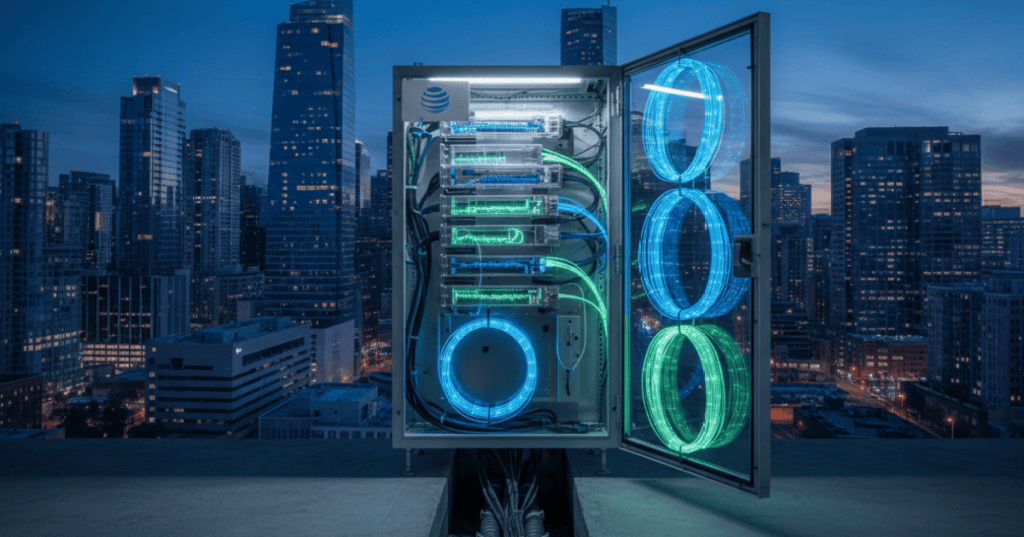
AT&T is creating a new wholesale fiber company with BlackRock’s Global Infrastructure Partners and CPP Investments, combining two existing build platforms into a joint venture that is expected to begin with nearly 5 million fiber locations and more than 1 million AT&T fiber subscribers.
Reuters reported the agreement on October 6 as AT&T looks for a capital-light way to accelerate fiber deployment beyond its traditional wireline territory. The transaction brings infrastructure investors directly into the physical buildout while AT&T keeps a major ownership stake and customer relationship.
Forged Fiber 37 and Gigapower Are Becoming One Platform
Under the official AT&T announcement, the new company will combine Forged Fiber 37—the build engine and network assets AT&T recently acquired from Lumen—with Gigapower, AT&T’s existing open-access fiber joint venture with GIP.
AT&T will own 50% of the new venture. GIP and CPP Investments will collectively own the other 50%. The companies expect the transaction to close in the first half of 2027, subject to regulatory approvals and customary closing conditions.
The structure turns fiber construction into a shared infrastructure investment rather than requiring AT&T to fund every new route entirely on its own balance sheet. That is materially different from the supply-side expansion BitcoinVersus.Tech covered in AT&T’s more than $3 billion Corning fiber-and-cable agreement: Corning helps supply the glass and cable, while this JV changes who finances and owns portions of the network being built.
The JV Starts With Nearly 5 Million Fiber Locations
AT&T says the combined venture is expected to have nearly 5 million fiber locations at closing, serving more than 1 million AT&T fiber subscribers in major metropolitan areas across 16 states.
Forged Fiber 37 operates in Arizona, Colorado, Florida, Idaho, Iowa, Minnesota, Nebraska, Nevada, Oregon, Utah and Washington. Gigapower’s footprint includes Alabama, Arizona, Florida, Minnesota, Nevada, New Mexico, Pennsylvania, North Carolina and South Carolina.
The overlap is intentional: this is an open-access wholesale platform, meaning physical fiber infrastructure can support service providers without requiring every provider to construct a completely separate last-mile network.
AT&T Is Still Targeting More Than 60 Million Locations
The joint venture supports AT&T’s goal of reaching more than 60 million total fiber locations by the end of 2030. AT&T expects roughly 50 million of those locations to come from its owned-and-operated network, with the JV becoming its primary partner for expansion outside traditional service areas.
That scale matters because modern networks are carrying increasingly large flows from cloud services, AI tools, streaming, gaming and connected devices. The last mile is only one part of the chain: BitcoinVersus.Tech has also covered why top-of-rack switching inside data centers determines how efficiently traffic moves between servers once those workloads reach the compute facility.
Fiber Is Becoming an AI Infrastructure Asset
AI infrastructure discussions often focus on GPUs and electricity, but moving data into, out of and between compute sites is equally physical. Fiber offers high bandwidth, low latency and enormous upgrade headroom because operators can often increase capacity by changing optical equipment at each end without replacing every strand in the ground.
AT&T explicitly framed the JV around an “AI-enabled future.” The company says AI is beginning to reshape network traffic, strengthening the case for long-lived fiber assets rather than connectivity designed only around today’s residential broadband patterns.
At the data-center scale, that same bandwidth race is pushing optical links toward ever-higher rates. BitcoinVersus.Tech recently examined Marvell’s work on 3.2-terabit AI-network optics, showing how the fiber itself and the silicon driving light through it are evolving together.
Why Infrastructure Funds Want Fiber
Fiber networks require large upfront construction costs but can operate for decades. That makes them a natural fit for infrastructure investors looking for long-lived assets backed by recurring demand.
For AT&T, sharing ownership can lower the marginal capital burden of expanding into additional markets. For GIP and CPP Investments, the venture provides exposure to a network asset tied to broadband, 5G backhaul and future AI-driven data demand.
The Bigger Point
The new company is not merely a financing vehicle. It combines construction capability, existing fiber routes, open-access economics and AT&T’s distribution into one platform that can keep extending the physical network while sharing the cost of doing so.
AT&T’s 60-million-location target therefore depends on more than buying cable. It depends on creating repeatable ways to finance, construct and operate millions of individual fiber connections. Forged Fiber 37 plus Gigapower gives AT&T, GIP and CPP Investments a single vehicle for doing exactly that.
BitcoinVersus.Tech
Advertisement
Editor’s Note
The joint venture is expected to close in the first half of 2027 and remains subject to regulatory approval and customary closing conditions. Location and subscriber figures are company projections for the combined platform at closing.
We volunteer daily to help ensure the credibility of the information on this platform is Verifiably True. If you would like to support our research initiatives, please donate here: 3C9o19EH5HSiwEPyCTmEKzxhNCbo2X6TTb
BitcoinVersus.tech is not a financial advisor. Content is provided for informational purposes.


Leave a comment