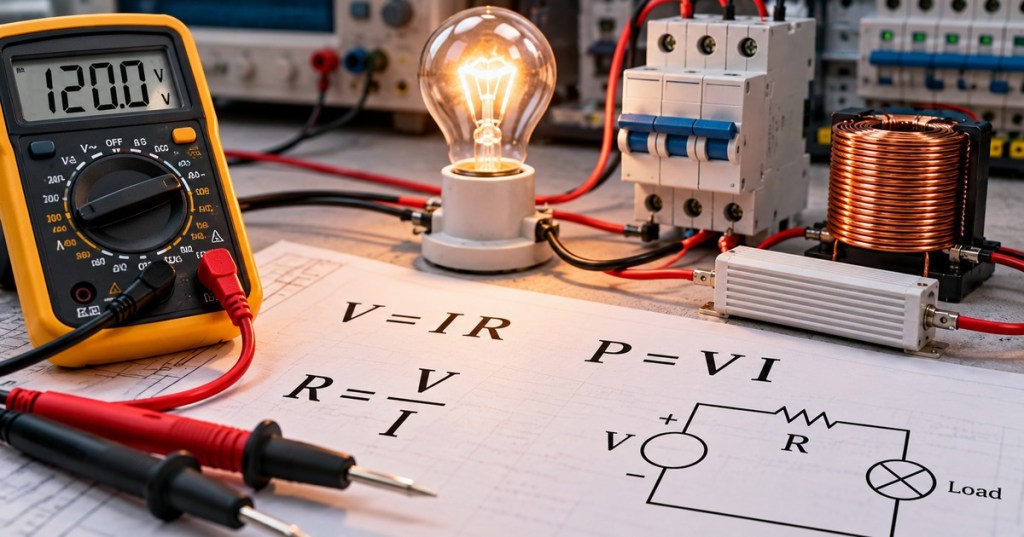
Volts, amps, ohms, and watts describe four different parts of electricity. Voltage is electrical potential difference, current is the rate of electric charge flow, resistance opposes that current, and power describes how quickly electrical energy is being transferred or used.
The easiest way to learn them is together. Voltage can push current through a resistance, and voltage multiplied by current gives electrical power. Once those relationships are clear, labels on outlets, power supplies, ASIC miners, servers, breakers, and electrical equipment become much easier to read.
Volts Measure Electrical Potential Difference
A volt measures electric potential difference between two points. In simple circuit language, voltage is the electrical “push” available to move charge through a circuit.
NIST identifies the volt as the SI unit of electric potential difference and gives the relationship 1 V = 1 W/A. Voltage does not by itself tell you how much current is actually flowing; the circuit and its impedance determine that.
Amps Measure Electric Current
An ampere, usually shortened to amp, measures electric current. Current describes the rate at which electric charge passes a point in a circuit.
A circuit can operate at a high voltage while drawing relatively little current, or at a lower voltage while drawing much more current. That distinction becomes important because conductors, connectors, fuses, and breakers have current limits.
Ohms Measure Resistance
Resistance describes how strongly a component or conductor opposes current. Its unit is the ohm, written with the symbol Ω.
SparkFun’s electrical fundamentals guide uses a water-flow analogy: voltage acts somewhat like pressure, current like flow, and resistance like a restriction in the path. The analogy is imperfect, but it is useful for building intuition.
Ohm’s Law Connects Volts, Amps, And Ohms
For a simple resistive circuit, Ohm’s law connects voltage, current, and resistance with one equation:
V = I × R

V = voltage in volts
I = current in amperes
R = resistance in ohms
If you know any two quantities, you can calculate the third. A 12-volt source applied across a 6-ohm resistance produces 2 amperes in the idealized DC example.
I = V ÷ R
I = 12 V ÷ 6 Ω
I = 2 AWatts Measure Electrical Power
A watt measures power: the rate at which energy is transferred. In a simple DC circuit, electrical power is voltage multiplied by current.
P = V × I

P = power in watts
V = voltage in volts
I = current in amperes
A device operating at 120 volts and drawing 5 amps uses 600 watts in this simplified example.
P = 120 V × 5 A
P = 600 W
Watts And Watt-Hours Are Different
Watts measure power at a moment in time. Watt-hours measure energy accumulated over time. A 1,000-watt load running for one hour uses 1,000 watt-hours, or 1 kilowatt-hour, of energy.
The same distinction scales into industrial systems. Our MW versus MWh guide explains why a megawatt is a rate of power while a megawatt-hour is a quantity of energy.
Higher Voltage Can Deliver The Same Power At Lower Current
Because power is voltage multiplied by current, raising voltage can reduce the current required to deliver the same amount of power. That is one reason power systems use high voltages for transmission and then transform those voltages closer to the load.
Our transformer fundamentals guide explains how AC transformers change voltage and current levels while transferring power between circuits.
Current Creates Heat In Conductors
Electrical conductors have resistance, so current produces heat. In a simplified resistive model, power dissipated as heat can be expressed as I²R. Doubling current therefore increases resistive heating by a factor of four if resistance stays the same.
P = I² × RThis is why conductor size, terminal quality, breaker ratings, airflow, ambient temperature, and connection integrity matter in high-current equipment. A loose or undersized connection can become a dangerous hot spot.
Breakers Are Primarily Current Protection Devices
A circuit breaker is selected for a particular electrical system and is designed to interrupt current under specified abnormal conditions. The voltage rating, continuous-current rating, interrupting rating, trip characteristics, and installation conditions all matter.
That protection fits into a much larger system. Our electrical substation explainer shows how breakers, transformers, relays, busbars, disconnects, and grounding work together at grid scale.
Real AC Systems Add More Variables
The equations above are intentionally simple. AC systems can also involve phase angle, reactance, impedance, power factor, frequency, harmonics, and single-phase or three-phase relationships.
That does not make the basic units wrong. It means volts, amps, ohms, and watts are the foundation, while real industrial power systems add more layers on top of them.
A Multimeter Measures Several Of These Quantities
A digital multimeter can commonly measure voltage and resistance directly, and many meters can measure current when connected correctly and within their ratings. The measurement method matters: voltage is normally measured across two points, while current measurement often requires the meter to become part of the current path.
Electrical measurements can expose the operator to hazardous energy. Meter category rating, leads, PPE, equipment condition, test procedure, and training must match the system being measured; a simple formula never substitutes for electrical safety practice.
The Easy Way To Remember It
Volts are the electrical push. Amps are the current flowing. Ohms are the resistance opposing that flow. Watts are the rate at which electrical energy is being transferred.
Then remember the two core relationships: V = I × R connects voltage, current, and resistance, while P = V × I connects voltage and current to power. Those equations are the starting point for understanding almost every electrical system from a tiny circuit board to a megawatt-scale data center.
BitcoinVersus.Tech
Advertisement
Editor’s Note
We volunteer daily to help keep the information on this platform verifiably accurate. If you would like to support our independent research, please donate here: 3C9o19EH5HSiwEPyCTmEKzxhNCbo2X6TTb
BitcoinVersus.tech is not a financial advisor. Content is provided for informational purposes.


Leave a Reply