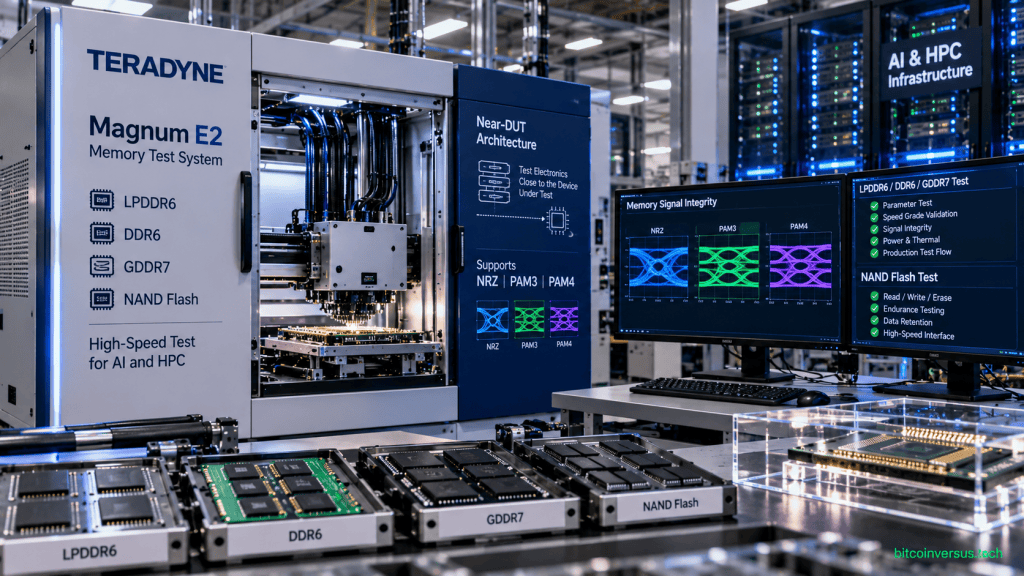
Teradyne has introduced Magnum E2, a new high-speed semiconductor memory-test platform designed for the interfaces expected to feed the next generation of artificial-intelligence and high-performance computing systems.
In the September 29 announcement, Teradyne said Magnum E2 supports advanced DRAM and flash interfaces including LPDDR6, DDR6, GDDR7 and NAND. The platform is intended to carry devices from engineering qualification into high-volume manufacturing using a common hardware and software foundation.
AI memory is forcing test equipment to get faster
Memory bandwidth has become a central constraint in AI computing. Faster DRAM, graphics memory and enterprise flash increasingly use wide interfaces and more complex signaling, which makes production testing harder as manufacturers try to preserve signal integrity while testing many devices in parallel.
Magnum E2 is built on Teradyne’s Near-DUT Test architecture. By moving digital test electronics close to the device under test, the system is designed to reduce signal degradation between the tester and memory package. Teradyne says that approach protects timing margin at the higher speeds expected from emerging memory generations.
NRZ, PAM3 and PAM4 share one test foundation
The platform supports NRZ, PAM3 and PAM4 signaling through programmable hardware. That matters because memory manufacturers are moving across several signaling approaches as interfaces increase data rates. A tester that can cover multiple protocols can reduce the need to replace equipment each time a new memory generation reaches production.
A same-day technical summary also highlights built-in logic-test capability, allowing memory and logic testing to converge on one platform and potentially reducing the number of separate test insertions required during manufacturing.
The memory race extends beyond HBM
High-bandwidth memory receives much of the attention around AI accelerators, but AI systems also depend on server DRAM, graphics memory and large pools of NAND flash. BitcoinVersus.Tech recently covered SK hynix preparing HBM4 for mass production, Micron demonstrating a 512 GB DDR5 server module, and Hanmi shipping new AI-chip packaging equipment. Magnum E2 sits farther downstream in that chain by checking whether increasingly fast memory devices actually meet electrical and reliability requirements.
Test equipment is becoming part of the AI hardware bottleneck
As memory packages become faster and more valuable, a test system has to balance two competing demands: accurate measurements at very high signal speeds and enough parallelism to maintain manufacturing throughput. Poor signal integrity can reject good devices or hide marginal ones, while slow test cycles can constrain factory output.
Teradyne says Magnum E2 is designed for both production and engineering configurations. That lets manufacturers develop and qualify test programs before carrying the same platform into volume production, rather than rebuilding the test flow around different systems.
The company plans to show Magnum E2 at SEMICON West in San Francisco from October 13 through October 15. For the AI hardware supply chain, the launch is another reminder that scaling compute requires more than manufacturing GPUs. Every faster generation of memory also needs equipment capable of proving that those devices work at production scale.
BitcoinVersus.Tech
Advertisement: Follow BitcoinVersus.Tech for independent coverage of semiconductors, AI hardware, Bitcoin mining, data centers, robotics and energy infrastructure.
Disclaimer: BitcoinVersus.Tech provides news, analysis and educational information for general informational purposes. Nothing in this article is financial, investment, legal or professional advice. Readers should independently verify information and make their own decisions.


Leave a Reply