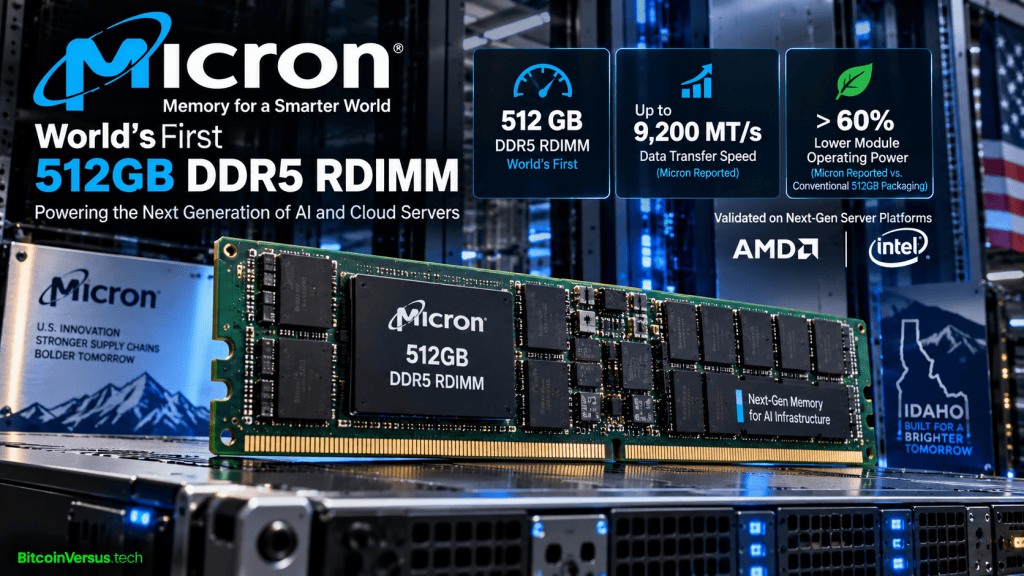
Micron has demonstrated what it calls the world’s first 512GB DDR5 RDIMM across multiple next-generation server platforms, pushing a single memory module to half a terabyte while targeting speeds up to 9,200 MT/s.
In a September 15 announcement, the company said the ultra-dense module is aimed at AI, analytics, in-memory databases and simulation-heavy data-center workloads. AMD and Intel are actively validating the module.
512GB on one DDR5 RDIMM
Server memory capacity increasingly matters alongside CPU and accelerator performance. Larger AI models, databases and scientific simulations can keep more active data close to compute when each DIMM carries more memory.
Micron reaches 512GB using advanced vertical-interconnect packaging. Rather than treating the module as a simple collection of conventionally packaged DRAM components, the design uses denser packaging to increase capacity without proportionally increasing board area and power.
The development follows the broader memory-scaling trend covered by BitcoinVersus.tech in Astera Labs’ CXL 3.2 memory expansion, SK hynix’s expansion beyond HBM and our explainer on DIMM form factors.
The Micron Technology video above explains the bandwidth-per-CPU problem that DDR5 was designed to address and provides useful context for why denser server memory matters.
Up to 9,200 MT/s
Micron says the 512GB module is designed for speeds up to 9,200 MT/s. Capacity alone would be less useful if moving data to the processor became the dominant bottleneck, so the company is pairing the density increase with high DDR5 transfer rates.
That balance between memory and compute is increasingly visible across AI infrastructure. BitcoinVersus.tech recently covered d-Matrix Raptor’s rack-scale inference memory architecture and AMD EPYC Venice server testing.
Micron claims more than 60% lower module operating power
Micron reports that its advanced packaging can reduce module operating power by more than 60% compared with a comparable 512GB implementation using conventional packaging. That figure is a Micron-reported comparison and should not be interpreted as a universal server-level energy reduction.
The distinction matters in dense data centers. Memory is only one portion of server power, but hundreds or thousands of high-capacity DIMMs can turn seemingly small per-module efficiency improvements into meaningful facility-level savings.
Those constraints connect memory engineering to the same power and thermal issues discussed in BitcoinVersus.tech coverage of 2.3 MW AI cooling and denser AI-rack power electronics.
Intel’s recent infrastructure updates provide additional context for the server ecosystem in which next-generation high-capacity DDR5 will operate.
AMD has likewise emphasized next-generation enterprise infrastructure, hybrid cloud and AI adoption. Micron separately says AMD is actively validating the new 512GB RDIMM.
AMD and Intel validation is underway
Micron says both AMD and Intel are actively validating the 512GB RDIMM. Demonstration and validation are important milestones, but they are not the same as broad commercial deployment. Micron has not presented the announcement as evidence that every current server platform can immediately use the new module.
The brand’s newsroom places the announcement within a broader push into AI memory, advanced packaging and U.S. semiconductor research.
Why half-terabyte DIMMs matter
A server populated with half-terabyte DIMMs can reach multi-terabyte memory capacities with fewer physical modules. That can be valuable for in-memory databases, large analytics workloads, virtualized infrastructure, scientific computing and AI systems whose working sets exceed accelerator memory.
The broader lesson is that the AI hardware race is no longer only about GPUs. CPUs, HBM, DDR5, CXL controllers, Ethernet fabrics, storage, cooling and electrical infrastructure all determine how effectively compute can be used.
Advertisement:
BitcoinVersus.Tech Editor’s Note & Disclaimer:
We volunteer daily to ensure the credibility of the information on this platform is Verifiably True. BitcoinVersus.tech provides news, technical analysis and educational information and does not provide financial or investment advice. Verify technical specifications and operational requirements with the manufacturer before making purchasing, deployment or investment decisions. If you would like to support to help further secure the integrity of our research initiatives, please donate here: 3C9o19EH5HSiwEPyCTmEKzxhNCbo2X6TTb


Leave a Reply