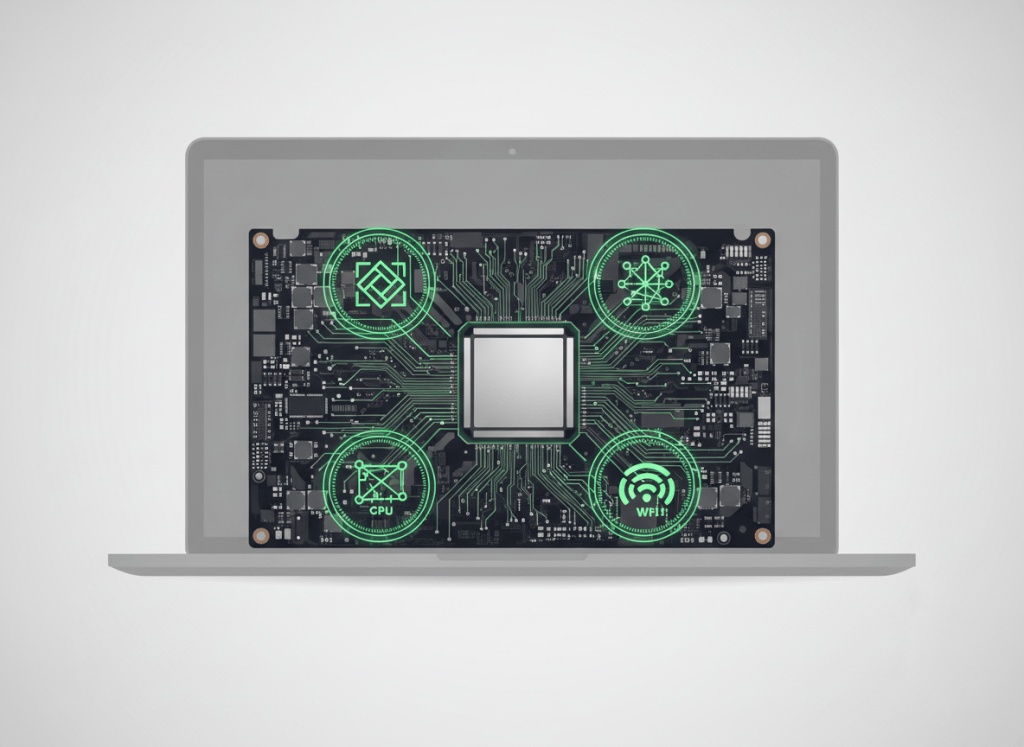

MediaTek’s newest flagship smartphone processor is pushing mobile silicon into the 2 nm era while treating artificial intelligence as a permanent hardware workload rather than an occasional app feature.
The company says the Dimensity 9600 Pro combines a 2+3+3 all-big-core CPU, a dual-NPU design, a new G2-Ultra NX GPU and support for LPDDR6 memory and UFS 5.0 storage. MediaTek announced the chip September 15 and says the first phones using the 9600 Pro and related 9600M are expected this quarter.
2 nm is about power as much as speed
The CPU uses two Arm C2-Ultra cores reaching 4.55 GHz, three C2-Pro cores at 4.35 GHz and another three C2-Pro cores at 3.1 GHz. MediaTek reports up to 17% higher single-core performance and 15% higher multi-core performance than its previous flagship, while claiming a 61% reduction in multi-core power consumption. Those figures come from MediaTek’s own demo-device testing and should be treated as manufacturer measurements until broader independent testing is available.
The architecture is especially interesting beside BitcoinVersus.tech’s recent look at Qualcomm’s new 5 GHz Snapdragon generation and our explainer on ARM chip architecture. Mobile chips are now competing on the same system-level variables that dominate larger AI hardware: compute density, memory bandwidth and useful work per watt.
Two NPUs split the AI workload
Instead of assigning every AI task to one accelerator, the 9600 Pro uses an NPU 1090 for heavier generative and agentic workloads plus a second Super Efficient NPU 2.0 for always-on activity. Its technical breakdown says the NPU 1090 delivers 55% more token generation per watt and 51% faster LLM prefill than the prior generation, while the efficient NPU cuts power consumption for always-on AI by 40%.
MediaTek says the architecture can support on-device models as large as 30 billion parameters, including mixture-of-experts inference. That does not mean every phone will ship with a 30B model: usable model size still depends on memory capacity, operating-system overhead, quantization, thermal limits and the software chosen by the handset manufacturer.
The broader trend connects to BitcoinVersus.tech coverage of AI memory expansion through CXL 3.2 and Micron’s 512 GB DDR5 server module. The scale is radically different, but the engineering constraint is similar: useful AI performance increasingly depends on feeding accelerators with enough memory bandwidth without wasting power moving data.
Neural graphics moves AI directly into gaming
The G2-Ultra NX GPU is paired with what MediaTek calls Neural Graphics Architecture, synchronizing GPU and NPU resources for AI-assisted rendering. MediaTek claims 27% higher peak GPU performance, 24% lower power use at peak performance and up to 18% faster ray tracing, with support for gaming above 185 frames per second under supported conditions.
That makes the 9600 Pro more than an AI-assistant chip. AI super-resolution and neural graphics are becoming part of the real-time rendering pipeline, echoing the same convergence between conventional graphics and machine learning visible in desktop GPUs.
The first phones will provide the real test
A processor announcement is only the beginning. Phone makers determine cooling, memory capacity, firmware behavior and sustained power limits, so two devices using the same silicon can behave differently. One early sign of the deployment pipeline came when the brand teased its Find X10 family for additional markets; the Find X10 Pro Max is among the devices associated with MediaTek’s newest flagship platform.
For semiconductor watchers, the important milestone is that leading-edge 2 nm manufacturing is no longer just a roadmap item. The Dimensity 9600 Pro puts it into a commercial mobile platform alongside dual-NPU agentic AI, neural graphics and next-generation memory interfaces.
It also fits a larger semiconductor transition tracked across BitcoinVersus.tech, from new DRAM manufacturing technology to advanced AI chip packaging equipment. The next meaningful evidence will come from retail phones: sustained performance, battery life, thermal behavior, local-model throughput and how often software actually uses the second NPU.
BitcoinVersus.Tech Editor’s Note
Support independent technology reporting: BTC donations may be sent to 3C9o19EH5HSiwEPyCTmEKzxhNCbo2X6TTb.
Follow BitcoinVersus.tech on X/Twitter for Bitcoin mining, AI hardware, semiconductor and data-center infrastructure reporting.
Disclaimer: BitcoinVersus.tech is not a financial advisor. This media platform reports on financial subjects purely for informational purposes. Manufacturer performance claims cited above should be independently verified under matched retail-device workloads.


Leave a Reply