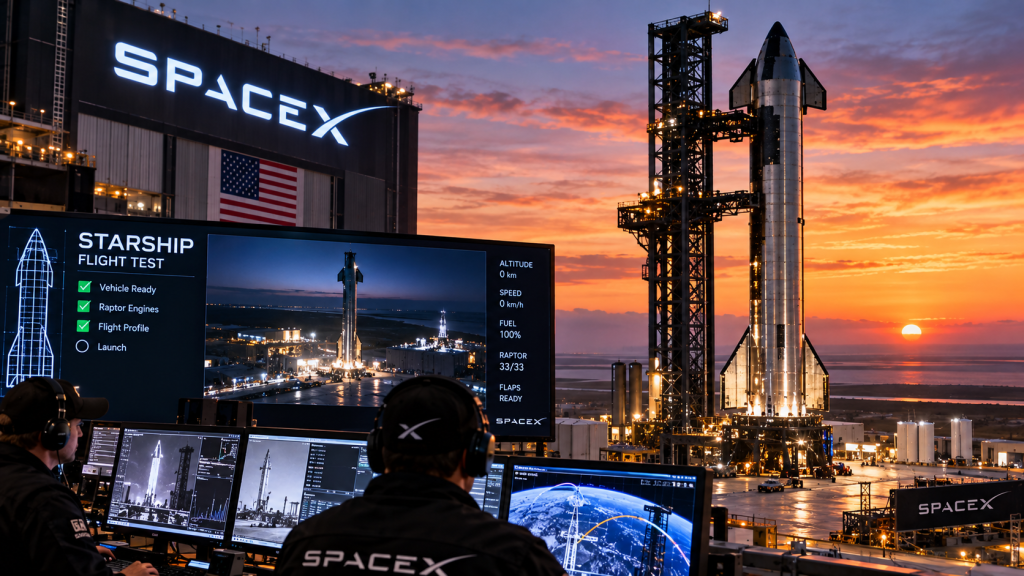
SpaceX’s Starship has crossed a threshold the program spent more than three years approaching: Flight 14 reached orbit for the first time and deployed 26 operational Starlink V3 satellites.
According to the company’s mission record, Starship lifted off from Starbase, Texas, on September 28 using Booster 21 and Ship 41. The mission marked both Starship’s first orbital flight and its first deployment of meaningful payload into orbit.
Flight 14 finally took Starship all the way to orbit
Starship’s previous integrated tests intentionally used suborbital trajectories. Flight 14 changed that profile. After separation from Super Heavy, the upper stage continued to orbital velocity and released 26 next-generation Starlink V3 spacecraft, giving SpaceX its first operational satellite deployment from Starship.
NASASpaceflight previewed the orbital attempt and the engineering stakes surrounding Flight 14 before launch. Its English-language coverage provides a detailed look at the vehicle, Starbase hardware and mission objectives.
An engine failure shortened the mission
The milestone did not make Flight 14 flawless. Reporting after the flight says a Starship Raptor engine shut down early. SpaceX proceeded to orbit after evaluating available redundancy, but the vehicle returned earlier than the original multi-orbit flight plan.
The mixed result is significant for NASA because a modified Starship is part of the agency’s Artemis lunar-landing architecture. Reaching orbit validates a capability Starship had not previously demonstrated, while the propulsion anomaly gives SpaceX another failure mode to investigate before increasingly demanding missions.
Starlink V3 gives Starship an immediate payload mission
The 26 Starlink V3 satellites also connect Starship development directly to SpaceX’s communications business. SpaceX says the larger V3 spacecraft are designed to deliver substantially more network capacity than earlier Starlink generations, making Starship’s payload volume and lift capacity central to future constellation expansion.
BitcoinVersus.Tech has been following the broader space-hardware buildout, including Rocket Lab’s 97th Electron mission and StriX satellite deployment, Astra Space’s planned return to orbital launches, and NASA’s two-engine CubeSat completing ground testing. Flight 14 represents a different scale: a super-heavy vehicle moving from repeated atmospheric tests into operational orbital payload deployment.
Orbit changes the Starship test program
Once a launch vehicle can reliably reach orbit, testing can expand into longer-duration operations, payload deployment, deorbit maneuvers and eventually on-orbit propellant transfer. Those capabilities are central to SpaceX’s plans for Starlink as well as NASA’s lunar program.
Flight 14 therefore delivered two conclusions at once. Starship can now reach orbit and deploy satellites, but the engine anomaly shows that reaching orbit is only one part of turning the world’s largest launch system into a repeatable transportation platform.
BitcoinVersus.Tech
Advertisement: Follow BitcoinVersus.Tech for independent coverage of space, artificial intelligence, semiconductors, Bitcoin mining, data centers and emerging technology.
Disclaimer: BitcoinVersus.Tech provides news, analysis and educational information for general informational purposes. Nothing in this article is financial, investment, legal or professional advice. Readers should independently verify information and make their own decisions.


Leave a Reply