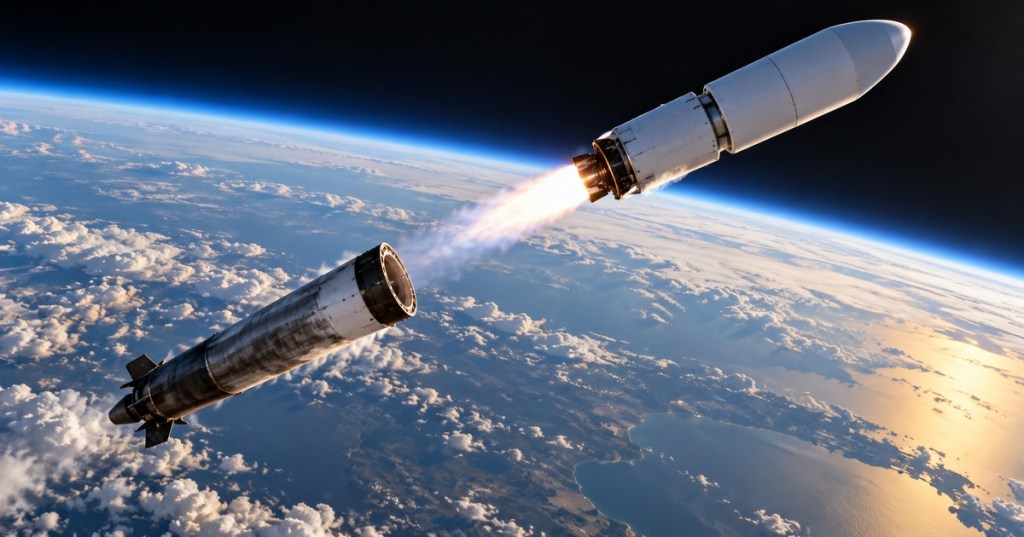
A rocket stage is a section of a launch vehicle that carries its own propellant, engines, structure or some combination of those systems. When that section has done its job, the rocket lets it go. The reason is simple: once a tank is empty and an engine is no longer useful, carrying that hardware farther becomes a penalty.
Staging is therefore one of the central tricks of spaceflight. It allows a rocket to begin the trip as a huge machine built to escape the launch pad, then progressively become a smaller and lighter machine optimized for the next part of the climb. NASA describes launch as a period of powered flight that continues until the final stage has finished its work and the spacecraft separates into orbit or onto another trajectory. NASA’s Space Launch System overview shows that same logic in a modern heavy-lift vehicle.
The core problem: rockets must lift their own fuel
A car can refuel from infrastructure along the road. An airplane can use oxygen from the atmosphere. A rocket headed for orbit has to carry nearly everything it needs: fuel, oxidizer, tanks, pumps, engines, plumbing, guidance hardware and the payload itself. All of that mass must be accelerated upward and, more importantly, sideways to orbital speed.
This creates a compounding problem. More propellant requires larger tanks. Larger tanks add structural mass. Extra structure requires still more propellant to accelerate it. Rocket designers therefore care intensely about mass fraction: how much of the vehicle is useful propellant and payload versus hardware that must be carried along.
The physics behind this tradeoff is often summarized by the rocket equation, but the practical intuition is easier than the equation: every kilogram you stop carrying is a kilogram you no longer have to keep accelerating. Staging is a way to throw away mass at exactly the moment it stops being useful.
What actually happens at stage separation?
A typical sequence begins when a stage nears the end of its planned burn. Its engines shut down, the connection between stages is released, and the two vehicle sections move apart. Springs, pneumatic pushers, small separation motors or other mechanisms can provide the initial clearance. The next stage then ignites once the vehicle is safely separated and properly oriented.
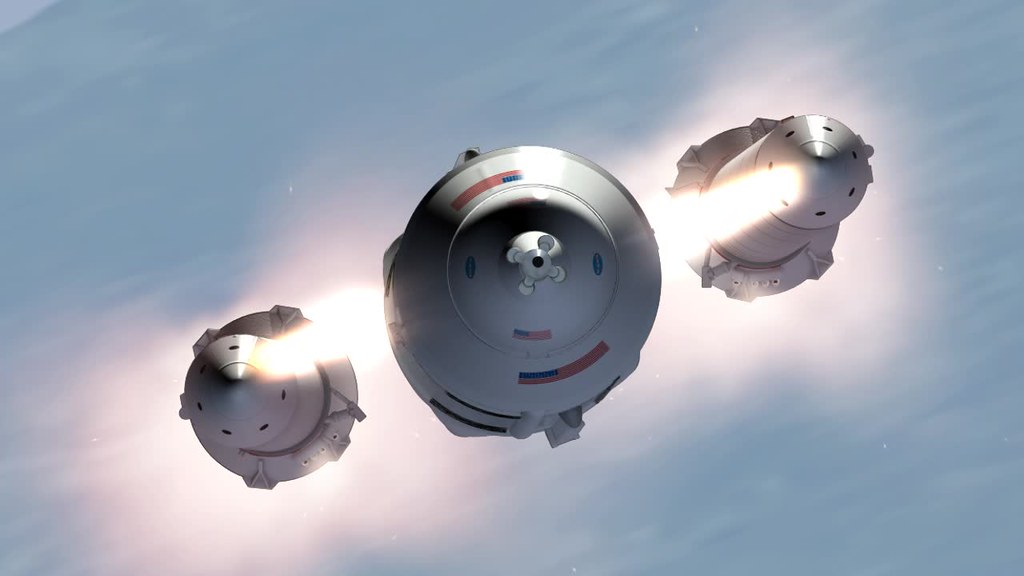
Separation sounds routine because successful launches make it look routine. It is actually a carefully timed mechanical event. NASA notes that poor separation geometry can allow discarded hardware to collide with the surviving vehicle, which can alter trajectory or end a mission. That is why stage adapters, separation joints, sensors and timing logic receive so much testing. NASA has documented one SLS system in which a frangible joint is deliberately broken and pneumatic pistons push the upper hardware away from the core stage.
Stage-separation footage makes the basic idea visible: the spent hardware falls away while the smaller surviving vehicle continues the climb.
Why not build one giant single-stage rocket?
Engineers have studied single-stage-to-orbit vehicles for decades. The attraction is obvious: no discarded stages, fewer separation events and potentially aircraft-like operations. The difficulty is that a single vehicle has to carry its tanks, engines, landing hardware or recovery systems all the way to orbital velocity. The mass margins become extremely unforgiving.
Staging relaxes that problem. A first stage can be large and powerful because it only needs to survive the lower portion of the ascent. An upper stage can be much smaller because it starts its work after the vehicle has already gained altitude and velocity. This is why modern orbital launch systems as different as SpaceX Starship, Falcon 9, Blue Origin’s New Glenn, Rocket Lab’s Electron and NASA’s SLS all divide the ascent across multiple propulsion elements.
Different stages can be optimized for different jobs
The lower atmosphere and the vacuum of space are very different environments. A first-stage engine must produce enormous thrust while the vehicle is heavy and moving through dense air. An upper-stage engine operates after much of that mass is gone and may use a larger nozzle designed to work efficiently in near-vacuum conditions.
That division of labor extends beyond engines. Lower stages need strong structures to handle launch loads. Upper stages can prioritize low mass and long-duration operation. Some missions need multiple upper-stage burns to change orbit, place payloads at different altitudes or begin a trip beyond Earth. Propulsion choices can become even more specialized once a spacecraft is already in space, as seen in BitcoinVersus coverage of iodine propulsion for CubeSats.
Rocket Factory Augsburg describes the same design split directly: multiple sea-level engines on its first stage and a vacuum-optimized engine on the second.
Boosters are another form of staging
Not every stage sits neatly on top of another. Strap-on boosters create what engineers call parallel staging. They fire alongside the central core during the earliest, heaviest part of flight and are discarded after burnout. The core then continues without them.
NASA’s SLS uses two solid rocket boosters attached to the sides of its liquid-fueled core. Those boosters provide a large share of the initial thrust, then separate once their propellant is spent. The core continues firing before it too is eventually discarded and the upper portion of the mission proceeds. This architecture is part of the broader Artemis lunar program.
Reusable stages change the economics, not the physics
Historically, staging often meant throwing hardware away forever. Modern reusable launch systems try to recover at least the most expensive lower stage. Falcon 9, for example, separates its booster and upper stage, but the booster can turn around, reenter and land for another flight.
That does not eliminate the reason for staging. The second stage still benefits from leaving the first stage behind. Reusability simply changes what happens to the discarded hardware afterward. Instead of becoming debris or falling into the ocean, the stage may reserve propellant for a boostback, reentry burn and landing. The trade is economic: carrying recovery hardware and landing fuel reduces some payload performance, but recovering the stage can reduce the cost of future launches.
The recent Crew-13 flight to the International Space Station is a useful everyday example of that sequence: first-stage cutoff, separation, second-stage ignition and first-stage recovery all occur as distinct parts of one launch.
Why stage count is a compromise
If two stages are helpful, why not use ten? Because every stage adds hardware and failure points. Each needs structure, plumbing, avionics, attachment points and a reliable separation event. More stages can improve theoretical mass efficiency, but they also increase complexity, integration work and operational risk.
Designers therefore search for a practical balance. A two-stage rocket is common because it captures much of the benefit without an excessive number of transitions. Heavy-lift systems may add side boosters or additional upper stages when a mission demands more energy. The architecture depends on payload mass, destination, engine performance, recovery strategy and cost.
The history is visible in famous rockets
The idea of multi-stage rockets predates the Space Age. Early rocket theorists recognized that shedding empty structure could dramatically improve performance. The principle became essential once engineers tried to reach orbit rather than merely make high suborbital flights.
- Saturn V: three main stages carried Apollo missions from the launch pad toward the Moon.
- Space Shuttle: two solid boosters separated first, followed later by the external tank, while the orbiter continued using its own engines and eventually glided home.
- Falcon 9: a reusable first stage does the lower-atmosphere work while a disposable second stage finishes orbital insertion.
- SLS: side boosters separate first, followed later by the core stage, leaving the upper mission elements to continue.
- Starship: the Super Heavy booster and Starship upper vehicle divide the job while both are designed around reuse.
The exact hardware changes, but the logic stays remarkably consistent. Missions to orbit, the Moon and eventually Mars all have to solve the same basic problem: accelerate useful payload without dragging every empty tank and exhausted engine all the way to the destination.
The takeaway
Rockets use stages because mass is brutally expensive during launch. A piece of hardware that was essential one minute can become useless weight the next. Dropping it allows the remaining vehicle to spend its fuel accelerating payload instead of hauling empty machinery.
That is the elegance of staging: a rocket does not need to be one perfect machine from the ground to orbit. It can be a sequence of machines, each optimized for a narrower part of the journey, handing the mission forward until only the spacecraft and the hardware still needed for the next step remain.


Leave a Reply