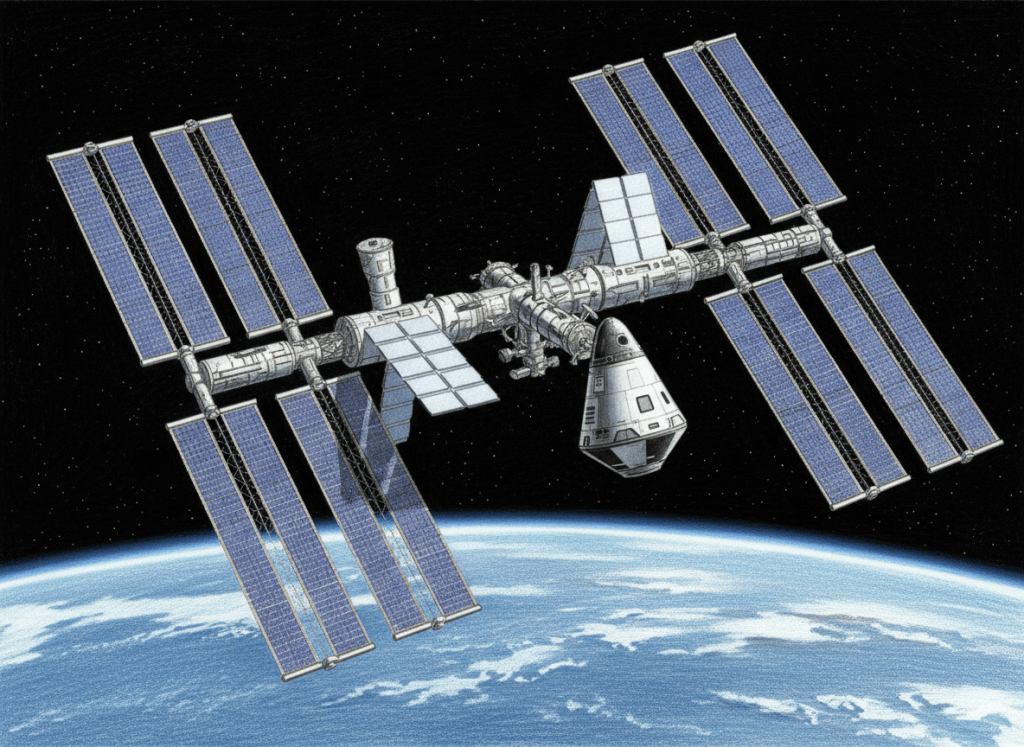
NASA’s SpaceX Crew-13 turned what is normally described as an eight-hour ride to orbit into a U.S. human-spaceflight record. The four-person Dragon crew launched from Cape Canaveral at 11:10 a.m. EDT on October 1 and docked with the International Space Station at about 7:05 p.m., just 7 hours and 55 minutes later.
NASA’s Crew-13 launch and docking plan had targeted a roughly 7-hour, 50-minute transit and explicitly described it as the fastest launch-to-docking profile for a U.S. spacecraft in space-station history. The actual flight finished within minutes of that plan.
The crew consists of NASA astronauts Jessica Watkins and Luke Delaney, Canadian Space Agency astronaut Joshua Kutryk, and Roscosmos cosmonaut Sergey Teteryatnikov. SpaceX marked the arrival with its Crew-13 docking post on X after Dragon completed the accelerated rendezvous sequence.
The record is American, not global
The wording matters. Crew-13 set the fastest launch-to-docking time for a U.S. spacecraft and the fastest such trip by a SpaceX vehicle. It did not set the all-time world record for reaching the ISS; Russian Soyuz missions have completed much shorter express rendezvous profiles.
Associated Press independently described Crew-13 as the quickest U.S. express flight to the station yet. That distinction keeps the achievement impressive without overstating it.
Why seven hours instead of a day or two?
Fast rendezvous is mostly an orbital-geometry problem. Dragon cannot simply point at the station and accelerate directly toward it. Launch timing has to place the spacecraft into an orbit whose plane and phase let a sequence of carefully timed burns raise Dragon toward the ISS while preserving safe approach corridors.
When the launch window, station position and spacecraft performance line up correctly, mission planners can compress the number of phasing orbits before final approach. The vehicle still has to perform navigation checks, approach holds, communications verification and automated docking logic. Crew-13’s record therefore reflects both orbital timing and a mature spacecraft/ground-control system.
Dragon is becoming routine infrastructure
The speed record arrives as NASA continues leaning on Dragon for long-duration crew rotation. BitcoinVersus.Tech recently covered NASA adding three more SpaceX crew flights to its ISS transportation plan, extending the role of Commercial Crew deeper into the station’s remaining operational years.
That reliability matters because the United States has seen how quickly crew-transport options can become constrained. The earlier Starliner crew-return disruption showed why having a proven operational vehicle is more than a convenience.
It also raises the competitive bar for the next generation of launch and spacecraft providers. BitcoinVersus.Tech has examined the companies trying to challenge SpaceX over the coming decades; matching launch cadence is one problem, but matching a mature end-to-end human-spaceflight operation is another.
The crew now shifts from transportation to science
Once docked, Crew-13 joined Expedition 75 aboard the ISS. Their long-duration mission includes biomedical and human-performance research, including work related to circulation, clotting, medical diagnostics and crop production for future deep-space missions.
The transportation milestone is therefore only the opening act. The more consequential measure is whether faster, increasingly routine crew delivery creates more usable time and operational flexibility for research aboard the station.
Crew-13’s 7-hour, 55-minute trip is not proof that every future Dragon mission will use the same profile. Orbital geometry changes continuously, and mission planners still prioritize safety over speed. But it demonstrates that a U.S. crew vehicle can now move four people from a Florida launch pad to a spacecraft traveling roughly 250 miles above Earth in less than one workday.
BitcoinVersus.Tech
Advertisement
Editor’s Note
This report describes Crew-13’s record specifically as a U.S./SpaceX launch-to-docking record, not an all-time global rendezvous record. The featured cover is an original editorial illustration and is not duplicated in the article body.
We volunteer daily to ensure the credibility of the information on this platform is Verifiably True. If you would like to support our research initiatives, please donate here: 3C9o19EH5HSiwEPyCTmEKzxhNCbo2X6TTb
BitcoinVersus.tech is not a financial advisor. This media platform reports on financial subjects purely for informational purposes.


Leave a Reply